


Previous Story
Self-service kiosks draw praise, ire
Posted On 10 Feb 2016
Comment: Off
by Nicole Lim
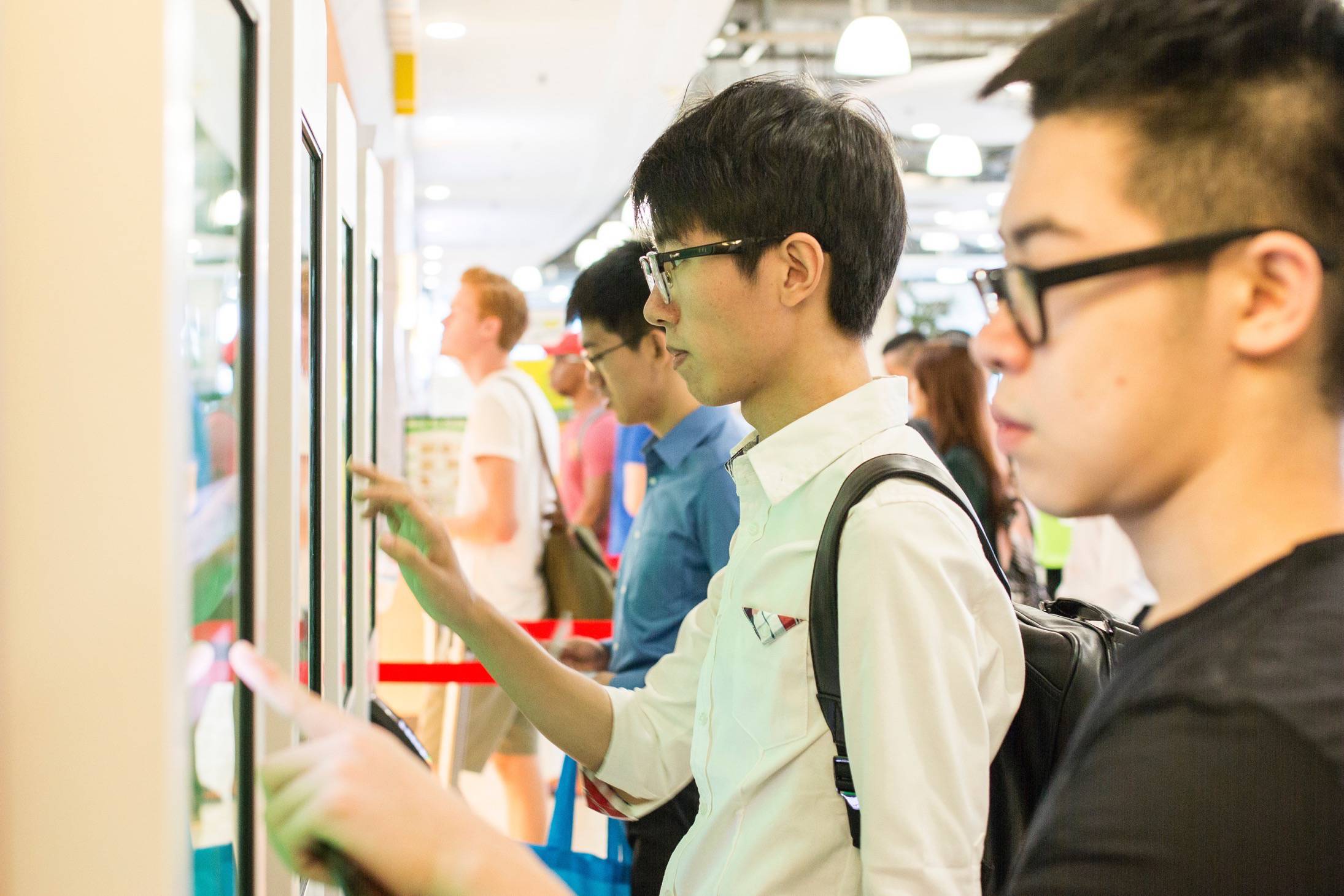
At least three establishments have introduced self-service kiosks this semester. PHOTO: Nicholas Yeo
With at least three establishments introducing self-service kiosks this semester, ordering and paying for food and groceries on campus is becoming more automated.
At McDonald’s, students and faculty can order food and make payment with a touch of the screen, while Prime supermarket offers a self-checkout option.
Previously, only the canteen at Hall of Residence 16 had self-service counters.
Most students interviewed by the Nanyang Chronicle felt the move towards self-checkout stations was a good initiative.
Tosy Tan, 19, a first-year student from the School of Computer Engineering (SCE), feels it is now more convenient for students who only purchase a few items at a time. “The self-service kiosks have really sped up the payment process, especially during peak hours, making it easier for Prime staff and students,” she said.
Meanwhile, the three self-service counters at Canteen 16, installed last semester, were also welcomed by diners. The counters service the Japanese, Chinese, Western and drink stalls.
Diners receive a queue number after ordering food and return to the stall to collect their food when it is ready.
First-year SCE student Lander Chin, 21, said: “Previously, students would have to wait at the stalls for their food. Now, we can wait comfortably in our seats.”
Other students, however, felt the kiosks did not serve their intended purpose of shortening queue times.
Germain Kwek, 20, a second- year School of Physical and Mathematical Sciences student, described the lines at McDonald’s as persistent and snaking, despite the new kiosks.
“As the name suggests, fast food is supposed to be fast. The food still takes so long to arrive, even with the new kiosks,” she added.
The fast food restaurant is equipped with four self-service kiosks, where customers can order food and make payment by NETS or credit card.
However, customers who wish to pay by cash after ordering at the kiosks can also choose to do so at any manned cashier counters. After payment, customers then receive a queue number to collect their food.
Although the kiosks were meant to ease human traffic at the popular fast food joint, the reality is that customers often have to queue twice – once to order their food and another to collect it — and end up not reaping any time savings.
Boh Xuan Jie, 22, a second-year student from the Nanyang Business School, questioned the rationale for installing the self-service kiosks.
“Instead of relying on the kiosks, McDonald’s should hire more employees to handle the crowd during peak hours,” Boh added.
“They’re trying to solve the issue of the bottleneck queues but they simply moved the queue to the food collection point.”


