


Previous Story
National Geographic photojournalist draws attention to marine issues
Posted On 10 Feb 2016
Comment: Off
by Quah Jia Ling
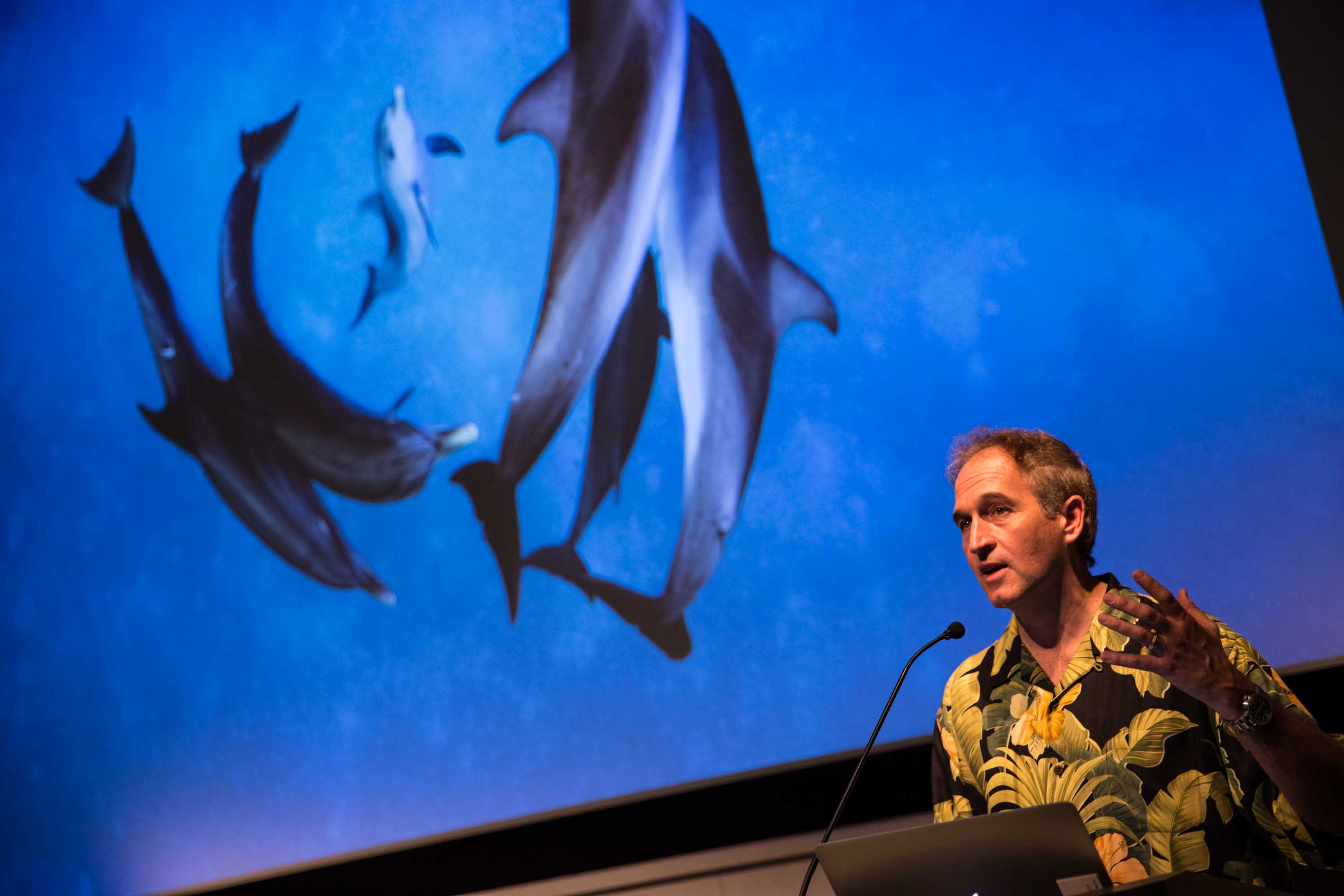
National Geographic photojournalist Brian Skerry uses his work to bring attention to issues that endanger the ocean and its inhabitants. PHOTO: Nicholas Yeo
Torn from the ocean, fish flounder on a bloody deck as hooks are repeatedly plunged into them.
Scenes like this one spurred National Geographic photojournalist Brian Skerry, 54, to use his craft to draw attention to marine conservation issues.
“When I was in Spain and they were killing bluefin tuna, the decks of the boat were gushing with bright red blood,” the veteran underwater photographer told the Nanyang Chronicle.
“I have been underwater with these animals and they are such magnificent creatures and to see them killed that way, it’s like watching a crime unfold.”
Mr Skerry was a guest speaker in NTU last month, as part of an ongoing collaboration between the university and National Geographic since 2014.
Apart from a faculty talk and lecture on photography techniques, Mr Skerry held a presentation about his experience as an underwater photographer at the Nanyang Auditorium, for which more than 1,000 people registered.
Having loved the sea since he was a child, Mr Skerry had always aspired to study the ocean. At the beginning of his career, all he wanted to do was “to swim with sharks and whales and do cool things.
However, after witnessing first-hand the effects of climate change and overfishing, the American photographer decided to raise awareness about marine conservation.
“The evolution in my career was that over time, I began to see a lot of problems. I used to see big schools of fish, and when I go back to the same places, I don’t see them anymore,” he said.
“I realised there were problems occurring in the ocean and I knew I had the opportunity as a journalist to begin telling those stories.”
In 2004, Mr Skerry photographed one of the most poignant stories in his career — the plight of harp seals. It was also the first time his photos were published in the National Geographic magazine.
The story described how harp seal pups were killed for their fur, and even those spared from the hunters cannot escape the effects of global warming, perishing as a result of melting sea ice.
“I would like to think that these pictures made more people aware of these problems now,” he said. “I think that’s what photography has the power to do.”
His work has affected him so much that he now avoids eating seafood, knowing that an unsustainable level of consumer demand is what fuels overfishing.
“We are at the precipice — the moment in time where our choices do matter,” he said. “It is not too late to start protecting the sea.”
Annabel Pang, a first-year student from the School of Humanities and Social Sciences, was one of the attendees at the presentation.
“I thought it was really informative and helpful. It didn’t occur to me that corals would die or different species of fishes were becoming extinct as a result of our actions and inactions,” Pang, 20, said.
“The pictures he showed were so breathtakingly beautiful. It was like diving into the deep sea and experiencing it through the lens of a talented artist,” she added.
Mr Skerry has been working with National Geographic and specialising in marine wildlife and underwater environments since 1998. He has spent more than 10,000 hours underwater over the last 30 years.


