


Previous Story
WKWSCI alumnus bags award for migrant short film at Berlin festival 
Posted On 10 Mar 2016
Comment: Off
By Dawn Puah, Quah Jia Ling
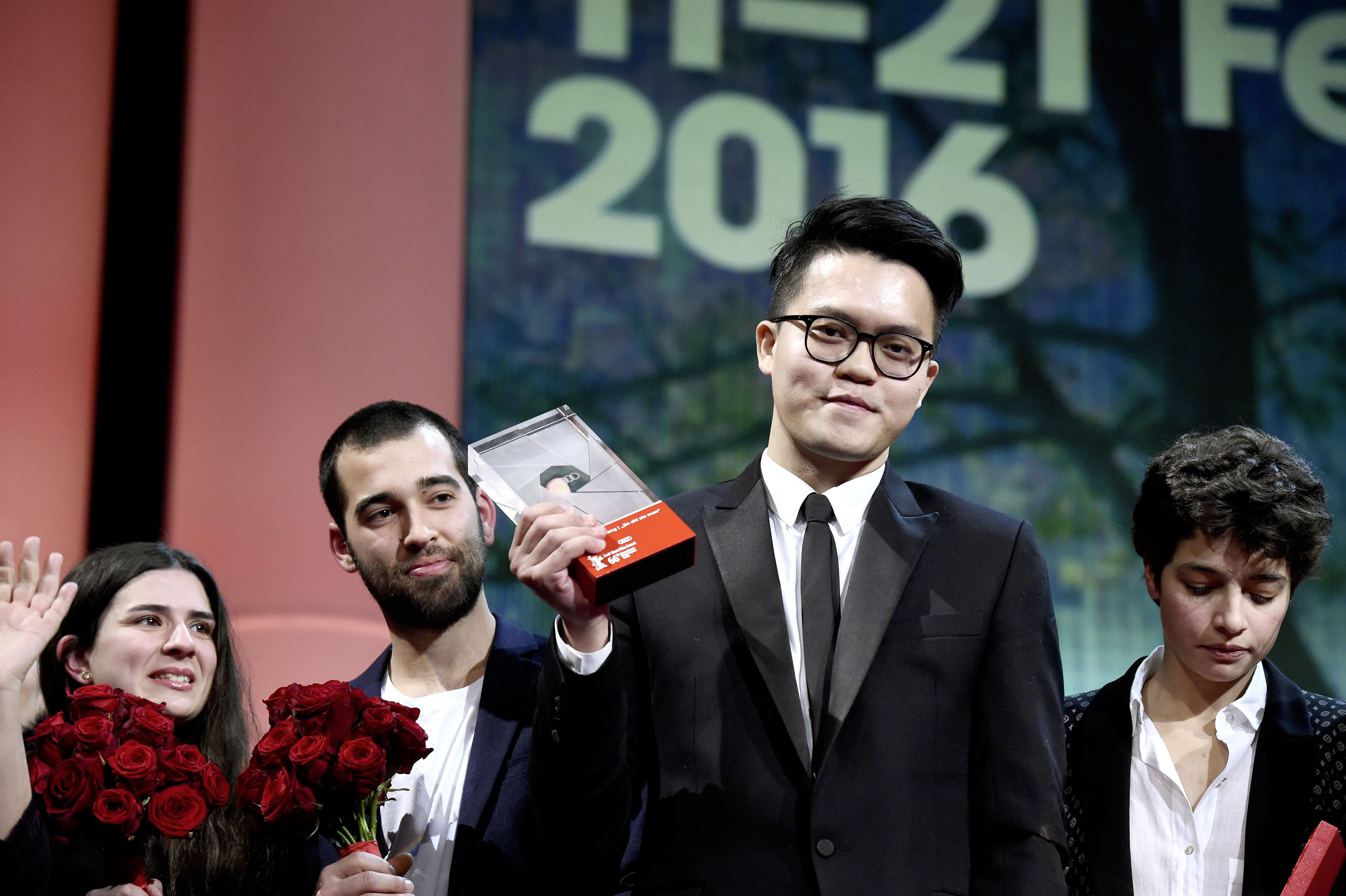
Wee Kim Wee School of Communication and Information alumnus Chiang Wei Liang, 28, credits Senior Lecturer Mr Kym Campbell for being a “great mentor”. PHOTO COURTESY OF AUDI AG
A routine class assignment for NTU alumnus Chiang Wei Liang, 28, turned out to be the winning short film at the 66th annual Berlin International Film Festival last month.
The short film, titled “Anchorage Prohibited,” is about the struggles of a Vietnamese migrant couple with a new-born child in Taiwan as they try to cope without government support.
The film beat 24 other nominations to win the Audi Short Film Award on 20 Feb. It came with a cash prize of 20,000 euros (S$30,400).
“This is a huge encouragement,” said Mr Chiang, who graduated from the Wee Kim Wee School of Communication and Information (WKWSCI) in 2013. He is pursuing a master’s degree in filmmaking at Taipei National University of the Arts.
The 16-minute film which features actual migrant workers was shot within only two days. “We didn’t have the finances to shoot for long periods and the workers couldn’t take many days off, so we worked with the finite resources we had and planned around it,” he said.
He hopes the renewed interest in his film will also increase awareness of the lack of government support for the welfare of migrant workers in Taiwan, who are reportedly paid less and work under
poorer conditions compared with those in some other Asian countries.
“There’s still a lack of supporting measures to take care of them socially,” said Mr Chiang. “Winning opens up doors (career-wise), but more importantly it gives us a platform to raise awareness about this issue,” he added.
The NTU alumnus also said he was grateful for film veterans who paved the way for directors like himself.
He specifically credited WKWSCI Senior Lecturer Mr Kym Campbell for being a “great mentor.”
“I really felt that he gave me a lot of room to try and do all that I can, sometimes more than what was prescribed,” said Mr Chiang.
“I guess, had it been someone else who taught me, perhaps I wouldn’t have been as inspired to learn more about the craft,” he added.
Mr Chiang plans to continue producing short films for some time.
He hopes to direct his first feature film after he completes his studies in Taiwan and returns to Singapore.
Asked about his advice to aspiring filmmakers, Mr Chiang said: “People are going to tell you what you can or can’t do. It’s up to you to decide what is really important, and it will reflect in the things you make.”


