


Previous Story
New semester brings old woes for campus bus users
Posted On 07 Sep 2016
Comment: Off
By Gracia Lee
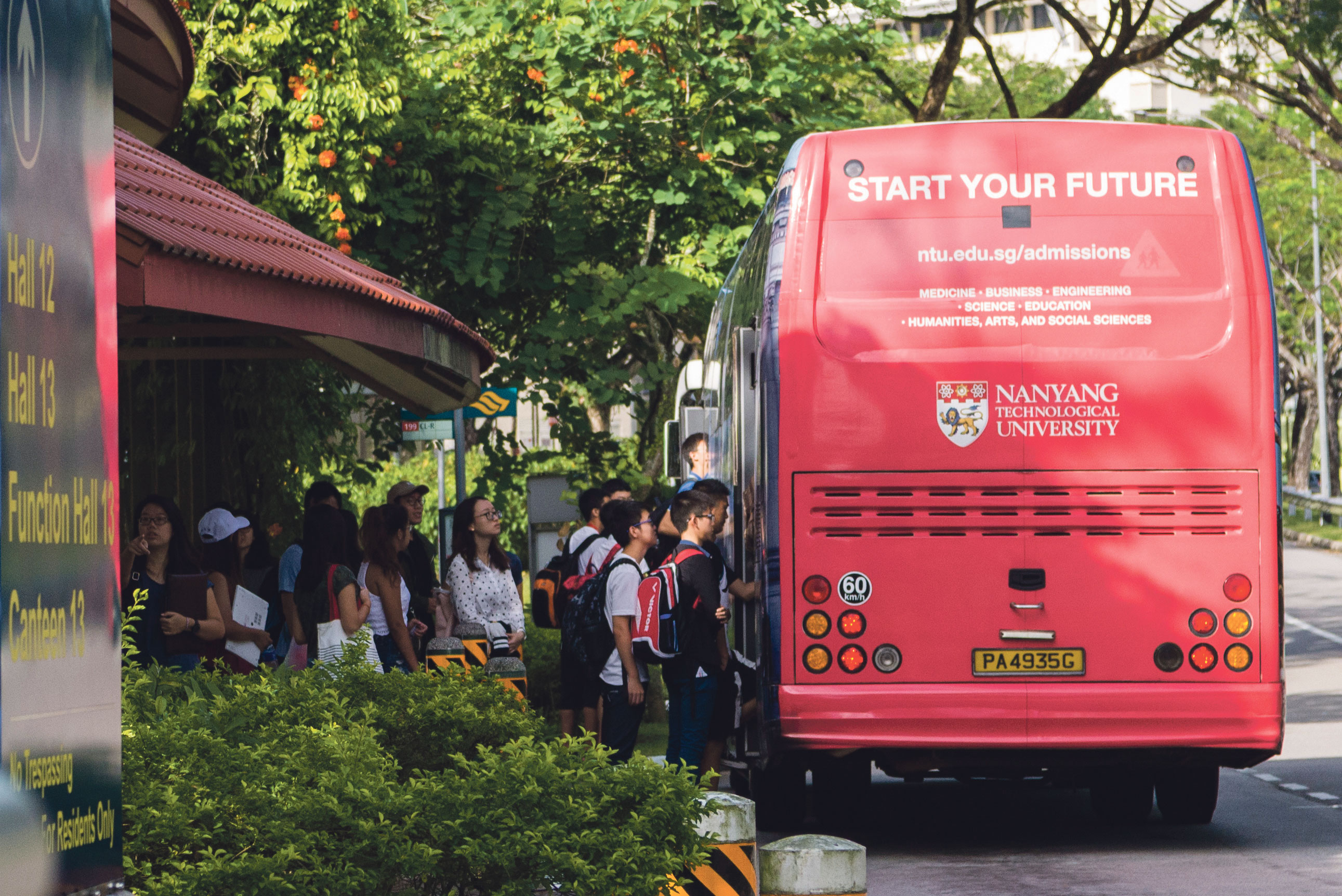
SHUTTLE BUS BLUES: Some students said they wait up to 40 minutes to board a shuttle bus, while others wake up almost two hours before class to account for delays. PHOTO: ZHENG JUNCEN
DESPITE living on campus, first-year student Hazel Tan sometimes has to get up almost two hours before her 9am class just to make it on time.
To avoid being late, the Wee Kim Wee School of Communication and Information (WKWSCI) student, who stays in Hall of Residence 10, adds about 45 minutes to her travel time to account for the slow campus bus services.
“The bus frequency is really low, especially from 8 to 10am. It’s also difficult to board because every bus is crowded. Most of the time, the bus driver doesn’t even stop to take passengers,” the 21-year-old said.
Long waits and full buses
Frustrations with the Red and Blue Campus Loops have resurfaced since the semester began last month, as students — who rely on these two lines to get around the 2-square-kilometre campus — often get to class late after being unable to board already-full buses.
One common complaint was waiting up to 20 minutes for a bus in the morning — four times the five to six-minute interval promised on the bus schedule.
Some commuters also told the Nanyang Chronicle there were instances when they were unable to board up to three consecutive buses because of the crowds.
“The bus frequency is really low, especially from 8 to 10am. Most of the time, the driver doesn’t even stop to take passengers.” Hazel Tan, 21, First-year student, Wee Kim Wee School of Communication and Information
The NTU GO! mobile app, which is based on the university’s online tracking system, was also down for the first three weeks of the semester.
“Without the app, I couldn’t decide if the fastest way to get to class would be waiting for the campus bus, taking the public bus, or walking,” said Damian Goh, 24, a third-year School of Electrical and Electronic Engineering student.
NTU GO! is not an official university app, but it uses data from NTU”s official website.
A long-standing problem
Some added that poor campus bus frequencies and packed buses are a perennial problem, and little has been done to improve the situation.
“The bus system is as bad as when I entered NTU two years ago,” said Hoong Shi Xiang, 23, a third-year School of Mechanical and Aerospace Engineering student.
“Buses still take up to 40 minutes to arrive, and are packed to the brim in the mornings and during lunch time,” he added.
Another commuter, final-year National Institute of Education student Ng Yang Han, 25, said that two years of frustration over the state of campus buses in the mornings drove him to buy a bicycle and cycle to classes instead.
Regulation in progress
However, the University is now seeking to regulate the frequency of buses.
NTU Students’ Union vice-president Kwok Meng Kei said in an interview that starting from September, a controller from Tong Tar Transport — the company which owns and runs the campus bus service — will be stationed daily at the Chinese Heritage Centre, which functions as a terminal for the internal shuttle buses.
The controller will ensure that buses run according to schedule, and arrive within five to six-minute intervals of each other during peak hours.
The assigned controller will also see that university’s online bus tracking system accurately reflects bus locations when plying NTU roads, Kwok added.
“The bus system is as bad as when I entered NTU two years ago. Buses still take up to 40 minutes to arrive, and are packed to the brim in the mornings and during lunch time.” Hoong Shi Xiang, 23, Third-year student, School of Mechanical and Aerospace Engineering
“I hope the new system will alleviate bunching, especially in the mornings,” said Chen Jia Yi, 23, a second-year School of Chemical and Biomedical Engineering student. Bunching occurs when multiple buses arrive at the same time.
Apart from improved regulation of buses, students also said they hoped for better information about arrival timings and available space on buses, such as through electronic boards at bus stops.
Christy Yip, 20, a second-year WKWSCI student, said: “The narrow doors and limited standing room (on buses) make it very difficult for people to get on and off, causing delays.”
“We should get buses with more standing room and fewer seats,” Yip added.
Sabrina Ang, 21, a second-year student from the School of Humanities and Social Sciences, said that she hopes the NTU GO! app can soon provide data on the available space in buses.
But for now, students said they are just relieved that the app is working again.
George Toh, 22, a second-year student from Nanyang Business School, said: “Thankfully, the app is fixed so I know when the buses are coming and can decide between taking the Red or Blue lines.”
He added: “It’s frustrating that students’ main means of travelling around campus is so unreliable. I hope the system improves soon.”