


Previous Story
Masters of land and sea
Posted On 07 Sep 2016
Comment: Off
By Fiona Mei Robinson
Team members, led by captain Ang Jun Xiang (second from right), have hours of training under their belts. PHOTO: ZHENG JUNCEN
NTU aquathlon team members spend their Saturday mornings at Sentosa, but not to relax at the beach.
They train every week at Tanjong Beach for the upcoming Singapore University Games (SUniG), which will start on 24 Sep.
For the athletes, the bitterness of defeat weighs on their minds. Last year, both the men’s and women’s teams came in second behind National University of Singapore. And in 2014, the men’s team were also second, while the women’s team emerged champions.
Emerging victorious
The team, however, has seen significant improvement since the heartbreak at East Coast Park last year.
In June, they won the overall Singapore National Aquathlon’s school category. The race, comprising a 750 metre-swim followed by a 5 kilometre-run, was a similar distance to that of SUniG. The team garnered more than twice the number of points of second-placed Singapore Institute of Management.
Overall team captain Ang Jun Xiang, a final-year student from the Nanyang Business School, attributed the victory to their diligent training from August to the time of the Singapore National Aquathlon in June.
The team has official two-hour trainings on Mondays and Wednesdays, with an additional brick session on Saturdays. Brick sessions are short high-intensity swim-and-run sets that get athletes used to the racing pace.
Members also go for a swim and hit the gym in their own time.
While the triathlon is growing in popularity, the aquathlon, a dual discipline race that comprises swimming and running, is much lesser known.
“An aquathlon is only raced in open water. We don’t race in a pool, so we train very differently from normal swimmers,” said Ang, 24.
Specialised training
To simulate competition and prepare better for races, the team has brick sessions at Sentosa, and tailored swim trainings.
The swim is done in the sea, where visibility is low and the water movement is unpredictable, compared to the controlled environment in a swimming pool.
For trainings held at the school’s Sports and Recreation Centre, the team removes the lane ropes, which allows the players to swim in a pack.
“The start of the swim makes you feel as if you are in a washing machine, so training like this helps make sure everyone is used to it before they race,” said Ang.
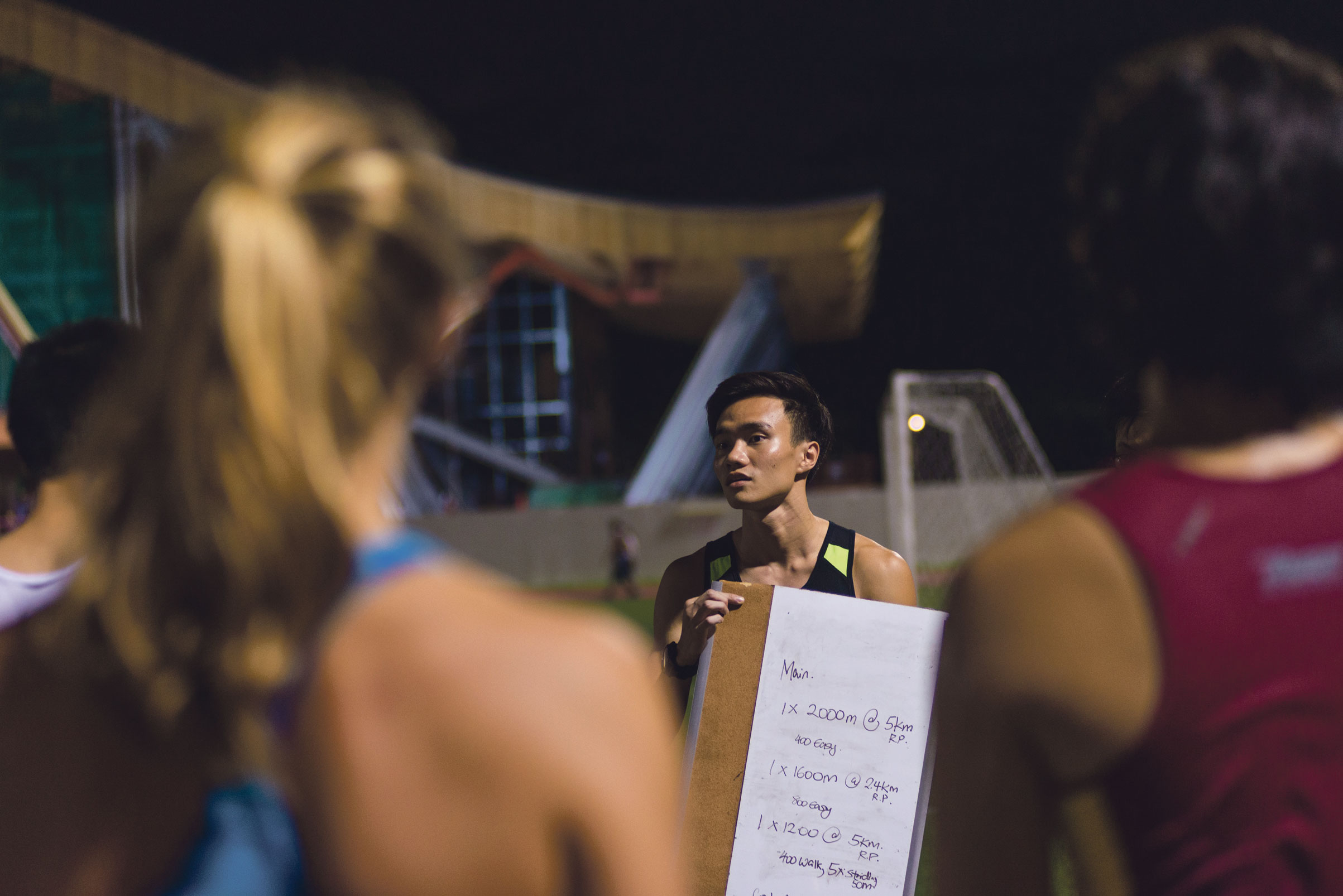
Team captain Ang Jun Xiang ensures that members are ready for competition. PHOTO: ZHENG JUNCEN
Guiding the team
More than just their rigorous training sessions, the team also has a mentor in teammate and national triathlete Chew Yi Heng.
Chew, a second-year Renaissance Engineering Programme student, was first exposed to the aquathlon when he was in Singapore Polytechnic, and has been in the multisport for the past four years.
He won the 18-24-year-old category for Ironman 70.3 Bintan in Indonesia last month, qualifying for the Ironman 70.3 World Championship to be held in Chattanooga, Tennessee next year.
Vice-captain Phua Jian Ming, 24, said Chew’s presence in the squad motivates the team to improve.
“While we know we won’t be able to reach his standard over a short period of time, internal competition helps bring the team to greater heights,” said the third-year School of Electrical and Electronic Engineering student. “Having a national athlete in the team makes me want to push harder.”
Team member Seah Fung Ling, 21, highlighted Chew’s propensity for guiding his teammates, despite them being less experienced.
“The best thing about having (Chew) in the team is that he doesn’t look down on us, but instead helps us improve,” said Seah, a third-year School of Material Science Engineering student. “This makes the aquathlon team feel like a family.”
The team’s family-oriented approach provides a great support system, said Phua. This is especially so during pre-season when they train up to 11 times a week.
He said: “As a vice-captain, my primary goal is to bring the team together. For instance, even if I’m not training, I’ll still come down to help train and support the team.”
After the disappointment of being double runners-up last year, nothing less than a gleaming gold medal will do for the aquathlon team this time.
“After last year’s SUniG, I told the team that we needed to come back in 2016 to win this,” captain Ang said.
“This is our year to win it.”