


Previous Story
NatGeo experts save the environment one trip at a time
Posted On 04 Oct 2016
Comment: Off
By Gabriela Lim
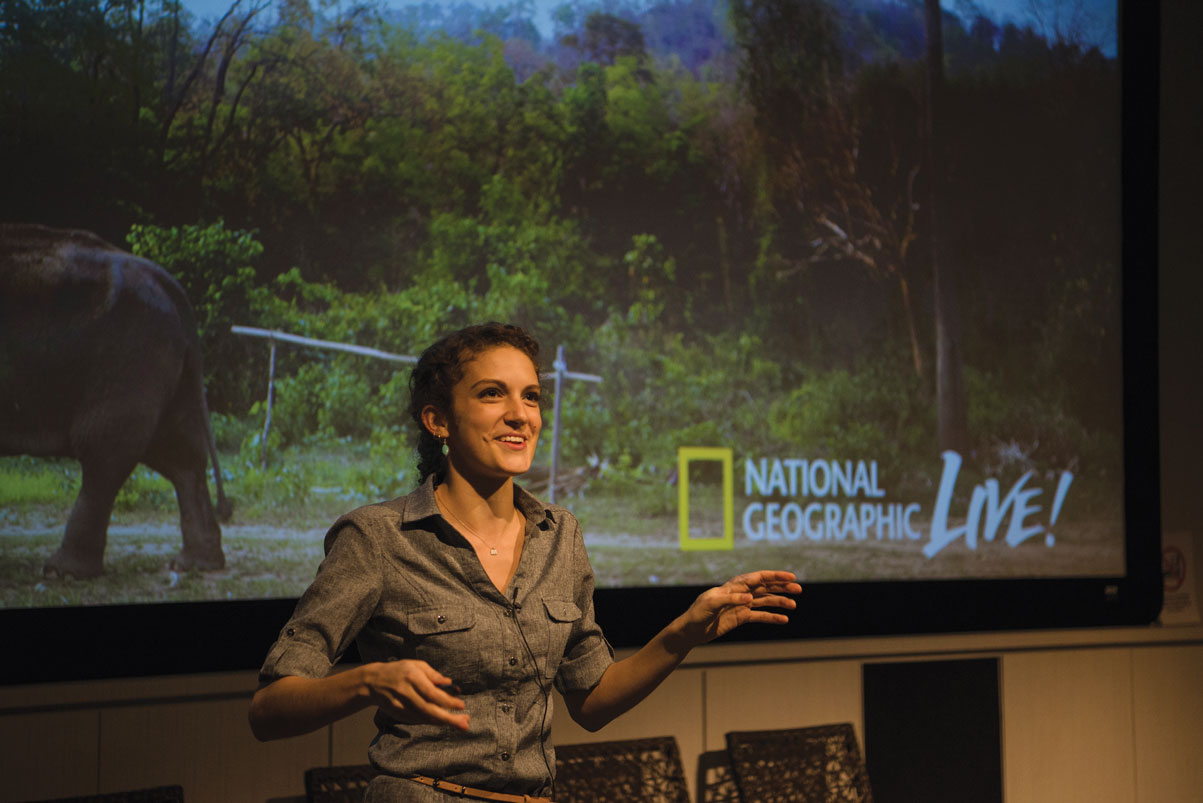
National Geographic Young Explorer Molly Ferrill (above) shares with NTU students how she uses photography as a tool to highlight issues from across the world. PHOTO: ZHENG JUNCEN
With a dream of making a difference to the world around her, National Geographic Young Explorer Molly Ferrill packed her bags and took off to a secluded village within the jungle of the Western Bago Mountains in Myanmar.
The Bago Mountain Range was once covered in lush forest, where humans and wildlife, such as elephants, resided peacefully side by side.
But during her time there, Ferrill discovered that Myanmar’s agricultural development for rubber plantation had resulted in mass deforestation.
This forced the elephants – which are revered in the country as auspicious animals – to hunt for food in the villages nearby, bringing them into conflict with the local people.
Ferrill then turned to photography to document issues surrounding deforestation and the unique relationship between wildlife and humans in the villages.
“What drives my photography is the passion to bring people closer to ongoing issues. But before that, the foundation lies in the passion for human rights and animals,’’ said Ferrill, whose works have bagged her international recognition on platforms such as The Discovery Channel and ASEAN Wildlife Enforcement Network.
“There was not a single farmer I met who didn’t know somebody who was injured or killed by an elephant,” she added, in an exclusive interview with the Nanyang Chronicle.
“At times, the villagers will injure or kill the elephants, but it was so interesting to see the strong spiritual beliefs they had about the elephants.”
The 26-year-old was a guest at NTU’s National Geographic Live! Talk in August, which also included a sharing by National Geographic research scientist Dr Albert Lin.
Ferrill received the National Geographic Young Explorer grant, which gives her the opportunity to roam the world in pursuit of her passion of studying the changing relationships between man and nature.
Ferrill shared that similar to her Myanmar project, many other innocent villagers in different countries around the world are forced to face the consequences of governmental decisions, such as mass deforestation and habitat destruction.
Also globetrotting to chase his dreams is Dr Lin, who travels to discover more about the history of cultures around the world.
“I am driven by the idea that this generation lives in the most powerful moment in time based on our connectivity to cultivate and build new knowledge collectively,” he said.
One of Dr Lin’s most inspirational moments happened during his trek in the remote mountains of Mongolia.
There, seven shamans, who believed that they had access to the spiritual realms, showed up to worship the eternal blue skies, which they regarded as the most important spiritual connection to Tengri, the God and power behind all nature.
This religion is known as Tengrism, or the “Sky God Religion’’, which has existed since the 8th century.
“I was on a search to understand ancient quests and mysteries I thought were a thing of the past,” said Dr Lin.
“But I realised there are still people in corners of the world who are living and breathing a continuation of that story.”
On top of that, Dr Lin led an international effort in 2010 — The Valley of the Khan Project — to discover the sacred tomb of Genghis Khan, utilising one of the most advanced technologies for ground, aerial and satellite-based remote sensing.
The project earned him the National Geographic Adventure’s 2010 Readers’ Choice Adventurer of the Year award.
Known for his world-class technological innovations created in pursuit of anthropological discoveries, Dr Lin is currently embarking on a large-scale educational technology platform, which seeks to bring together groups of children from across the world to create an interconnected online learning environment.
“Maybe instead of sitting there and playing Pokemon Go all day long, we can do the same thing in another way. Our ‘Pokemon Go’ could be used to collect data and information of phenomena happening all across planet earth that we can’t really see unless we work together to see it,” he said.