


Previous Story
NTU athletes rebound from injuries
Posted On 04 Oct 2016
Comment: Off
By Fiona Mei Robinson
Sticks and stones may break their bones but injuries will not keep them down. Sports writer Fiona Mei Robinson speaks to three athletes who have bounced back from serious injuries to fly the national flag again.
Aiming for glory
Ang Han Teng, national archer, School of Physical Education and Sports Science
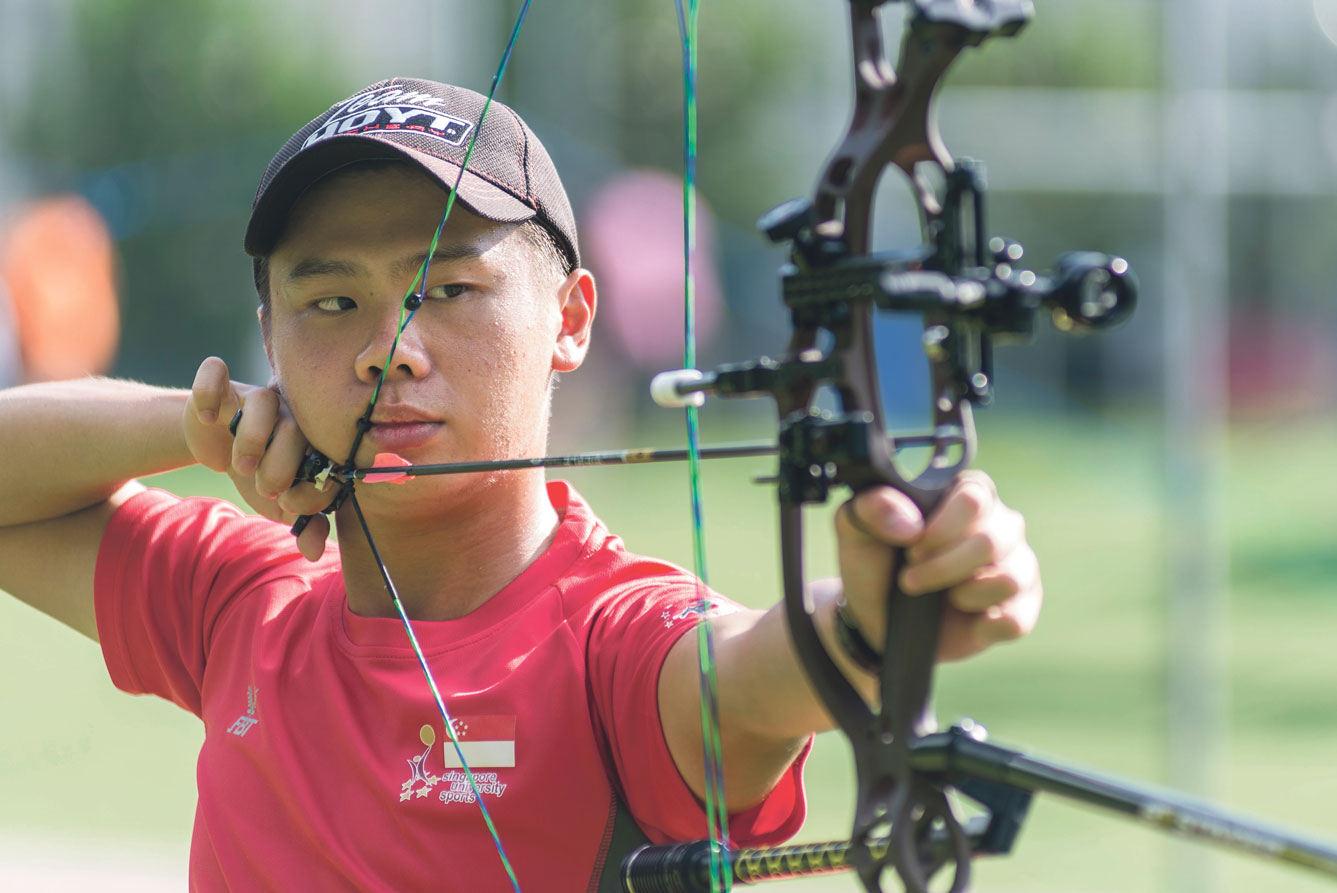
A wrist injury did not stop archer Ang Han Teng from winning two bronze medals at the ASEAN University Games in July. PHOTO: ZHENG JUNCEN
A fractured scaphoid bone five months prior to the ASEAN University Games in July did not dull archer Ang Han Teng’s hunger for success.
The 23-year-old made a formidable comeback from injury to win two bronze medals in the men’s team and mixed team events at the Games despite only having a month of training.
“My injury didn’t change how I go into a competition,” said Ang, a second-year Sports Science and Management student.
“I just went in with a competitive mindset.”
The scaphoid bone, which is found slightly below the base of the thumb, is an important part of wrist movement and stability.
Ang sustained the injury during a training session when he tripped on a rope on the archery field and used his left hand to break his fall.
After his surgery, Ang’s wrist was placed in a cast for an intial two weeks, and then in a splint for another six weeks.
“I was taking a module where I had to type a 3000-word report for a project. At that time, I was still wearing my splint and couldn’t remove it, so I had to type it with just one finger,” he said.
This fracture was the first major injury Ang sustained since he joined the sport in 2012, but it was a timely break as he was starting to feel burnt out after four years.
“This injury, I feel, was a blessing in disguise as it made me think about where I want to go in this sport,” he said.
“This is the first time I put my heart into doing something for so long, and so intensely. I had to drag myself to trainings before this injury. After (getting injured), I realised how much I actually like archery,” he added.
Ang is currently training for the 2017 Southeast Asian (SEA) Games qualifiers.
The archer trains with the NTU archery team thrice a week, with an additional shooting session on Mondays. He also has two gym sessions and a run as part of his weekly training regimen.
Apart from the SEA Games, Ang is also looking to make his debut in the 2018 Asian Games.
“These are the two main Games I’m looking forward to, and why I’m training,” he said.
“It’ll be a personal achievement as well. Next time, I’d want to tell my children I competed in the Asian Games.”
Kicking her injuries to the ground
Nurul Shafiqah, national silat athlete, School of Physical Education and Sports Science
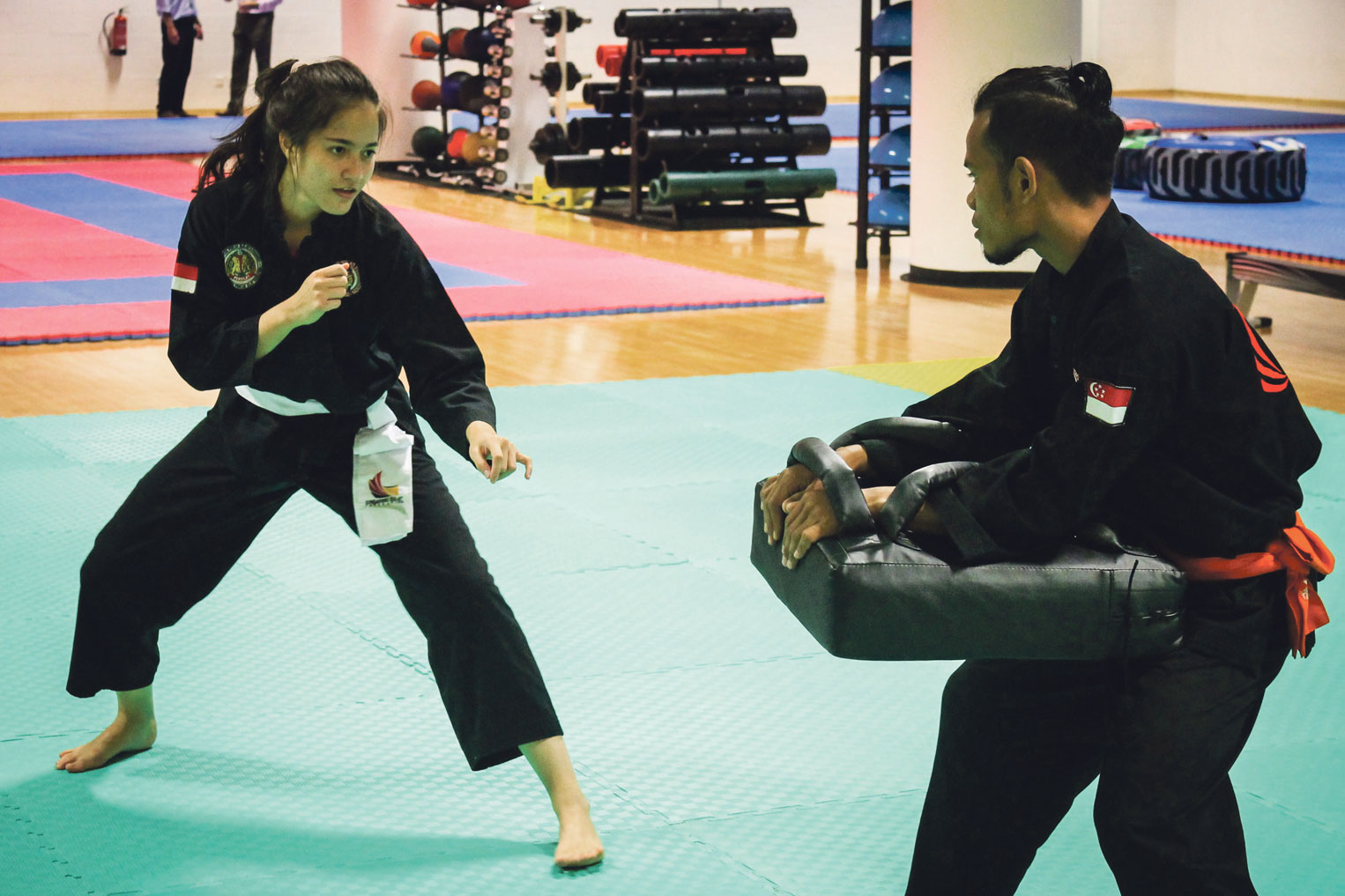
Nurul Shafiqah (left) is spoiling for a fight at the Asian Beach Games in Vietnam, on her return from injury. PHOTO: FIONA MEI ROBINSON
FOR national silat athlete Nurul Shafiqah, two medial collateral ligament (MCL) tears in her left knee have not stopped her from competing in the sport she loves.
“I’ve been in silat for so long — if I quit, everything would have gone to waste,” said the second-year Sports Science and Management student, who has been in training since she was six.
Shafiqah completely tore her MCL, one of the four major ligaments in the knee, for the first time in 2010 during the National Pencak Silat Championship.
“When I got injured, I was disappointed. But I took my time to make sure I was properly recovered,” said the 22-year-old.
The former Singapore Sports School student then took a year off from competition to concentrate on her rehabilitation.
Despite her efforts to strengthen her knee through physiotherapy, Shafiqah tore the same ligament for a second time at the Asian Pencak Silat Championship in June this year while fighting against a Thai opponent in the quarter-finals.
“I felt angry (at the situation), but at the same time, I could have been more careful. It was my own mistake,” she said.
Her second injury left her in a brace for a month. It was only after a further two weeks before she could resume normal training.
Looking back on her injuries and her return to the sport, Shafiqah cited her younger sister — full-time national silat athlete, Nurul Suhaila — as her pillar of support.
“She understands my pain,” said Shafiqah. “We give each other moral support because we understand what the other is going through.”
At press time, Shafiqah was preparing for her maiden Asian Beach Games — a biennial competition regulated by the Olympic Council of Asia — that will be held in Vietnam from 21 Sep to 1 Oct.
Despite her initial second thoughts about participating, she decided that missing the competition would be worse than suffering another injury.
“After my rehabilitation and physiotherapy, I think I’m quite strong now, and more stable,” said Shafiqah. “I’m eager to fight.”
Displaying her never-say-die spirit, the tenacious athlete added: “I’ve been through (this injury) once, and did well after my setback. I think I’m able to do it again for the second time.”
Lifting himself back up
Ng Choon Yeow, national weightlifter, School of Physical Education and Sports Science
FORMER badminton player Ng Choon Yeow switched his racket for a barbell seven years ago when he saw an advertisement that ultimately shaped his sporting career.
The advertisement had promoted four sports that would be held at the inaugural Youth Olympic Games: archery, taekwondo, wrestling, and weightlifting.
Ng, 23, found archery too technical, and feared getting injured in taekwondo and wrestling. That left him with weightlifting.
Ironically, it was weightlifting that caused the second-year Sports Science and Management student’s major injury.
Ng suffered a slipped disc in 2012, which occurred when he and his friends challenged each other in deadlifting. When he had lifted near his maximum load, Ng heard a ‘pop’ in his back, and felt the symptoms of his slipped disc a week later.
The injury caused him back pains and discomfort that impeded daily activities like getting dressed, as he was unable to bend down to put on his clothes.
Despite not needing an operation, the injury caused Ng to stop intensive training for three months.
The episode taught the weightlifter how to better prevent injuries.
“Before you get injured, there’s a certain feeling you get before your body gives way,” Ng said.
“Now I know when I might get injured. This is when I tell myself to stop, because it’s not worth getting another injury and having to come back from it again.”
Ng also has a spinal condition called facet joint arthrosis since June last year, and experiences numbness in his glutes when he stands after sitting for long periods.
He hopes to ease his way back to form for the upcoming Commonwealth Championships in October, and to push for the national record only at the World University Championships in November.
“I’m afraid that if I push (for the Commonwealth Championships), I’ll get another injury,” said Ng.
But he is motivated by his coaching aspirations to constantly excel in the sport.