


Previous Story
Fewer air-conditioned rooms in new North Hill halls
Posted On 02 Nov 2016
Comment: Off
By Cheryl Tee
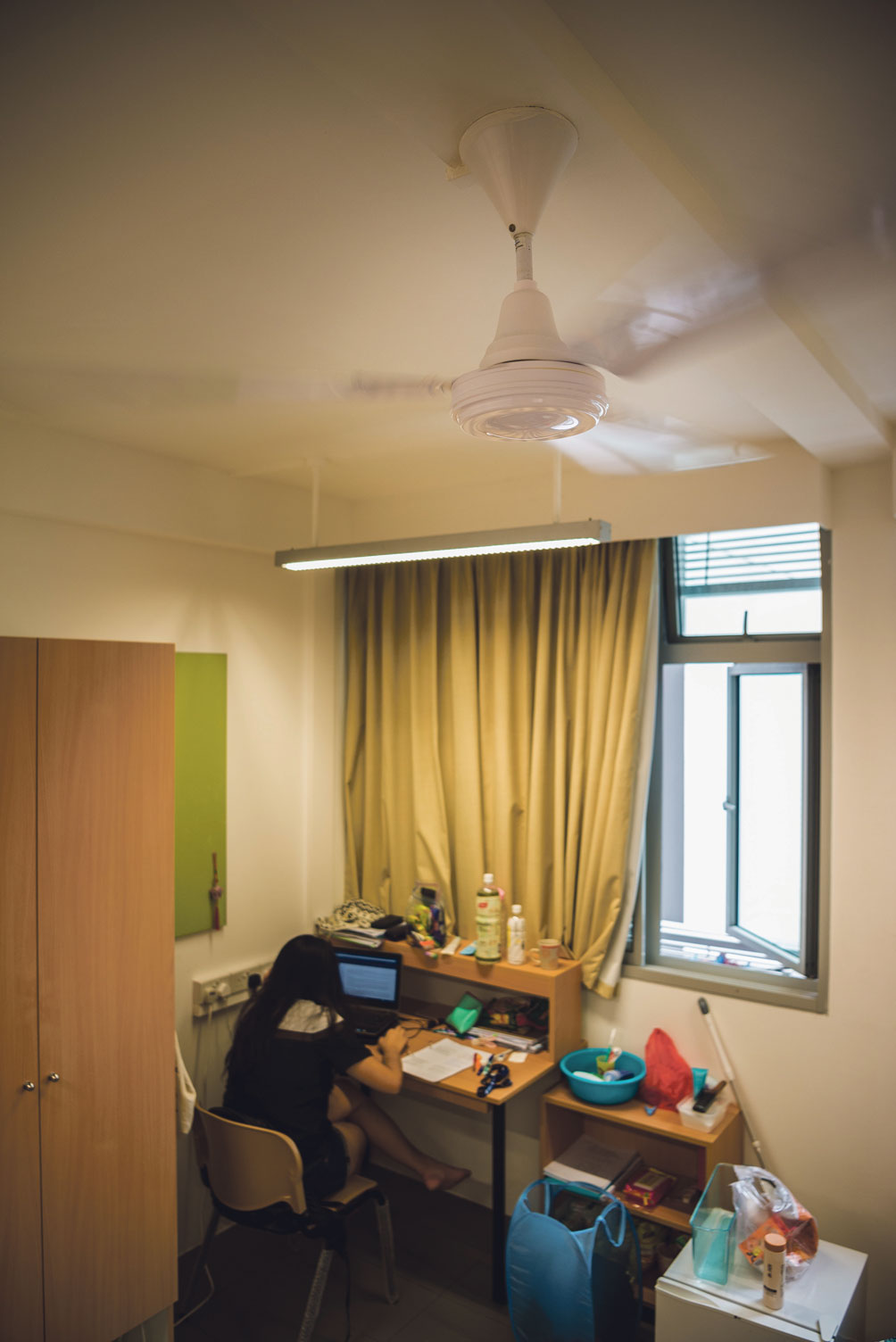
The new halls are the most expensive on campus, but have the lowest percentage of rooms with air-conditioning. PHOTO: ZHENG JUNCEN
They are new. And probably hot.
Some students have expressed concern that majority of the 1,850 rooms in the three new North Hill residential halls are without air-conditioning units.
While the availability of air-conditioners is among the top priority for some students looking for accommodation on campus, only 30 per cent of Banyan Hall’s rooms have air-conditioners, followed by 37 per cent for Binjai Hall and 45 per cent for Tanjong Hall.
In comparison, 75 per cent of rooms in Pioneer Hall and 45 per cent in Crescent Hall — the second-newest Halls of Residence completed in 2014 — are air-conditioned.
This was a deliberate decision by the University as part of its energy conservation efforts, said Chief Housing and Auxiliary Services Officer Jimmy Lee.
“The new residences are designed to optimise the natural environment by having numerous sustainable design features in place, so as to manage energy consumption,” he added.
These features include windows painted with a heat-deflecting glaze, landscaping and sky terraces. As a result, the North Hill buildings recently received the Green Mark Platinum certification — Singapore’s highest green building rating, Mr Lee said.
Jennyfer Lee, vice president of Earthlink NTU – the University’s environmental club – said that this is part of efforts to make NTU the world’s most environmentally friendly campus by 2020.
But second-year Nanyang Business School student Renecia Ang said her new room at the Banyan Hall still gets stuffy even if she keeps her windows open.
“I have to switch on the air-conditioner every night, or else I can’t fall asleep due to the heat,” said Ang, 21, who was among the first residents to move into the North Hill cluster in September.
Ang said the University should have planned for more air-conditioned rooms from the start, rather than risk incurring higher costs if students complain and demand additional air-conditioning units.
Students are charged between S$385 and S$425 for a single air-conditioned room and between S$285 and S$320 for a double air-conditioned room.
The price for a non-air conditioned room ranges from S$340 to S$390 for a single room, and S$245 to S$285 for a double room.
“Instead of introducing the new green features, the University should have considered switching to energy efficient air-conditioning units,” said Phan Ngoc Tam, 19, a second-year student from the School of Biological Sciences.
“There should be a balance struck between energy conservation and students’ comfort,” she added.
“As much as the idea of environmental conservation sounds good in theory, the lack of air-conditioning will affect students on a daily basis due to Singapore’s humid weather.”
Second-year School of Electrical and Electronic Engineering (EEE) student Elizabeth Wun, 20, said that air-conditioning is a necessity for her during hazy periods, which can last for several months.
Wun is currently on the Temporary Sharing scheme, which allows students to stay with their friends in a fully occupied room if they are unable to secure their own room.
She said she would reject an offer of a non-air conditioned room in the North Hill hall cluster.
“I usually keep my windows and door shut during the hazier months to prevent the room from smelling of smoke — but because of that it becomes really warm and stuffy. You’ll need air-conditioning then,” Wun added.
But some students said they find the proportion of air-conditioned rooms in the North Hill hall cluster to be adequate.
“Since not everyone wants to stay in an air-conditioned room, there is no need to spend money to fit more air-conditioning units,” said Tanjong Hall resident Yan Biao Guo, 19, a first year School of Biological Sciences student.
Others also hope to benefit from a potential fall in applications to the new halls, as less competition means better chances of them getting a room.
“The high risk of getting a non-air conditioned room will be a turnoff for many students, who would rather apply for a spot in other halls that guarantee them an air-conditioned room,” said Kevin Yeo, 22, a third-year EEE student. He intends to apply for a place at Binjai Hall next year.
“It takes me over one and a half hours to get to school by public transport,” he said. “Even though it’s not ideal, I would take a non-air-conditioned hall room over having no room at all.”