


Previous Story
From intern to TNP chief
Posted On 30 Nov 2016
Comment: Off
By Nicholas Tan, Chief Editor
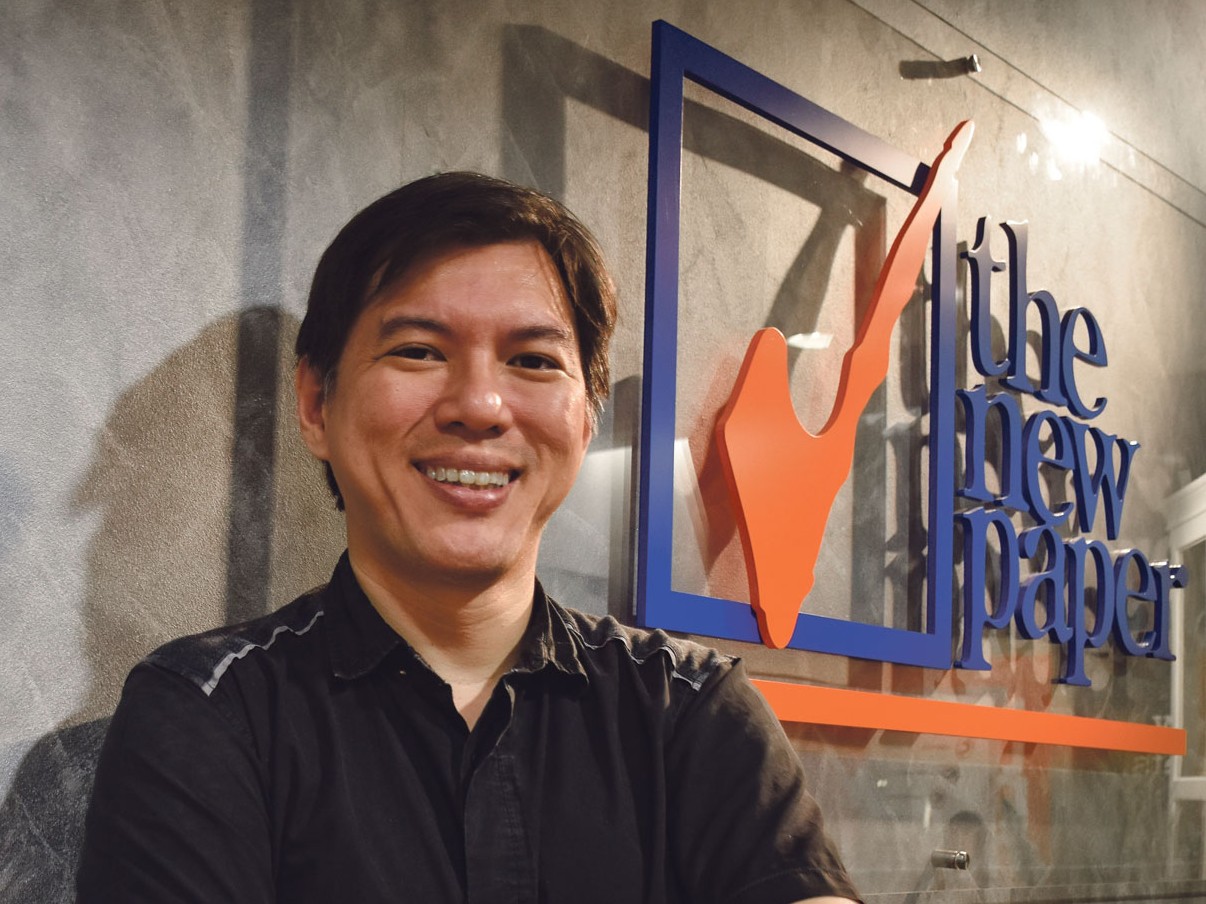
From plane crashes to pits filled with jelly, Mr Eugene Wee (CS ’99) has covered it all. He will now face his biggest challenge yet as TNP’s new editor. PHOTO: MATTHEW MOHAN
In a journalism career spanning two decades, the story that sticks with Mr Eugene Wee the most begins on board his first-ever business class flight in 2000.
While most would be thrilled with a seat upgrade, the NTU alumnus was hardly in the mood to enjoy the additional leg space.
This was because he was en route to Taoyuan International Airport in Taiwan, where the Singapore Airlines flight SQ006 crashed on a closed runway, killing 83 people.
In an interview with the Nanyang Chronicle, the 42-year-old recalls receiving a call from his editor at 1am that morning, demanding he get on a flight to Taiwan immediately to cover the calamity.
Back then, he was barely a year into his reporting stint with Project Eyeball, a now-defunct Singapore Press Holdings (SPH) publication.
Mr Wee, who was recently named editor of the revamped The New Paper (TNP), said of his immediate reaction: “I was more lost than anything. Usually, for any overseas assignments, all the bookings for flights are handled by our administrative side. But at 1am, no one was working.”
It did not help that online booking was not a thing then, and his poor command of Mandarin only raised further uncertainty in him.
Yet he eventually gathered himself, packed his bags, and cabbed to Changi International Airport with his photojournalist colleague at dawn. There, he got the go-ahead from his editor to purchase business class tickets as economy seats were fully booked.
Mr Wee, however, was too tired from the flurry of events to appreciate the upgrade. He said: “I didn’t enjoy it very much because I fell asleep before takeoff, waved off the stewardess when she came with my meal, and only woke up when the plane landed,”
Hours later in Taiwan, and surrounded by senior reporters in action, the wide-eyed rookie observed how they worked to “feel his way around” the situation.
During a hospital tour, he broke off from the group to find his own story, and met former Singapore Airlines air stewardess Farzana Abdul Razak, then aged 18.
Bandaged from head to toe, she suffered burns to 40 percent of her body while trying to save passengers on the burning plane.
Mr Wee wrote her story for the next day’s news. He said: “It was a small article in Project Eyeball because human interest was not our focus at that time, but TNP saw it and rewrote it — and it became their big story of the day.
“The duty editor told me if it wasn’t for me, the girl’s story wouldn’t have been told. I was very happy; (it is special) for a rival newsroom to tell you it was a good story, and for them to use it.”
Madam Farzana eventually became a national icon for her heroism, while Mr Wee went on to become TNP’s news editor in 2012.
Unexpected promotion
Dressed in a casual short-sleeved shirt, he admitted to being “caught off guard” when he found out about his appointment as editor of TNP in September.
“It was never on my radar because I don’t think I clocked enough time at the level where I can see the big picture,” said Mr Wee, who graduated with first-class honours in Communication Studies in 1999.
“I’ve always been a content guy, but now 80 to 90 per cent of my time is spent on things outside of editorial work like circulation, marketing and distribution. I’m starting to see that there are so many things that I don’t know.”
The tabloid’s new incarnation, which will appeal to PMEBs (professionals, managers, executives and businessmen), merges the old TNP and My Paper, starting 1 Dec.
My Paper’s Chinese section will cease to exist, while sports and entertainment will continue to be a “big part” of the paper.
“There will be sacrifices. One of the reasons why we’re merging is because the audiences from both sides for that particular kind of news seems to be dwindling,” he said matter-of-factly.
“It’s nice to know that an accident happened, or that someone is trying to jump from a flat. But we’re going from ‘nice to know’ to ‘need to know’ news, where you are a bit more engaged because you need to know the facts.”
A lengthy climb
Despite going on to write for school newsletters in Victoria School (VS) and Anderson Junior College, Mr Wee initially wanted to pursue aeronautical engineering.
Yet, the pen and notebook came calling — he was offered the SPH scholarship after applying for a number of scholarships upon finishing his ‘A’ levels, and was swayed by the high annual stipend.
His first internship was also with TNP, after he completed his first year of university.
It helped that he was treated like a full-fledged journalist there, rather than a lowly intern.
He said: “I had done part-time work at my dad’s company before; all I did were things like shred paper and buy coffee for others.
“But once I went in, they (TNP) put you straight to work. That builds a lot of confidence in you as an intern, when people trust you to put out live material.
“I was a little shocked about how much I had to go listen to people, but I enjoyed it. You meet different people from all circles of society, who tell you things that you never would have thought.
“That got me really hooked; you think you have seen it all until the next day happens.”
Despite being an SPH scholar and having to be a journalist after graduation, Mr Wee specialised in broadcast studies in NTU.
As part of his course, he did a semester-long internship in the MTV studio, where he fostered close relationships with video jockeys like Mike Kasem.
“Broadcast allowed me to learn a new skill, in terms of radio, camera work, and studio work. It inadvertently prepared me for the new integrated generation of the newsroom, where you have to do things like videos and online stuff,” he added.
Mr Wee’s proclivity for skills beyond the newsroom also extends to music: he plays bass for local band The Lilac Saints, alongside four VS schoolmates. The band enjoyed its heyday in the 1990s, and performed at an SG50 music exhibition at The Substation last year.
The daily grind
He returned to TNP after one-and-a-half years with Project Eyeball, and went on to cover a range of news beats, including crime, entertainment and politics.
The journey, however, was far from smooth. Lamenting the irregular working hours, Mr Wee recalls a working day in TNP that spanned 20 hours.
“I left Singapore at about 10am and spent the whole day finding the family of a killer in Malaysia,” he said.
“When we were crossing the Causeway, we could see a huge fire happening at Woodlands. Then I got a call from my editor saying they needed the (company) car to get to the fire; I said I could see it.”
He was then diverted to cover the incident, and only ended his shift at 6am after writing both stories back in the newsroom.
“Your work revolves around news, and news doesn’t have a schedule. But that’s what makes it exciting,” he added.
Mr Wee then moved to the United States shortly after marrying his university coursemate Gina Ooi, 40, in 2003. He decided to accompany his wife, who was posted to St. Louis, Missouri for work.
There, he was a foreign correspondent for TNP for five years, covering stories like Hurricane Katrina, the Golden Globe Awards and the odd sport of jelly wrestling.
Upon returning home in 2008, reporting took a backseat as he transitioned to a supervisory role.
Always eager to learn, he earned his Executive Master’s degree in Business Administration from graduate business school Insead last year, taking 17 months.
Still a reporter deep down
Though he edits stories rather than reporting on them these days, the itch to “get into the trenches” still persists for the reporter at heart.
“Instead of just telling the reporter to do the story, I do it with them. I go to the phonebook, go online, do all my searches in databases… it’s like a puzzle where I can connect the dots, and I miss that,” said the father of two.
“I have to actively pull myself out when I get too sucked into the individual stories, so I can manage all stories from a helicopter view.”
In an industry notorious for its turnover rate, Mr Wee makes sure to devote time and attention to interns and young journalists, so they get the same empowering experience he had as a rookie.
“I think 80 per cent of our full-time staff are all former interns — and it is by design. If I work with you before and I know you can do it, I want you back,” he said.
Two decades might seem a long time, but Mr Wee’s pride for the paper remains as strong as the first day he stepped into its newsroom.
“I like the whole underdog image we have,” he said. “Even The Straits Times acknowledges that we are the kings when it comes to scoops; it thrills me that a small outfit like us can still punch above its weight.”
Armed with a wealth of experience, passion for the craft and the drive to conquer extended shifts, don’t count on this veteran to hit the brakes anytime soon.