


Previous Story
Seeing Donald Trump win up close: A Singaporean’s take on the US elections
Posted On 28 Nov 2016
Comment: Off
By Hillary Tan
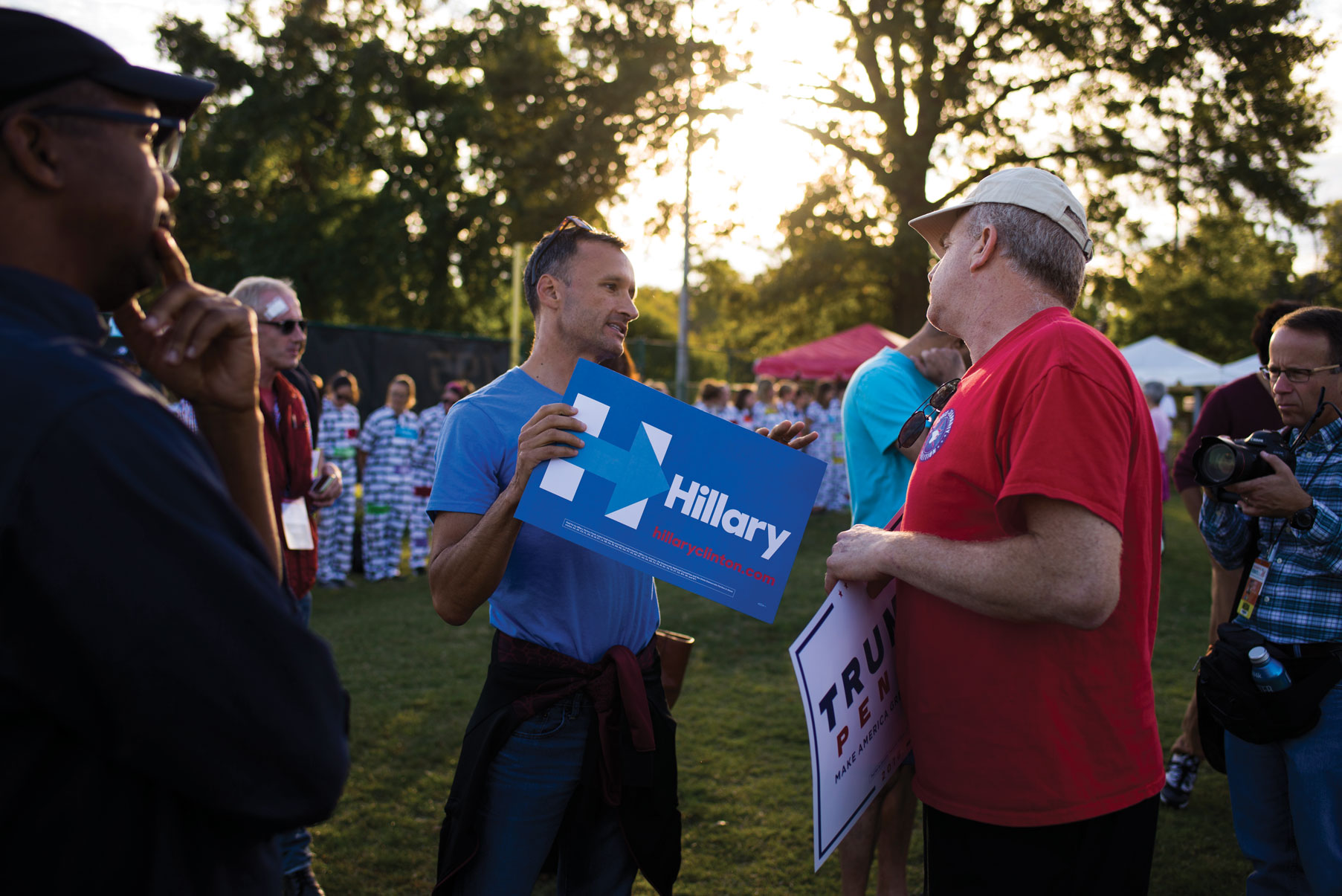
DEBATE: Two men engage in discussion at the “Free expression zone” just outside the debate venue at Washington University, St. Louis, Missouri. PHOTO: HILLARY TAN
Three months ago, it all seemed so simple. I had just arrived in the United States for my exchange semester, and thought I had my political beliefs sorted out.
Donald Trump and the Republican Party seemed to be the enemies of everything decent; hateful towards anyone who didn’t fit the mould of a stereotypical “straight white male”.
Looking back, I realise how broad and uninformed my thinking was. But how could I have known?
Singapore is more than halfway across the world from America — at least 13 hours behind, or 14 with Daylight Saving Time.
From that distance, it is easy to lean back and think you have an omniscient view of foreign politics. But, I could not understand from that far away.
I am now studying at the University of Missouri, in the city of Columbia.
Although Missouri is a heavily conservative state, Columbia itself leans left. Throughout my time here since arriving in August, I have come to know an amazing group of people, including Americans with diverse beliefs, personalities as well as sexualities.
As the election wore on, I could sense the outrage from my friends, especially the locals.
They not only had to comprehend Trump being a legitimate candidate, but also could not vote for Democratic presidential nominee Bernie Sanders, a favourite among younger voters for his more liberal stance, which Hillary Clinton would later adopt.
Before going on exchange, I had already identified myself as a liberal, and could not help but feel and express the same outrage as my newfound friends.
Being objective was hard when I was close by.
A month into my time here, I started chatting with all the cab drivers whose cabs I got into. All of them espoused liberal beliefs, some stating outright that they would be voting for Clinton.
One day, I met a driver who said he would not be voting at all.
It was the first time I had heard that opinion, which also reflected how much of a bubble I was living in. My interest in talking to a fellow liberal faded away, replaced by curiosity as to how someone could think Clinton was as bad as Trump.
His reply was simple, and introduced me to an increasingly popular viewpoint: “It’s either slitting your throat, or slitting your wrist.”
Faced with such a blunt opinion voiced directly to me rather than reading it online, I was stunned into quiet agreement.
Sweeping judgment was difficult to make when I was close by.
I had the incredible opportunity to travel to the city of St. Louis in Missouri on the day of the second presidential debate.
Although I could not get into the debate itself, I was at a “free expression zone”.
It was the first time I had the opportunity to be among campaigners and protesters with different points of view.
We’ve seen angry protesters on television, shouting at each other and occasionally breaking out into violent acts, and I admit to bracing myself for chaos when I got there.
Instead, I saw peace, serenity, and even grace in how they reacted to one another.
I witnessed Trump and Clinton supporters engaging in discussions about the economy; Green Party campaigners cheekily suggesting a football match with Libertarian Party campaigners.
Not a single person present was close to shouting.
After listening in on a Trump supporter talking to a fast food worker union campaigner, I realised why everything was so civil.
Everyone had a rational argument for whom they were voting for, and by the time they parted ways amicably, about 20 onlookers stood around, nodding vehemently in acknowledgement at the logical arguments made.
Shutting out arguments was hard when I was close by.
One common question asked after a disaster is: “Where were you when it happened?”
On Election Day 2016, I was at the Blue Note music venue in Columbia where the local Democratic Party supporters gathered to watch a telecast of the election results.
The air was heavy with the anticipation of the inevitable news of a new Clinton presidency.
There was not much worry despite Trump winning some early states. “The Republican states always get counted first anyway; all we need are Ohio and Florida” was a familiar refrain.
Late into the night, when we realised that Trump had won the state of Florida, it felt like everything was crashing down after the giddy high of a premature celebration.
All we had left was the crushing reality that Trump would be the next president.
I had never seen the town as quiet as the day after the election. Where there was once the rabble of students heading to class, now I could only hear leaves rustling and falling in the late autumn wind.
Even those walking with friends kept their voices low.
Professors pushed aside their normal curriculum to talk about what had happened. One of my professors expressed concern for the role of the media in the aftermath of the elections. We would both be close to tears when we talked after the class. I would be in actual tears by the end of the day.
After seeing my friends — whom I share beliefs with and love dearly — afraid and depressed, how could I not weep? I was angry, in disbelief, worrying for my friends.
The pain is hard to take when I am close by.
On Facebook, I saw the reactions of fellow Singaporeans to the news. Most were laughing at the absurdity of the results, while some were angry at the American voters.
At the same time, American news organisations theorised that Middle America had felt left out and abandoned by the liberal media and politicians.
Suddenly, it all made sense.
So many of the liberals’ concerns, like equal rights, are good, beautiful things, and should have already been accepted.
But they were pushing massive change on multiple fronts in a relatively short period of time, without understanding how it must feel for the other side. Simply put, change is hard.
The chasm between both sides had been too wide, and it was all too easy to dismiss the other side. My mistake from the start was not being able to relate and not realising my lack of true understanding.
If anything is to advance, it must be done together, with everyone having an open mind to hear and comprehend one another’s views.
After all, it’s never easy to understand from far away.