


Previous Story
Products that are certified made in NTU
Posted On 10 Mar 2017
Comment: Off
By Claudia Tan
Art markets are thriving, and everyone wants something customised to call their own. For bespoke trinkets that won’t break the bank, Lifestyle writer Claudia Tan scopes out NTU’s own community of crafty entrepreneurs.
Handmadebychin
Teo Chin
@handmadebychin on Instagram
Price: $6.90-$30
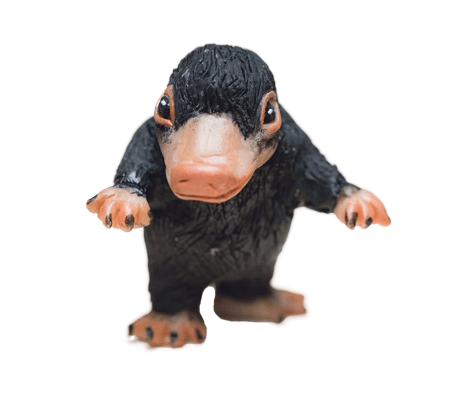
Teo Chin’s online shop selling clay miniatures may be less than two months old, but it has already gained international recognition.
In January, a Canadian customer had purchased her hand-sculpted miniature Niffler, a character from the 2016 movie ‘Fantastic Beasts And Where To Find Them’, from Teo’s Etsy account. The online platform allows people from all over the world to sell their handmade crafts.
The miniature, sold for $40, including international shipping, bore striking resemblance to the actual critter, with its black fluffy fur and tiny claws sculpted down to the most minute of details.
“I did not expect someone to be willing to pay so much for my work,” said the 23-year-old, who used to dabble in different crafts like painting and crocheting when she was younger. But it was sculpting miniatures that captivated her last December.
She started sharing her work on her personal Instagram account. In January, Teo’s boyfriend set up a separate account “Handmadebychin”, and encouraged her to use it as a platform to sell her work.
Initially, the final-year School of Chemical and Biomedical Engineering student did not intend to offer customisation services, but realised there was a demand for it, especially before Valentine’s Day.
“One customer asked me to make a figurine of this particular brand of cup noodles and insisted that the colour of the broth matched the one in a picture he showed me,” laughed Teo. “Apparently those cup noodles had a special meaning to him and his girlfriend.”
Other Valentine’s Day requests included a figurine of a potato with a heart attached to it, and a tofu charm.
Teo sold six figurines over the week leading up to Valentine’s Day.
Now, sales have returned to a steady two to three clay miniatures a week. But Teo, who works on her clay sculpting at home, admits it is challenging to juggle customised orders and schoolwork sometimes.
“I had to reject someone when she asked if I could sculpt a person, because it would take up too much time,” said Teo. “I would love to customise whatever I can but it depends on the project size.”
Each clay miniature can take up to five hours to complete, depending on its complexity. Teo prices her miniatures at around $8 for a simpler customisation, while more complex custom orders can go above $20.
“A lot of people might think it is crazy to pay for something so tiny, but sculpting these miniatures take up a lot of time as there are a lot of details,” she said.
The time consuming nature of sculpting miniatures limits Teo to only viewing it as a side job. “If I consider my profits in relation to the time I put in, it is really not a lot, but I enjoy doing it as a hobby.”
Heavenhaswifi
Barnabas Chua
@heavenhaswifi on Instagram
Price: $14-$24
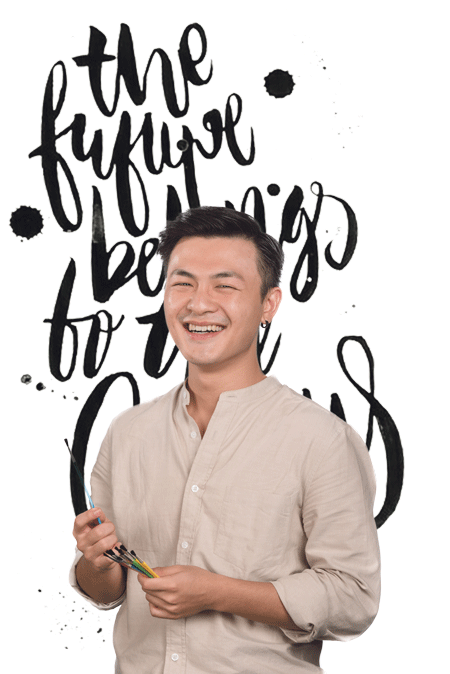
Behind the deft brush strokes of handmade quote cards on @Heavenhaswifi is a masculine hand.
Hand lettering may be an art done mostly by females, but Barnabas Chua first picked up his brush while in National Service.
Initially drawing inspiration from other art accounts, the first-year Wee Kim Wee School of Communication and Information student found a style of his own over time.
Chua now adopts a style of hand lettering with bold and dynamic strokes that appears seemingly effortless. When it is not the conventional black text against a white background, hues of pastel colours and ombre effects would be present in Chua’s work.
As he improved, Chua decided to start an Instagram account to sell customised hand lettered pieces.
“When it started, I didn’t have any grand intention,” explained the 21-year-old. “But it has grown to a point where I get orders quite often, especially during seasonal periods like Valentine’s and Christmas.”
He received 15 orders last Christmas and more than 24 orders for Valentine’s Day.
Chua decided to focus more on customised orders as he wanted each buyer to have something unique.
“They can be guaranteed that each piece is one-of-a-kind,” said Chua. “It won’t be reprinted or photocopied for anyone else.”
Customers can choose the colour scheme of the paper and text, and pick their own messages to be hand lettered onto the card. Pieces with a painted background may take up to four hours. A simple design without a background typically takes around an hour and a half.
But remember not to make it too wordy or it might not turn out pretty, Chua warned. “The words need to be spaced out on the paper. If it’s too cluttered, it’ll look ugly.”
Being his own boss has its ups and downs.
Besides receiving more requests for customised orders, Chua said putting his work out there has opened many windows of opportunities, such as designing logos for local art exhibitions.
But the artist also once went five months without receiving a single order. Feeling dejected, he decided to put his account on hold.
“I put down the brush for quite some time, but when I came across other hand lettered work by other artists on the streets or on Instagram, I would be reminded of the beauty of it,” said Chua who gradually rediscovered his inspiration after the five-month hiatus.
For aspiring hand lettering artists, Chua assured that artistic talent plays only a miniscule part.
The secret to perfecting your hand lettering is to have realistic expectations when you first start out and keep practicing from there, he said.
Foptics
Raynald Zhang
www.Foptics.club
Price: $35.90 flat for prescription glasses, $22.90 for PC glasses
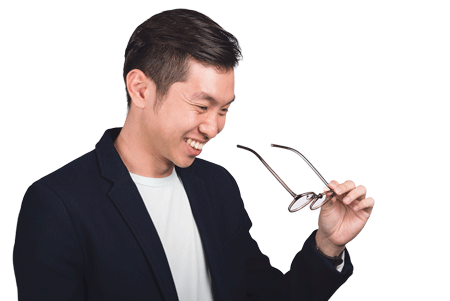
When Mr Raynald Zhang could barely make out the words on the projector screen in class without squinting, he knew it was time to get a pair of glasses.
Not wanting to overspend on a pair that he would only use during lessons, he decided to go online in the hope of finding a suitable and affordable one.
But his search yielded no results — so the 27-year-old decided he would pursue the business idea upon his graduation.
After two months of sourcing for suitable suppliers and someone with the expertise to prescribe glasses, Mr Zhang finally launched Foptics last June.
The online store specialises in prescription glasses, which customers can purchase at flat rates after entering their prescription values, and choosing their desired frame online.
A pair costs $35.90, but Foptics also carries PC glasses (glasses that protect the eyes from blue light emitted from electronic devices) at $19.90, and non-prescription frames at $15.90.
Besides offering affordable prices, Mr Zhang hopes to reach out to youths by emphasising both the form and function of the glasses Foptics carries.
“I thought that if people could own so many clothes and shoes, perhaps it could be the same for glasses too,” said Mr Zhang, who graduated from the School of Civil and Environmental Engineering in 2015. “I wanted to give people the freedom to express themselves through glasses of different styles without the limitations of a budget.”
Customers can choose between round and rectangular frames. There are 21 designs for prescription glasses and eight for PC glasses, and every design comes in multiple colour schemes, ranging from “matte black”, to “cherry” and “aqua”.
One of Foptics’ bestselling frames is “Lit”, a minimalistically designed round pair that comes in five different colours, including bronze and gold.
There were initial doubts among early customers about purchasing prescription glasses online, but Mr Zhang remained undeterred.
“We advise our potential customers on how to order through a comprehensive guide in the FAQ section of our website to show them how simple it actually is,” he said.
“With that knowledge, and the affordability of the glasses, many customers were willing to take the first step.”
Today, Mr Zhang is encouraged by Foptics’ growth, which has increased by 60 per cent since its launch.
While customers are becoming more receptive towards purchasing prescription glasses online, he is looking into expanding and setting up a physical store in the future.
MakerlySG
Lum Xin Yi
@makerlysg on Carousell
Price: $10-$30
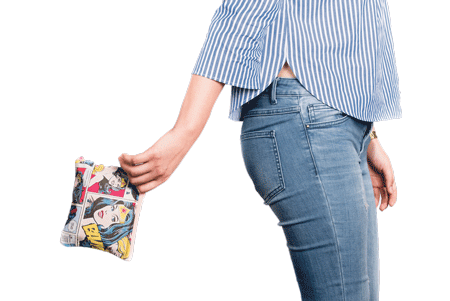
These days, when Lum Xin Yi comes across something she likes while shopping, the first thing that comes to her mind is, “Can I make it myself?”
The 22-year-old runs an online business called MakerlySG, selling hand-sewn bags and pouches on Carousell. It started like any hobby — when Lum was 16, she began sewing clothes, a wallet and tote bags for herself. After recognising her passion for sewing, her mother bought her a sewing machine for Christmas two years later.
She then took to Carousell to sell some of the bags and pouches she had made, including floral fabric pouches and simple black tote bags, which ended up being some of her bestsellers.
“I tried my luck putting some items up for sale and people were quite interested,” said the third-year School of Art, Design and Media student.
“I then tried to make items according to what people want by allowing them to customise their desired size and fabrics, and I got a lot of positive feedback from that.”
Totebags take 30 minutes to sew whereas more complex items with zippers such as a pouch takes up to an hour. A laptop sleeve takes around four hours.
Some of the fabric choices Lum currently offers include florals, geometric patterns and quirky prints like eggs and pizzas.
Should none of these fabrics appeal, customers can also purchase their own fabric and pass it to her for customisation.
The final price depends on the item, but would generally cost 80 per cent of what she charges for her own fabrics. Lum spends $70—$100 a month on sewing materials.
Once, a customer insisted on paying $40 for a customised laptop sleeve, $10 more than the original price, as she was pleased with the outcome.
“It was quite awkward,” said a slightly embarrassed Lum. “I still haven’t mastered the art of reacting to things like that.”
Other that sewing pouches from fabric, Lum also experimented making pouches with plastic bags earlier last year. The plastic bags are heated with an iron to get a texture similar to that of fabric, she said, before being sewn into pouches.
While similar in shape, pouches made from plastic turn out stiffer than those made out of cloth.
“I’ve noticed some nice prints on plastic bags before and it’s great that I can turn them into pouches,” said Lum who has sold three such pouches. “And every one turns out differently.”
Despite Lum’s heavy workload in school this semester, she has no intention of quitting her business anytime soon.
“I really like how I create my designs and see it actualise on my products so I would keep sewing,” said Lum. “And I think there is still a lot to learn.”