
Previous Story
Hall participation remains high despite guaranteed two-year stay
Posted On 25 Sep 2017
Comment: Off
By Jasmine Hoe and Wee Rae
GRAPHIC: AMY ONG
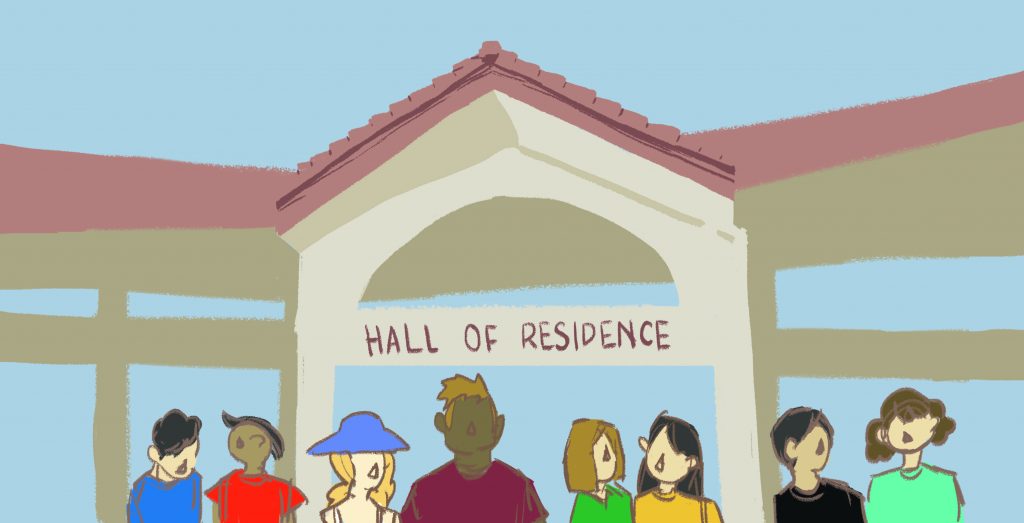
When the announcement was made in March that first-year students would be guaranteed a two-year residential place on campus – up from the previous one year – concerns were raised by seniors that students would be less motivated to participate in hall activities.
But as the Nanyang Chronicle found out, this has not been a problem in NTU’s Halls of Residences – overall sign-ups for hall activities have not declined.
Previously, first-year students had to join at least three sports or recreational games, and either one main committee or two subcommittees to vie for a place in the same hall the following year.
With the new scheme in place, students only need to join a minimum of two committees, such as the Freshman Orientation Camp and Dinner and Dance committees.
For Hall 13, sign-up rates for this year’s Junior Common Room Committee (JCRC) elections in August were more than satisfactory.
Twenty–four people ran for 16 positions in the Committee this year – an improvement from the previous year when only 20 people came forward, said President Soh Wan Fang, 20.
“Most of the people who ran (for JCRC) wanted to try something new, and have a genuine interest in the role,” added the second-year student from the Wee Kim Wee School of Communication and Information.
Hall 14’s JCRC elections were equally promising this year.
“During my year (2016), there were 21 candidates who signed up but seven of them pulled out,” said former President Goh Voon Jin, 23.
None of this year’s 17 candidates dropped out from the elections.
The final-year student from the School of Biological Sciences said that 11 out of the 17 candidates were first-year students.
JCRC involvement aside, participation in other hall activities, such as sports and recreational games, also did not differ much from previous years.
Former Hall 1 Sports Director, Matin Nordin, 23, said overall sign-ups for sports remained the same.
“Popular sports like badminton and netball had a high sign-up rate while less popular sports like squash and touch rugby had fewer sign-ups (just like previous years),” said the second-year student from the School of Social Sciences (SSS).
For recreational games, former Hall 3 Recreational Games Director Calvin Goh, 22, said there was a 20 to 30 per cent increase in the number of sign-ups this year.
“Even traditionally unpopular games like contract bridge and Weiqi saw a significant increase as compared to previous years,” said the second-year student from the School of Mechanical and Aerospace Engineering.
A second family
To many first-year students, hall is more than just a residential place on campus.
The guaranteed two-year stay does not necessarily discourage them from participating in hall activities.
“It’s important for residents to have a sense of belonging to their hall. It’s like a second family,” said Regine Sim, 19, a resident at Tamarind Hall.
“The efforts of the current JCRC in providing a more vibrant hall life makes us want to pass down their legacy to future residents as well,” added the first-year Sports Science Management student.
Hall 8 resident Jake Lee participates in hall activities so that he can continue staying with his friends in the same hall in his second year.
“Hall activities allow you to take your mind off studying and enjoy the company of your fellow hall mates,” said the 21-year-old from the School of Electrical and Electronic Engineering.
Seniors are important
Tanjong Hall president Thomas Lam, 23, said seniors play a crucial role in ensuring that participation in hall activities remains high.
“Seniors will have to go the extra mile to share their experiences and love for their hall clubs and activities through channels such as the Freshman Orientation Programme and resident welcome events,” said the third-year student from Nanyang Business School.
Lam hopes that doing so will encourage first-year students to participate in hall activities.
The 23-year-old added that seniors need to be patient with their juniors.
“For example, there are those interested in dance, but are afraid of dancing in front of others,” he said. “Seniors have to come in to guide these freshmen to ensure they come back for practice, improve and continue joining the dance crew next year.”
Hall 14 resident Eunice Seah stressed the need for seniors to facilitate bonding among hall residents.
“Since most people participate in hall activities because of their friends rather than for the hall stay, seniors who know the freshies from orientation can always ask them along for events,” said Seah, a third-year student from the School of Physical and Mathematical Sciences.
The 21-year-old believes that this would help students feel a greater sense of belonging to hall and hence be more willing to participate in hall activities.
“Of course it’ll be good if the freshmen can take charge of their own activities, but if the seniors are there to encourage them to do so, that’ll be even better.”