
Previous Story
More shared e-scooters on campus by year-end
Posted On 25 Sep 2017
Comment: Off
By Adele Chiang
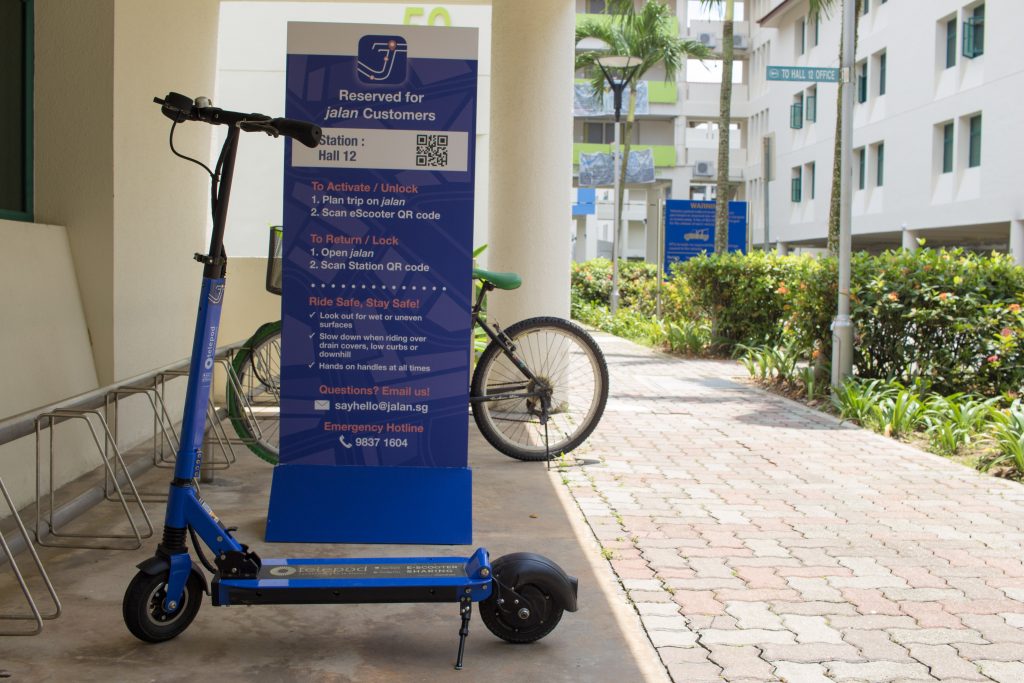
PHOTO: HAZIM ZULFADHLI
NTU will see an increase in shared e-scooters by the end of the year as the University serves as a test bed for integrating shared modes of transport.
A total of 100 e-scooters will be available on campus by the end of the year after a successful e-scooter sharing trial with 15 e-scooters that started on 22 Aug.
The e-scooter sharing service is run by Telepod, a local transportation and tech start-up, and is similar to bike-sharing services such as oBike and ofo. Telepod also provides e-scooter rental and delivery services.
The e-scooters are currently docked at eight stations on campus: Lee Wee Nam Library, Sports and Recreation Centre (SRC), North Hill residences, Halls of Residence 8 and 12, Canteen 2, Research Techno Plaza and the School of Humanities and Social Sciences building.
An additional five to 10 stations will eventually be added to accommodate the new e-scooters, said Telepod’s chief operating officer Louis Goh.
The 27-year-old added that the response to the trial was “overwhelming” and proved there was a demand for the service here.
Telepod aims to see 20 per cent of the school’s population getting the chance to try out the service once all 100 e-scooters are available, he added.
Students who have used the service said it is a convenient means of transportation.
Second-year School of Mechanical and Aerospace Engineering student Seet Cheng Xiang, 21, said this is especially so after 9pm, when the campus buses arrive at lower frequencies of 18 to 20 minutes.
The Hall 14 resident once rode a Telepod e-scooter from the SRC back to his hall at 10pm. This took him seven minutes compared to the 20 minutes he usually spends on the campus bus.
Ahmad Rabani, a second-year School of Electrical and Electronic Engineering student, has taken the e-scooter once. He said he will use the service again.
“I can get to my destination without having to wait for the bus or struggle to squeeze onto one during peak hours,” the 22-year-old said.
But others found the service expensive. Users are charged $1 for every 10 minutes.
First-year Masters of Science in Technopreneurship and Innovation student Low Hong Liang said: “I would want to use the e-scooter (service) again only if the cost is lower.”
The 24-year-old, who has used the service twice, added that he would rather take the campus bus since it is free.
Telepod CEO, Mr Goh, said the e-scooter rental rate is “quite competitive” compared to bike-sharing companies, which charge an average of $1 for 30 minutes of use.
He added that this is because bicycles take 20 to 30 minutes to travel the same distance that e-scooters would in 10 minutes.
Promotional codes will also be made available on Telepod’s social media sites in October to encourage e-scooter use, he said.
Telepod is a partner of jalan.sg, a route planning mobile application that seeks to integrate various transportation options like e-scooters, bicycles, shuttle buses, Mass Rapid Transit (MRT) networks and eventually automated self-driving vehicles.
Mr Stanley Ong, lead of service and experience design at jalan.sg, said NTU is a test bed for their Mobility as a Service (MaaS) initiative, which promotes the shift from personal cars to shared modes of transportation.
“We hope to not just implement this in Singapore but across Asia too,” the 35-year-old added.
Jalan.sg was launched in mid-August and is a collaboration between Singapore Mass Rapid Transit (SMRT), JTC Corporation and NTU.
To use the application, users input their starting location and destination. The app will then display a list of possible routes. For example, for a shorter travel time, it may suggest that the user take the campus bus before switching to an e-scooter or bicycle.
Users can then book and pay for the e-scooter or bike-sharing service through the app.
The app was launched for trial on 21 Aug and is currently only available on Android. It has since been downloaded more than 600 times, said Mr Ong. He added that it will be made available to Apple users by November.
More than 1,200 students have also indicated interest in it, based on a survey carried out by jalan.sg in August.
When first-year Nanyang Business School student Tan Si Wei learnt about jalan.sg, he said the app would be useful to him since he is still unfamiliar with the campus.
The 22-year-old added that using it would save him the time spent on planning his routes beforehand and getting lost on campus.
Automated self-driving vehicles may also one day be part of the MaaS concept as jalan.sg partners with Dutch company 2 Getthere Holding (2getthere) to test out automated vehicles (AV).
An AV testbed has been stationed in the carparks between Halls 12 and 14 since 21 Aug.
“It is definitely not a full service yet, we are still collecting data in this experimental stage,” said Mr Leong Wei Yang, 24, an operations executive at jalan.sg.
If successful, the use of AVs will eventually be launched nationwide to complement bus services and bring commuters from MRT stations to their homes or workplaces more conveniently, said Mr Ong.