
Previous Story
In the bloom of campus artistry
Posted On 25 Sep 2017
Comment: Off
By Dayna Yin
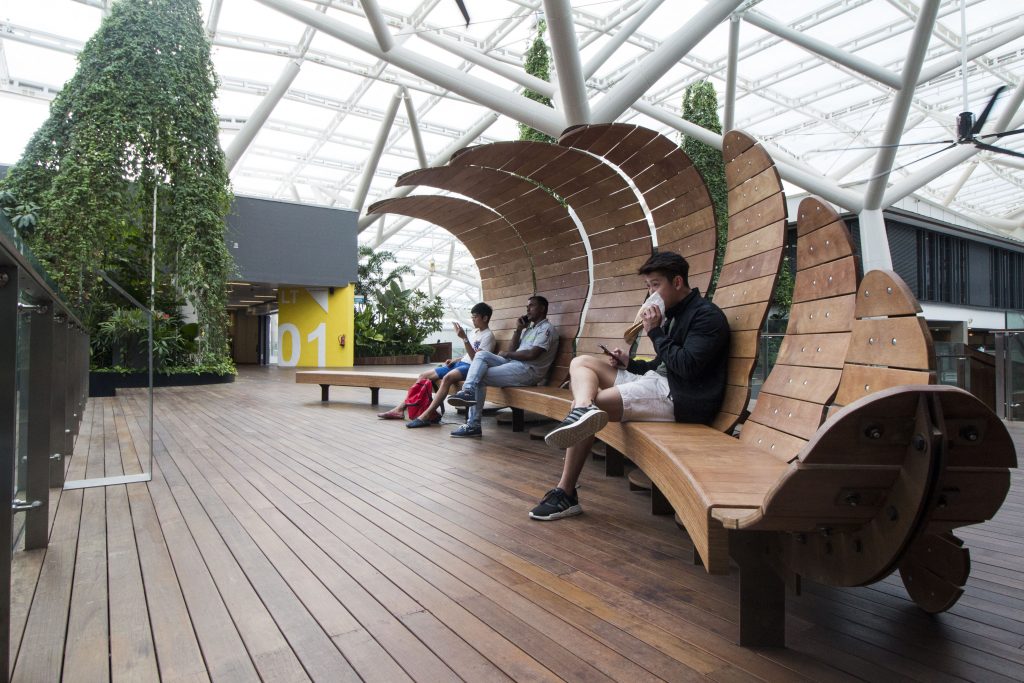
PHOTO: BELICIA TEO
For a museum that turns 10 next year, it may come as a surprise that the NTU Museum is not a destination on the campus map.
Rather, it is a team of artists, trade professionals and coordinators that conducts workshops and creates artworks together with the University’s staff and students.
Currently, the NTU Museum’s team is developing an NTU art trail guide for staff and students that will be ready in the first quarter of next year. The art trail is expected to showcase over 20 large artworks and 150 paintings located around the main NTU campus and the Lee Kong Chian School of Medicine’s (LKCMedicine) campus in Novena.
“Art is not something restrictive, it can come in any form,” said the museum’s deputy director Faith Teh. “Through their participation, students may be more aware of art.”
To create the art trail guide, students from the School of Art, Design and Media (ADM) were tasked to design a series of themed maps, complete with innovative signposts and markers to guide visitors, under the mentorship of ADM Associate Professor Laura Miotto.
An augmented reality version of the guide online is presently in the works, and is slated to be completed in the third quarter of next year. This is part of the museum’s efforts to immerse students in the artworks through interactive content, and to make navigating the installations easier.
The latest addition to the NTU Museum’s collection is Bloom — a spectacle of light and motion unveiled at LKCMedicine’s Clinical Sciences Building at Novena, on 28 August this year
The three-metre tall installation comprises 18 flowers of various sizes. Built-in motion sensors trigger the flowers to “bloom” in the presence of visitors, while the light-emitting diodes (LED) outlining the flowers and vines change colours based on weather conditions.
Bloom is powered by solar energy harvested through on-site solar panels. Inspired by the colour changes in Chinese honeysuckle flowers, the installation features LEDs that tint the white flowers with different colours when there is a change in temperature at the Novena campus.
In the second phase of the project, which will be completed in April 2018, the LEDs are set to be programmed to react to weather conditions on the University’s main campus.
“By creating Bloom to react to the changing environment on the main campus, and seeing how the artwork responds to it, it symbolises the connectivity between the two campuses”, said Ms Teh.
“It shows that when art is infused with technology, it can transcend distance and bring the campuses together”, she added.
Designed by five ADM students and former ADM faculty adviser Fabrizio Galli, Bloom was executed with the help of a team of scientists and engineers from the Energy Research Institute @ NTU (ERI@N).
“We had to come up with art installations that were inspired by modern technology,” said one of the students, 23-year-old Ms Ivana Goh, who graduated from ADM last July. “Most of the projects were based on renewable energy, so the sustainability aspect is key.”
Commissioned in 2016, Bloom is the fourth installment in NTU Museum’s Renewable Energy Art and Public Art initiatives, which aim to create sustainability-themed art by bringing experts from different disciplines together.
The previous three installments were also by Mr Galli’s ex-students.
“We try to combine art and technology to stimulate an appreciation among students for art installations,” said Mr Galli, who collaborated with ERI@N on a module about creating art with renewable energy technology during his time at NTU.
Mr Galli hopes that every class he has taught will have their work both completed and displayed. Currently, he is working with NTU Museum on their next project – two outdoor sculptures for the new North Spine Learning Hub.
A hands-on approach to art awareness
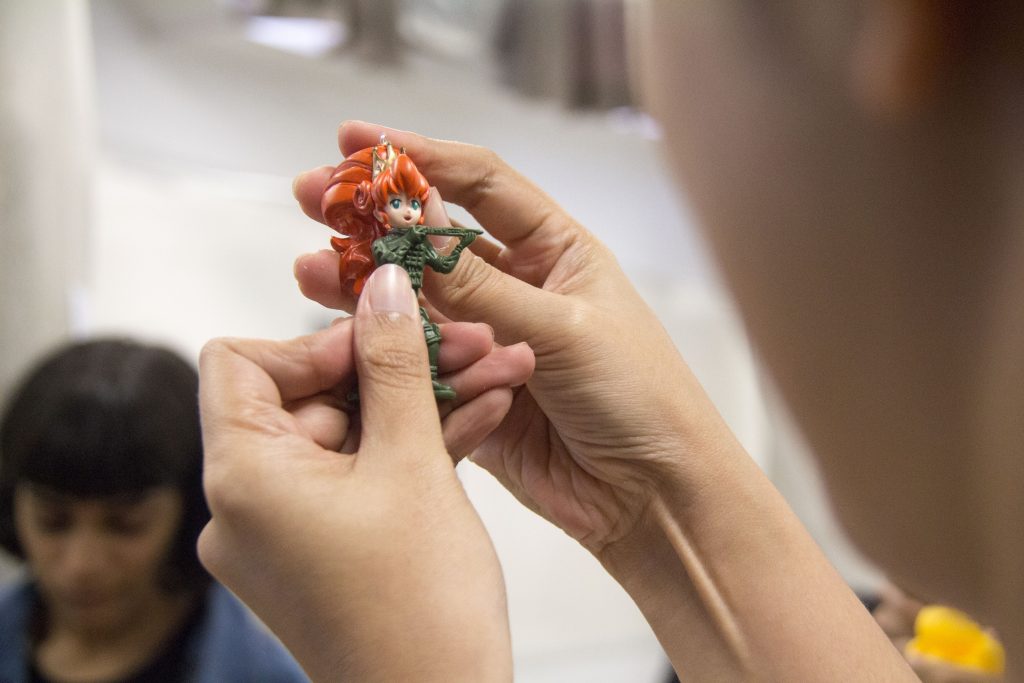
NTU students try their hand at re-purposing toys into statement pieces. PHOTO: BELICIA TEO
Aside from art installations, the museum conducts workshops to give students a chance to unleash their creativity and pick up different art skills during the school semester.
At the Wearable Art: From Toys to Accessories workshop last month, which was jointly organised by local art studio Kult Gallery and the NTU Museum, 20 students learnt how to recycle old toys into colourful pieces of jewellery.
The workshop was inspired by a previous toy exhibition, Choking Hazard, held by Kult last February at its studio space in Emily Hill. The toy exhibition showcased over 30 artworks made from old toys and packaging materials, depicting an exploration into the social implications of mass production.
“For this particular workshop, we were very interested in the concept of upcycling – the repurposing of old materials – and artistic creation,” said Ms Faith Teh, the NTU Museum’s deputy director.
Four months after Choking Hazard ended, Ms Teh found out about the exhibition online, and invited Kult Gallery to adapt their workshop for students here.
At the Wearable Art: From Toys to Accessories workshop, Kult’s assistant art curator Tulika Ahuja encouraged participants “to take high art into their own hands.” Her demonstration of how to dismantle and remodel old figurines into pendants and badges impressed Yang Kaiyi, a first-year School of Electrical and Electronic Engineering student who attended the session.
“It was really fun and I have so many old toys at home too, so it was quite useful,” said Yang, 19, on how she has been inspired to declutter her room by turning unused items into accessories.
Whether one is a veteran or amateur, the NTU Museum believes that making and appreciating art can brings people together, by forging meaningful bonds through creative expression.
“Art should have some qualities to connect with people,” said deputy director Ms Teh. “ It gives you another perspective of what others are thinking and broadens a person’s experience.”
__________
In 2008, the NTU Museum was established to develop a greater appreciation for art and heritage within the University’s community.
In line with NTU’s sustainability research and efforts, some notable works under the museum’s Renewable Energy Art and Public Art initiatives include:
- Reaching High — the first renewable artwork displayed at the NTU Sports and Recreation Centre;
- Dandelion — a five-metre-tall solar-powered light installation located outside the School of ADM;
- Fern — an installation that serves as a 12-seater bench and solar-powered charging station located at the North Spine.
Aside from physical installations, the museum also conducts virtual ‘tours’ of past exhibitions online.
This includes last year’s Trees Upcycled project, where Pioneer and Crescent Hall residents used wood reclaimed from campus to make handcrafted art pieces. For more information, visit: http://www.ntu.edu.sg/museum/exhibitions_programmes/Pages/virtual_exhibitions.aspx