


Previous Story
New residential education programmes for hall residents
Posted On 16 Oct 2017
Comment: Off
By Syed Muhammad Faris and Wee Rae
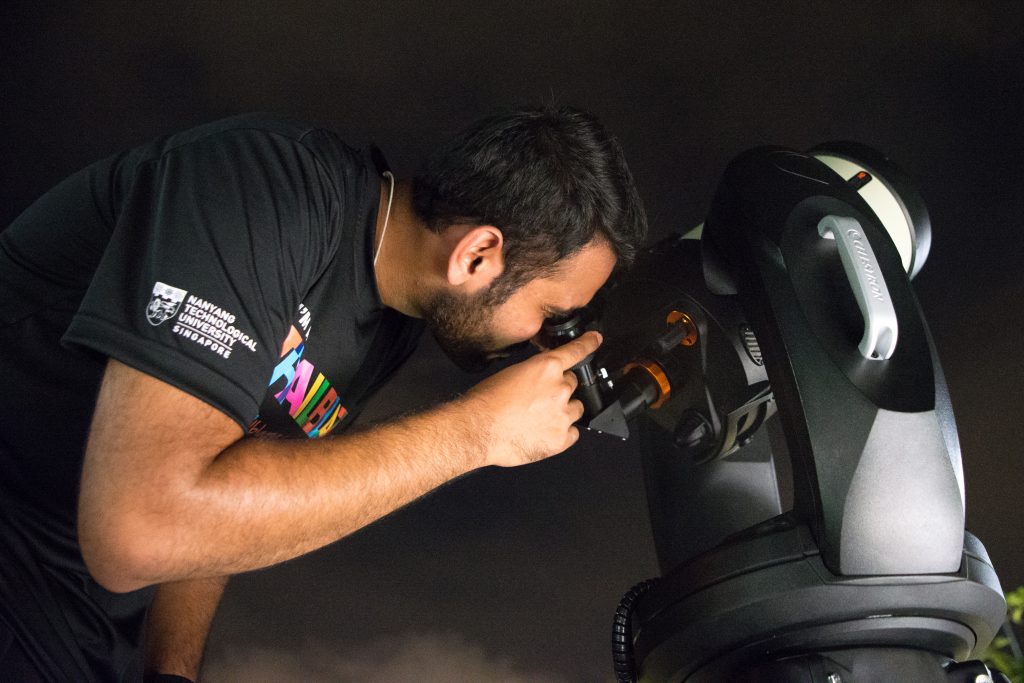
PHOTO: WEI LUN YEO
Students living on campus can now participate in programmes such as yoga classes and astrophotography workshops following the launch of the second phase of the Residential Education Programme (RE@NTU) this semester.
The second phase of RE@NTU saw the Yunnan cluster (Halls 4, 5 and 7), Halls 1, 2, 6 and Tamarind Hall introducing their own programmes to hall residents. Since its establishment in 2014, RE@NTU has been providing students living on campus with experiential, out-of-class learning opportunities.
Crescent and Pioneer Halls pioneered the programme in 2014. The North Hill cluster and Halls 8, 9, 10 and 11 participated in the first phase of the programme in August last year.
New programmes
Spartan is among the slew of new programmes that students can take part in. Jointly organised by the North Hill and Yunnan clusters, it is a health and fitness programme that involves activities such as cardio-kickboxing and power yoga.
Astrophotography, a new programme at Hall of Residence 10, is the specialised use of photography to capture images of celestial objects such as the moon and planets, as well as large areas of the night sky. It consists of four sessions held over one academic year, conducted in three stages — basic, intermediate and advanced.
Conducted over two sessions, the basic stage introduces participants to the fundamentals of astronomy. In the intermediate and advanced stages, participants will learn more about the photography aspect of the programme.
The first astrophotography session on 21 Sep saw a turnout of 40 participants. Held at Tamarind Hall’s sky garden, participants took turns to view planets and stars using telescopes.
“This (astrophotography) isn’t something you come across every day, so it’s really interesting,” said Clara Lai, 24, who attended the first session.
“I’m looking forward to future sessions, especially for the photography aspect,” added the second-year student from the School of Humanities.
Other new programmes include pottery, financial management and Ceroc lessons — a partner dance that includes moves from salsa, rock and roll and other dance genres.
These programmes are conducted by NTU staff. Students can register for these activities on the RE@NTU website or via sign-up links sent to their emails, depending on which halls they reside in.
Positive feedback
RE@NTU has received promising responses from the student body since its initiation.
Pioneer Hall resident Viknesh Sangaraju, 21, got to prepare a “burger” made of desserts such as souffle, chocolate fudge and cheesecake last semester. This was part of the Exploring the Science of Good Eating Experience programme offered to Crescent and Pioneer Hall residents.
“You can’t just follow a recipe. You have to constantly tweak your recipe and cook your dish over and over again just to get the taste right. It’s this hands-on aspect which was the highlight of the programme to me,” said the second-year student from the School of Chemical and Biomedical Engineering.
For Hall 10 resident Bridgel Sze, 21, allowing students to take ownership of the programmes is the most appealing aspect of RE@NTU.
The second-year School of Art, Design and Media student is the chairperson of Hall 10’s edible gardening programme, where she helps to coordinate workshops and recruit new participants.
“Our members play an equally important role as well by maintaining the garden and learning new gardening techniques. We all play a part in pruning, harvesting, and planting new plants,” said Sze.
Future plans
The third and final phase of RE@NTU will be launched in August 2018 at Halls 3, 12, 13, 14, 15 and 16.
After all the halls have adopted the RE@NTU Programme, the next goal is to foster greater participation from students, said Assistant Director of Residential Education Marcelino Jr Navera Lizaso.
Mr Lizaso added that apart from signing up for existing RE@NTU programmes, students should also take the initiative to organise their own activities.
Currently, programme ideas are generated by the faculty-in-residence at the respective halls.
“Before we start the academic year, the faculty-in-residence goes through a planning process and submit their proposals to DAP (Deputy Associate Provost), where we will look through to see if it is viable,” said Mr Lizaso.
Once the proposals are approved, funds will be provided to run the programmes.
“We want programmes to come from the ground, with residents sharing their ideas and running things because they want to, and they know that their co-residents will benefit from it,” said Mr Lisazo.
“The hope we have is that one day, all that the faculty and residential mentors need to do is to guide the students.”


