


Previous Story
ADM design takes IKEA by Ström
Posted On 16 Oct 2017
Comment: Off
By Xu Qi Yang
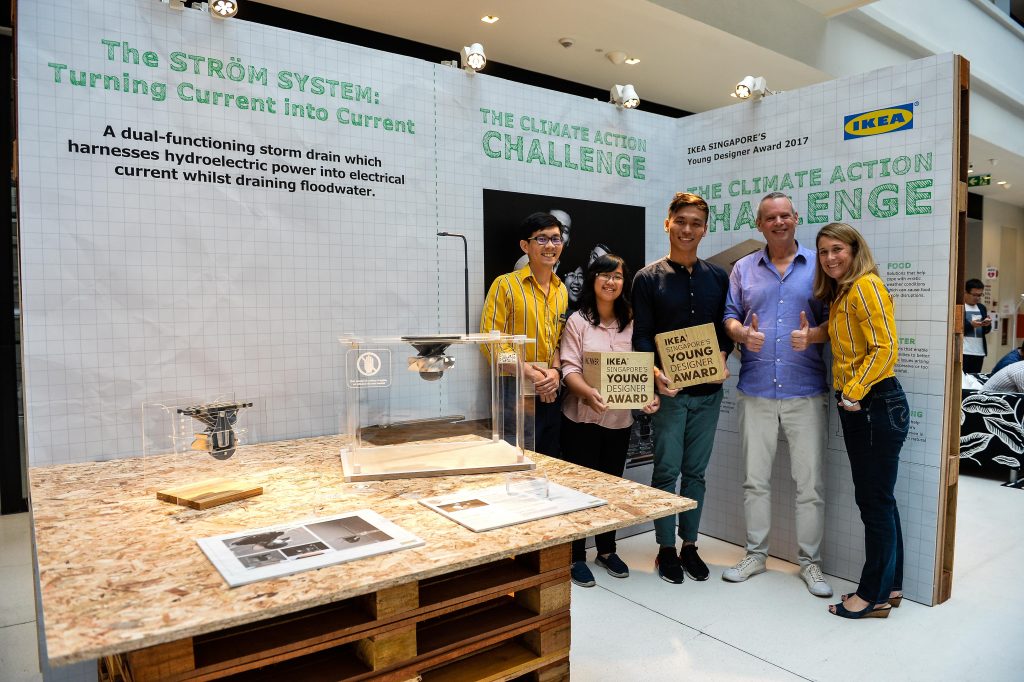
PHOTO: IKEA SINGAPORE
The process of designing the Ström System — a storm drain that generates electricity from floodwater — was so gruelling that third-year student Foo Heng Tong dreamt that he was the turbine in the model.
“I remember dreaming that I was situated underground, hanging on to the storm drain cover. I woke up with my hands stretched upwards and was sore for the whole day,” said the 25-year-old from the School of Art, Design and Media (School of ADM).
The Ström System is the brainchild of Foo and his teammates Orion Dai, 24, and Casey Kwokdinata, 21, who are also third-year students at the School of ADM.
A typical storm drain is designed to drain excess water in the event of heavy rain. The team’s innovative storm drain is aptly titled Ström — which translates to current in Swedish — as it generates electrical currents from a turbine that turns with the force of floodwaters.
The trio clinched the top prize at IKEA Singapore’s Young Designer Award last month — a design competition that challenges tertiary students to come up with innovative solutions to fight climate change. They were awarded a grand prize of $1,500, and were each offered a trip to the IKEA headquarters in Sweden and an optional internship at IKEA Tampines.
A picture of a manhole flooded with water was the inspiration behind the Ström System.
“There were torrents of water coming out of the storm drain (in the picture),” said Dai. “We thought we could utilise the kinetic energy of the water and turn it into something that benefited the people.”
As water runs down the storm drain, the kinetic energy of the water turns the turbine. The rotation of magnets around metal coils inside the turbine generates an electrical current that is used to power up street lamps and emergency shelters for victims and rescue workers.
With only a basic understanding of physics, the trio had to learn engineering concepts from their friends in the School of Electrical and Electronic Engineering. They spent almost every day in school building the prototype from July to August.
Despite being familiar with 3D printing and laser cutting from their product design modules in school, the process of building the Ström System was not a smooth one.
“We always had problems printing the turbine and blade,” said Dai.
The team took three attempts to print the turbine successfully.
On their first attempt, the printer’s filament — a plastic material used to make the product — broke during the printing process.
The team’s second attempt was met with a power shortage, which caused the printing to stop when the turbine was already 90 per cent completed. They had to reprint the turbine, which took a full day.
“We printed a lot of test prints and if they didn’t look nice, we could still reprint them multiple times,” said Dai.
Though gruelling, the competition was a fruitful learning experience for the trio.
“(The competition) was a good experience. We hope we made our school proud, and spread word among future employers that our product design students have standards,” said Dai.