


Previous Story
No degree class tag but soft skills still important
Posted On 06 Nov 2017
Comment: Off
By Adele Chiang
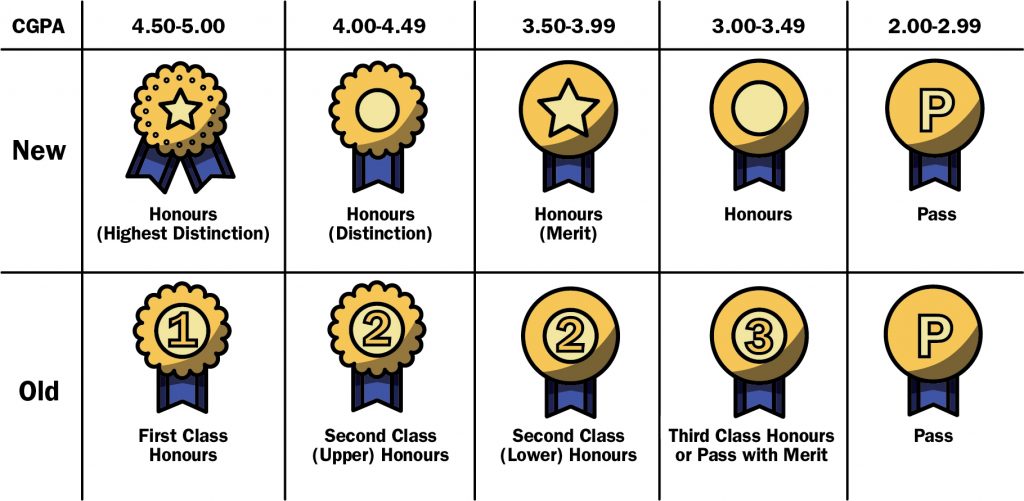
GRAPHIC: REYNARD ADRIANTO
NTU may have dropped the degree class tag in a bid to make its graduates more competitive in the job market, but human resource (HR) professionals say having internship experience and other soft skills are as — if not more — important in boosting employability.
On 5 Oct, Deputy Provost for Education Kam Chan Hin announced in an email to students that all undergraduates graduating from next January onwards, except medical students, will receive degrees according to a new nomenclature, regardless of their intake year.
In an interview with the Nanyang Chronicle, Prof Kam said the implementation of the new nomenclature will help NTU graduates remain competitive in job selection processes that filter candidates using their degree classification.
“In terms of perception, honours without the second and third class qualification sounds better,” he said, adding that this will put NTU graduates on par with their counterparts from National University of Singapore (NUS), which adopts the same nomenclature degree classification, in the shortlisting process.
Prof Kam also said the University hopes this will reduce the emphasis on grades among employers and better reflect the increasing quality of the school’s graduates.
“In an ideal world, it is best not to have classifications at all,” he said. “Over time, we hope (the classification) will become less important.”
Some HR professionals the Nanyang Chronicle spoke to said the new names will not affect their selection of candidates, as greater emphasis is placed on experience and a good work attitude.
Ms Lina Chan, HR director at Peninsula Excelsior Hotel, said she focuses more on an applicant’s work attitude and willingness to learn.
“Having good grades doesn’t reflect an applicant’s character,” said Ms Chan, adding that having a high GPA does not guarantee an applicant will excel in the workplace.
Ms Betsy Sin, HR director of tech distribution company Avnet, said: “We look at the graduate’s experience — the internships they did and what kind of part-time work they have taken up.”
A candidate’s degree classification only becomes a deciding factor if two or more applicants have similar internship and part-time job experience, she added.
Nevertheless, she acknowledged that bigger international companies in the pharmaceutical, research and engineering industries focus more on a candidate’s degree classification, as the skill sets required in these fields are more specific.
Students the Nanyang Chronicle spoke to said the new nomenclature helps to remove the negative connotation attached to a Third Class Honours degree.
Second-year School of Physical and Mathematical Sciences student Lim Li Ling, 20, said: “Now it sounds more like a general degree, rather than a poor degree class.”
Jonathan Lam, 21, a first-year student from Nanyang Business School, said: “By removing the first, second and third class labels, there doesn’t seem to be a hierarchy anymore.”
But Nur Fatehah Salim, 23, said she does not feel the change makes a difference, since the grades required to achieve each class of honours remain the same.
“There are still clear distinctions in the degrees. Employers would probably know that just an Honours equates to a Third Class,” said the final-year School of Social Sciences student.
NTU has no plans to allow alumni to reprint their certificates, however, as the school has too many batches of alumni from the past 26 years, said Prof Kam.
He hopes graduates can be judged based on their holistic abilities instead of whether they are book-smart.
He said: “What’s important is how you deliver results in your job. It matters more than what your degree labels you as.”