


Previous Story
Focus on issues that will shape our future: Shanmugam
Posted On 06 Nov 2017
Comment: Off
By Gracia Lee
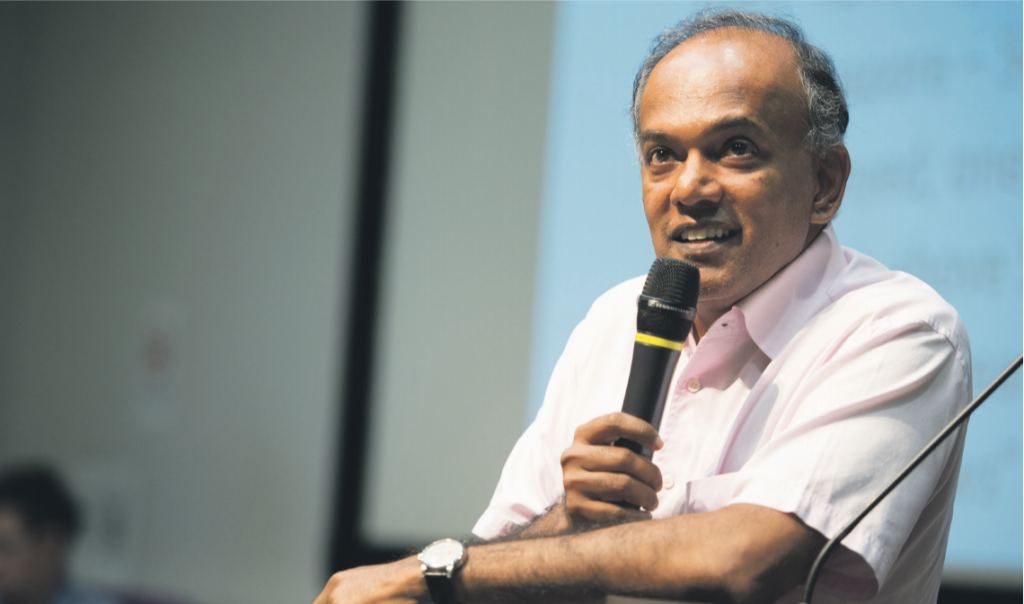
PHOTO: FELINE LIM
Singaporeans need to think about and engage more on the real challenges that the country will face in the future, said Minister for Law and Home Affairs Mr K Shanmugam in a dialogue session at the Wee Kim Wee School of Communication and Information (WKWSCI) on 10 Oct.
“We debate a lot about day-to-day issues. But there is not as much discussion on the issues that are critical for Singapore’s future,” Mr Shanmugam said. He offered examples such as the fiscal impacts of the declining birth rate and the need to keep the city economically competitive.
He added that Singaporeans need to be aware of the reality of the country’s economic position, its strategic challenges, and how these can impact its future.
Speaking to some 90 students, Mr Shanmugam highlighted some key economic and social challenges that the Republic is facing.
The first and “most pressing challenge” he raised was the country’s rapidly ageing population and the fiscal challenges that accompany it. By 2030, close to 30 per cent of the country’s population will be above the age of 65, he said.
“What that means in terms of healthcare costs, social support, economic vibrancy, (and) the declining number of people coming into the workforce, you can work out for yourself,” said Mr Shanmugam.
During the two-hour dialogue, Mr Shanmugam also brought up the challenge of sustaining Singapore’s economic vibrancy and viability in the face of increasingly competitive economies in the region.
Ancillary services like accounting, law and finance, which fuel a large part of Singapore’s economy, are now easily outsourced to lower-cost countries like China and India with the help of technology, he said.
He added: “People will start asking, why do you need to pay so much for a Singapore-qualified lawyer or accountant or doctor?”
On the country meeting the challenges of regional competition, Mr Shanmugam likened the Singapore economy to a spinning top: “The only way to stay up is to spin faster and faster and faster.”
Students’ reactions
Students who attended the talk agreed on the importance of acknowledging the economic and social challenges in Singapore.
Final-year WKWSCI student Nicole Ang said: “It’s necessary for Singaporeans to be aware of the threats and challenges of the country so we can prepare ourselves for the future.”
But the 22-year-old admitted that while she keeps up with the news daily, she tends to read only the latest stories or the articles that interest her.
“I should try to read everything, including the trend and insight pieces,” the 22-year-old added.
Similarly, second-year WKWSCI student Eugene Tang said he does not make it a priority to read about the issues the country faces because he often feels that he cannot make a difference to them.
“There’s nothing I can do to actively resolve these national issues, so I’d rather spend my time doing my assignments and school work, and eventually contribute to the economy in a way that I can when I go out to work,” added the 22-year-old.
Third-year WKWSCI student Nicholas Yeo feels that the average Singaporean may have difficulty finding time to debate about the intricacies of government policies when he has to worry about bread and butter issues.
Nevertheless, he said Singaporeans should at least be aware of the things that are happening locally and abroad.
“Those who keep abreast of current affairs have an advantage in this global and digital age where change in the economy is commonplace,” said the 24-year-old.
Students also said that institutions like universities and the media can help young people to be more aware of current affairs.
Schools can integrate these topics into students’ education by discussing real life problems instead of hypothetical ones, said final-year WKWSCI student Alicia Lim.
The 24-year-old added that more dialogues with ministers and other experts can also be organised to surface issues to students in a more engaging way.
Final-year WKWSCI student Cara Wong, 22, said through during classroom discussions and talks, universities can also “bring important issues closer to home” by educating students on how regional politics will impact their jobs, safety and future, which will likely cause them to be less apathetic about these issues.
The media can be an important educational tool as well.
Jayden Teng, 21, pointed out that even though Singaporeans might not think or talk about the bigger issues facing the country because they seem less immediate than the day-to-day issues, the media can change this.
The first-year WKWSCI student said: “The media can strive to show readers how these larger issues are relevant to them by delving deeper into their impacts and bringing them up regularly.”
But ultimately, it is up to people to keep themselves updated and involved in the latest national and regional issues.
Third-year WKWSCI student Ho Kai Feng, 23, said: “All the information is already out there. At the end of the day, we need to have the intrinsic motivation to use it to educate ourselves.”