


Previous Story
Squawking Clean Initiative
Posted On 23 Sep 2013
Comment: Off
Bird droppings at South Spine Canteen are much less now as a result of a new speaker system installed.
By Sheena Tan
Koufu @ the South Spine just got livelier.
Since its reopening in August, the canteen has become home to random bird squawks that blend in with the usual buzz of student chatter. The caws and cackles come from four little green speakers mounted overhead on pillars, and are spread out across the outdoor sitting area.
Along with these squawks comes a noticeably cleaner canteen.
Nanyang Business School student Fung Yi Biao, 23, who noticed the speakers last month, said it has been an effective measure against birds. “For one, you don’t see as many birds around anymore. Also, tables at the edge of the canteen are not as dirty,” said the second-year student.
Chia Yong Hui, 23, who frequents Canteen B for lunch, appreciated the cleaner canteen.
“In the past, there were a lot of bird droppings on the tables and chairs. It affected how I dined as I felt annoyed seeing them on the table,” said the third-year student from the School of Physical and Mathematical Sciences. He added that the inconvenience of finding seats due to bird droppings was especially problematic during peak hours in the past.
“There are no more bird droppings on the tables and chairs, and the overall cleanliness of the canteen has improved,” Chia said.
The Bird-X Broadband PRO, a bird-scaring speaker system, is a new implementation by the Office of Development & Facilities Management (ODFM). The system is meant to help reduce the number of birds in the vicinity and keep chairs clean of bird droppings. At random intervals, it emits a combination of distressed bird cries, harassing sounds, and ultrasonic high frequency sounds waves inaudible to humans but irritating to birds.
Mr Ong Lai Seng, Assistant Director of ODFM, said: “It confuses, disorients and intimidates pest birds, hence keeping them away.” He added that the system would not cause harm to the birds.
This initiative cost S$1,600 and was introduced after receiving student feedback that birds were pecking at leftover food on tables and defecating on chairs and tables, said Mr Ong.
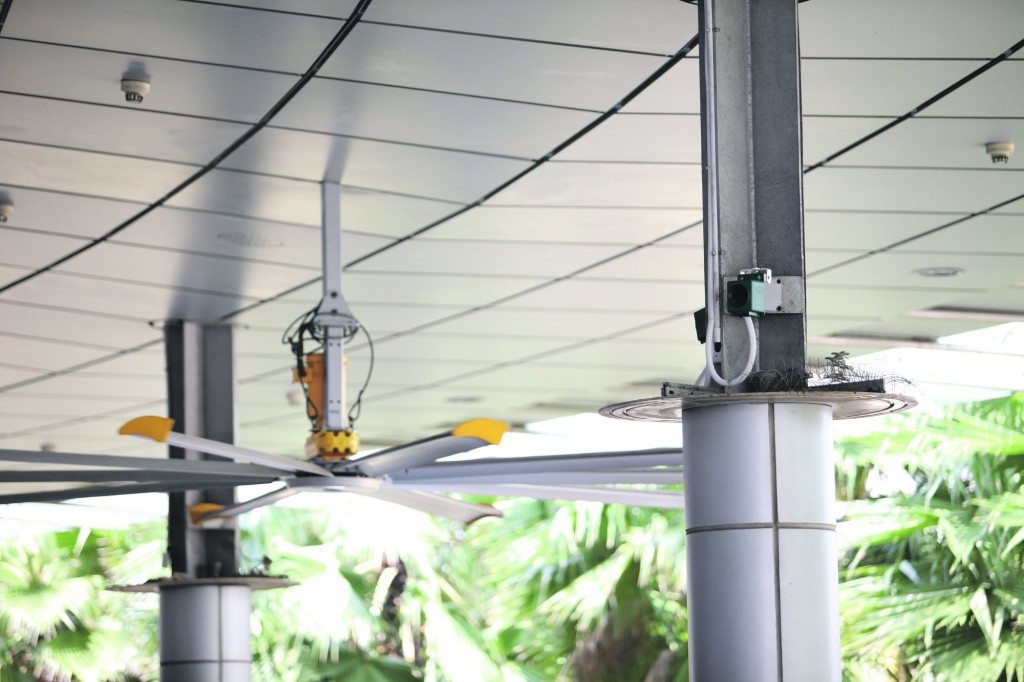
ANTI-BIRDS: Bird speakers installed in Koufu have managed to chase bird blues away.
PHOTO: LIM MU YAO
ODFM had previously added anti-bird spikes and installed cables on the ledge of tray return points in Canteen B to deter the birds. These initiatives failed to be completely effective, so the speakers were added to supplement them.
The new device has also benefitted Koufu.
Food court manager, Mr Paul Hoh, 50, said that the speakers have been effective in chasing birds away and making the jobs of cleaners easier as well.
But the effectiveness of the device in the long run remains to be seen. Mr Ong warns that there is “a possibility that the birds may get used to the sounds and this form of control may become ineffective”. He added that students have a part to play and urged them to return all crockery to tray return points after meals.
Leftover food, when not removed, will inevitably attract the birds back, he said.
If this device is deemed successful by ODFM, it may also be introduced to other open-air canteens around campus.


