


Previous Story
The ‘R’ Word
Posted On 03 Oct 2013
Comment: Off
A recent study revealed that four in 10 Singaporeans judge someone based on their skin colour even before getting to know them. But are such polls still relevant today, or are they merely reopening old wounds?
By Andrew Toh, Opinions Editor
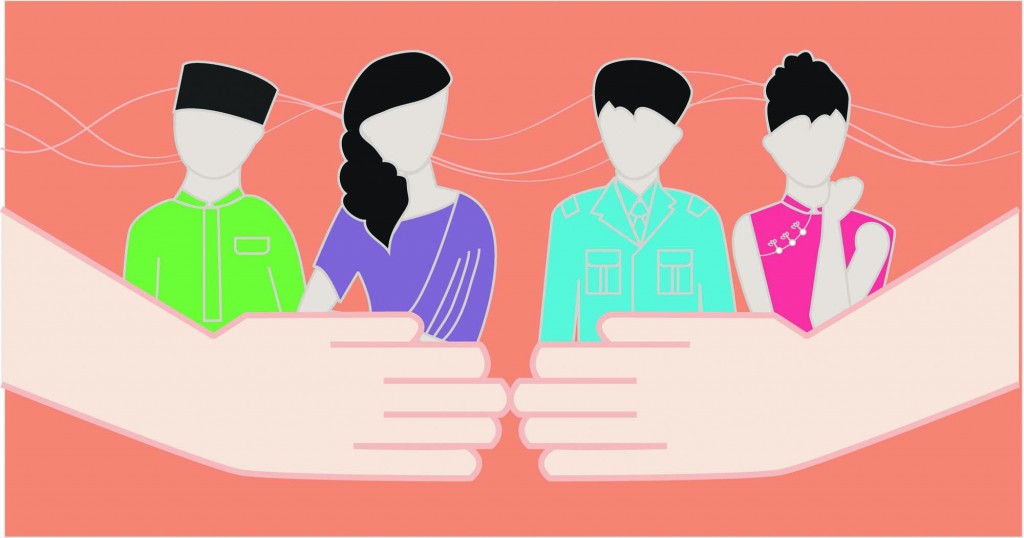
Graphic: Angelica Tan
A study conducted by the Institute of Policy Studies last week on racial diversity in Singapore produced some interesting results. Foremost was that at least four out of 10 Singaporeans tend to judge someone based on their race even before getting to know them.
Polls like this on race are conducted every few years in Singapore, with a similar poll done in 2007. They have the unfortunate effect of reminding us that Singapore might not be as racism-free as we think it is.
But are such polls still relevant in Singapore today?
By focusing on this issue and exposing our racial lines, these polls have the similar effect of continuously poking the scab on a healing wound. Perhaps we have to face up to the idea that no matter how hard we try to stamp out racism, it will always exist deep down within the human psyche.
It is not that we feel a natural urge to be hostile towards those of a different colour.
Racism boils down to a very fundamental aspect of the human mind: that we fear or are unable to take immediately to people who look different, or were raised in a different environment, from us.
In an article on Psychology Today, American Philosopher David Livingstone Smith called this a powerful illusion, whereby overall “visual stimuli” becomes the basis for assigning people to racial categories. Smith said that we have the tendency to judge people based on a few select traits, of which the primary trait is skin colour, instead of looking at the overall character of the individual.
This pre-conceived judgement by skin colour then becomes the basis by which we produce stereotypes that we use to judge all members of the same race.
If we take a look at another city halfway across the world that is very much like us, we would find the same thing happening.
New York City’s ‘Stop-and-frisk’ enforcement programme, whereby police officers are given permission to stop and search anyone on the streets they find suspicious, has been widely criticised as being biased against the city’s African Americans and Hispanics.
It was found that close to nine in 10 people stopped under the programme in 2011 and 2012 were either African Americans or Hispanics.
The official line on the ‘Stop-and-frisk’ programme has been to curb crime in the city, but that has not spared the racially diverse city from similar forms of racial profiling. If racial profiling could happen in a city as diverse and multicultural as New York City, and in a country that prides itself on providing ample opportunities for all regardless of race or nationality, then there is little that would shield Singapore from that trend.
To Singapore’s credit, policies have been in place to teach racial harmony and tolerance from a young age. And considering that we are the most multiracial country in the region, surrounded by neighbours with a relatively homogenous demographic such as Malaysia or Indonesia, I think we deserve a pat on the back for having come this far.
We emerged from a turbulent period in the 1960s when racial tensions were rife in our country. The Singapore we know of today is worlds apart from that one. Ultimately, what matters are our actions and not our intentions.
Yes, it might be true that we are closet racists, but if we consciously examine our beliefs and tell ourselves that there is no basis for such discrimination or unease, then we would already have won the war against racism.
Furthermore, if we look at Singapore society today, which one of us can claim to feel unsafe in the presence of friends of a different race?
Although racism might exist in Singapore, the extent of it is far from serious and does not translate into the violent, dangerous racism situations we see in other countries. A country in which racism does not exist at all might be impossible, but as long as we ensure that it does not cross over to the extent we see in other countries, then we can be assured that our country is safe.
Former United States President Abraham Lincoln once said: “We must not be enemies. Though passion may have strained, it must not break our bonds of affection.”
He went on to say that we cannot let the “better angels” of our nature be overcome by violence and untamed emotions.
Similarly, as long as we don’t let our raw emotions overcome our better judgement, then that’s what ultimately counts; such polls should not lead us to question the racial lines in our society.
Having come this far from the highly strained racial tensions of the past, it’s about time our ‘better angels’ laid this particular demon to rest.


