


Previous Story
NTU 5.0
Posted On 04 Nov 2013
Comment: Off
With the exciting developments currently taking place in NTU, such as the new learning hubs and the university’s focus on clean energy, Huang Caiwei imagines what the university might look like in 20 years.
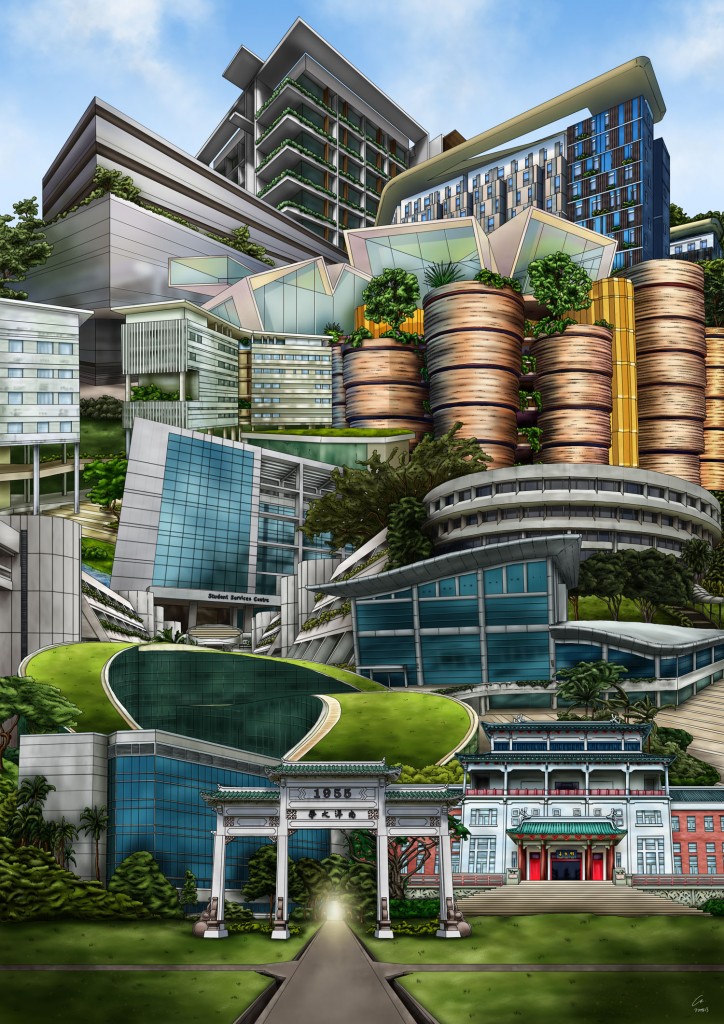
Graphic: Chin Li Zhi
The year is 2033.
College is no longer, as Mark Twain puts it, “a place where a professor’s lecture notes go straight to the students’ lecture notes, without passing through the brains of either”.
NTU is now among the first universities in the world to wed its education with the advancement of social good. In an age where technological innovation is of the essence, NTU has realised its importance in civic society.
The more powerful our grasp on technology, the more we need to ask: “To what end?” Historians have established centuries ago that science and technology are never value-neutral — they can be used to harm others or to serve the needs of society.
Today, NTU’s education system adopts a focus on innovation, as well as on its relation to ethics and society. Indeed, technology has always existed to benefit society. Thus, what the new curriculum seeks to do is to scale up such efforts and cultivate a moral awareness of science.
For instance, this is done by educating students not only on the theories of science, but also on its utility and practical implications. The university understands that when the goal is to change Singapore, the university must not engender a learned helplessness but instead create a sense of empowerment.
Towering “farmscrapers” now dominate the NTU landscape. First designed by Belgian architect Vincent Callebaut, these are classrooms, offices and canteens that have been integrated and stacked into one gorgeous skyscraper. These farmscrapers, with their translucent glass dorms and indoor planetaries, are not only architectural feats but also exemplars of clean energy building design.
The scrapers give testament to how the school has managed to achieve one of its five peaks of excellence: Sustainable Earth. Through intensive research, the school has finally come up with ways to ease off its reliance on coal energy
Groundbreaking innovations in solar technology, that has improved the energy carrying capacity of solar cells by 60 per cent, now allows the sleek solar panels on each scraper’s facade to provide fully for the building’s energy needs.
A separate revolution has also taken place in the classrooms.
Lectures are now redundant due to the increasing popularity of massive open online courses (MOOCs). Whilst it might have seemed unlikely two decades ago that online courses would grow in popularity, eight out of 10 of the world’s universities have jumped onto the MOOC bandwagon.
The digital sphere is now used as the optimal medium to teach difficult concepts. But that has not spelt the end of student-professor interactions. Although lectures are no longer held, students are still expected to come for tutorials where they can discuss concepts and clear any confusion they might have with the professor.
There are cross-disciplinary projects between the different faculties, facilitated by the building of the learning hub two decades ago. This was also made possible through changes in the school curriculum, which placed students from across faculties into the same classes, and gave them simulations of important real-world problems to solve.
Technology has also been used to solve bus congestion problems in the school. Irregular bus timings and crowded bus stops are now a thing of the past. Driverless, solar-powered shuttle buses that run on fixed intervals of five minutes transport the students, faculty and staff to and fro around the school.
These changes are the result of the revolution in 2021. The old system, a long outmoded legacy of the Industrial Revolution, was rendered obsolete in the 22nd century, to be replaced by the Information Revolution.
Educational leaders thus sought to push the benchmark of achievement, giving creativity the same importance as literacy. Our education system was restructured to focus on diversity and dynamism.
It is a modern utopia that the school would only have dreamed of 20 years ago. NTU students are now at the forefront of the education curve, armed with the creativity and initiative that the school has taken years to cultivate.
The future of education continues to look bright. If so much could be achieved in 20 years, who knows what more could be done in another 20.


