


Previous Story
Why care about Crimea?
Posted On 31 Mar 2014
Comment: Off
The recent and rapid developments in Crimea, Ukraine may be confusing. Opinions Writer Rachel Gong outlines the various developments and main concerns revolving around the crisis.
By Rachel Gong
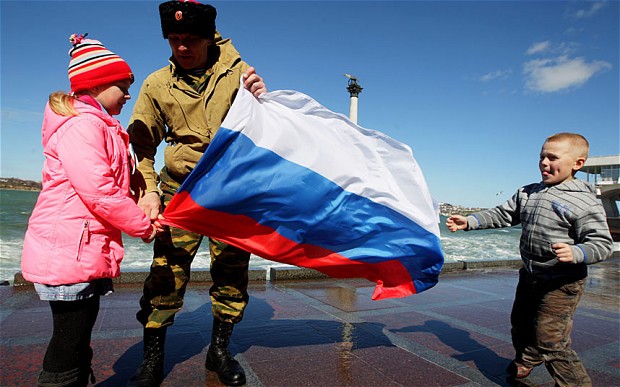
PHOTO: THE TELEGRAPH
Troops in Russian camouflage kits attacked a military base in Simferopol, the capital of Crimea on Tuesday, 18 Mar. Firing automatic weapons in the air, these masked men killed one Ukrainian officer in the chaos. This was the first deadly conflict since hundreds of pro-Russian troops invaded and took over two airports in Crimea on 1 Mar.
The very next day, Russian forces promptly took over Ukraine’s naval headquarters in Sevastopol city, located on the Black Sea coast of the Crimean peninsula, consolidating their control of the Black Sea peninsula.
Initially, NTU’s Assistant Professor Kei Koga, from the Division of Public Policy and Government Affairs in the School of Humanities and Social Studies, said that because of the “shooting on Tuesday (18 Mar), political and military tug-of-war would be expected in the next few weeks”.
However, Russia had successfully taken over Crimea in just two days with little bloodshed, teaching the world a painful lesson about the importance of building a united country.
In fact, at a press conference on 26 Mar in Luxembourg, Singapore Prime Minister Lee Hsien Loong talked about how the situation in Crimea is a stark reminder of the importance for small countries like Singapore, which are surrounded by more powerful neighbours, to build up military capabilities to defend itself against potential acts of aggression.
The crisis was set in motion on Sunday, 16 Mar, when a referendum on the status of Crimea was held by the legislature of Crimea. It sought to find out if Crimeans approved of joining Russia or if they wanted to return to the 1992 Constitution that made Crimea an independent entity within Ukraine, free to chart its own course and build relationships with countries such as Russia. Either option will lead to the inevitable separation of Crimea from Ukraine.
The referendum results revealed that an overwhelming majority of about 97% of the people in Crimea approved of the annexation of the region to Russia.
National correspondent William Saletan from US-based online current affairs and culture magazine Slate, commented that “Russia’s 90-plus per cent victory in Crimea tells you the referendum was a joke.”.
This landslide victory is unanticipated, given the fact that only 60 per cent of the Crimean population see themselves as ethnic Russians and the remaining, who are ethnically Ukrainian or Tatar, are known to oppose the reunification of Russia and Crimea.
Andrey Illarionov, former economic policy adviser to the Russian Government said that the figure supporting the reunification of Crimea and Russia is closer to 34 per cent. He recently published a study showing that “support for joining Russia has varied between 23 and 41 per cent since 2011”.
The disputable 97 per cent support for Crimea joining Russia might be due to the fact that retaining the status quo, which gives Crimea only limited autonomy from the central government in Kiev, the capital of Ukraine, was not an option in the ballot. This led to many Crimean Tatars boycotting the referendum.
Still, the results from this highly controversial, yet strategic ballot, gave Russian President Vladmir Putin the confidence to sign a treaty of succession with Crimean leaders in the Kremlin on 18 Mar, making Crimea and the city of Sevastopol the 84th and 85th regions of the Russian Federation.
The way Putin sees it, a majority of the Crimeans want to be part of Russia and any effort to stop this reunification can and will be seen as a violation of the Crimeans’ right to self-determination, which is entrenched in the United Nations (UN) Charter, a UN treaty.
However, this move on Crimea, according to UN Secretary-General Ban Ki-moon, violates the 1994 Budapest Memorandum — in which Russia guarantees Ukraine’s sovereign in exchange for Ukraine giving up Crimea, which was then the world’s third-largest nuclear arsenal.
The United States (US) has also been firm in its condemnation of Russia’s actions, with Vice President Joseph Biden describing it as “nothing more than a land grab”.
Yet, there may be a tinge of hypocrisy to this claim.
Jeffrey Tayler, a contributing editor at the Atlantic Monthly, commented in a Foreign Policy article that the US has taken “numerous aggressive steps since the end of the Cold War to reduce Russia’s influence…” and that it “is bent on maintaining and increasing its hegemony — at Russia’s expense”.
To this end, Asst Prof Kei Koga said that if the US does not successfully thwart Russia’s annexation, it may be taken as a decline in US hegemony. If this is the case, the annexation can have strategic implications in other regions, possibly influencing behaviors of emerging superpowers such as China.
On Monday, 17 Mar, US President Barack Obama signed a new executive order, imposing limited travel and financial restrictions against 11 Putin loyalists responsible for “undermining the sovereignty, territorial integrity and government of Ukraine”.
However, these sanctions have had little effect on dampening Russia’s stride, with Putin announcing Crimea’s annexation in his address to the Federation Council in the Kremlin on 18 Mar. Putin’s nonchalant attitude has fuelled fears that he could have his eye on eastern Ukraine as well, and that the annexation of Crimea is just the start of a situation that may possibly evolve into the second Cold War.
Russia’s non-violent acquisition of Crimea, and possibly eastern Ukraine, is history in the making, creating a sticky situation for the rest of the superpowers. Unless Russia turns violent, the US cannot utilise military threats to stop Putin in his tracks. Instead, the US would have to rely on much less effective diplomatic measures such as the imposition of trade and travel sanctions.
But words and treaties can only bring us so far, as seen from Putin’s blatant disregard of the 1994 Budapest Memorandum that protects Ukraine’s sovereignty from Russian advances.


