


Previous Story
We Are Young
Posted On 23 Apr 2014
Comment: Off
The Syrian Crisis has entered its third year of violence, protests and casualties. It may be seen as a youth revolution — not only was it sparked by teenagers, Syrian youths actively participated in the subsequent protests. In this article, Syrian youth activist, Zahed (not his real name), shares his personal story of youth activism, and Swedish exchange student in NTU, Rasmus Rodineliussen, recounts how the crisis in Syria connected their separate lives.
By Zahed & Rusmus Rodineliussen
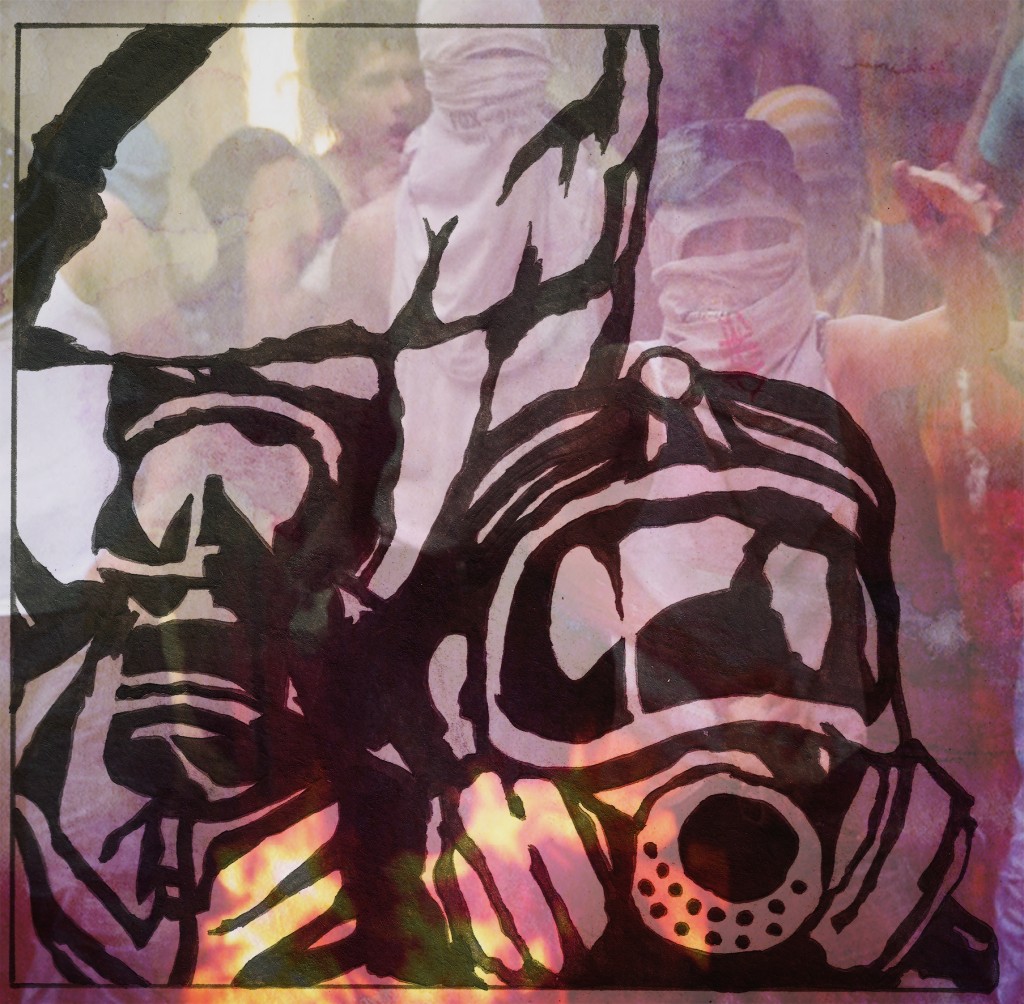
GRAPHIC: JONAS YEO
The Story of Zahed
My name is Zahed and I am doing my second master’s degree in a highly-ranked university in Sweden. I regard this as quite an achievement, especially if you consider where I come from.
I’m from Syria, a country that has experienced a lot of violence. A few years ago, I fled my country without anything, not even my family. I left for my personal safety. It was no longer possible for me to stay in Syria if I wanted to be alive and free.
In Sweden, my peers and I are able to enjoy a peaceful environment that gives us opportunities to indulge in our desire to study — something that I wish for my friends back home. Though I am in Sweden, far away from Syria, I am still concerned with their struggle against the regime.
My story unwinds in war-wrecked Syria, which has been under the control of the Assad regime since the 1970s. There had been no opposition until the revolution burst out in March 2011, because the regime came down on those who dared to question it.
On a fateful day three years ago, a group of 13 and 14-year-old children wrote on the wall in their school in the southern city of Daraa, Syria: “People want to topple the regime”. As a result, the children and their families were arrested by the regime forces and brutally tortured.
When the Syrians heard about this, it led to demonstrations against the regime. They continued their protests even though the regime tried to stop them by killing demonstrators every day.
The death toll as of 1 Apr has surpassed 150,000, according to the Syrian Observatory for Human Rights, a human rights group based in the United Kingdom. They estimate that half the casualties are civilians and almost 8,000 are children.
But the more people were killed by the regime, the more people took to the streets.
Back then, I was a university student and had joined the protesters. For many outside Syria, it is difficult to understand that participating is not about fear. The fear was something that we left behind at home before participating in our first demonstration. Our hopes for freedom were stronger than our fears.
We knew that the regime would not listen to our voices. We knew that there was a high possibility of being killed or arrested. We did not demonstrate to get killed.
These demonstrations were for the sake of our brothers and families. We wanted the freedom that we had dreamed about for a long time. Finally, we overtly opposed the regime and did what we could to change the future of our country.
The protests were also directed towards the rest of the world, who, while claiming to promote democracy and human rights, did not challenge the regime.
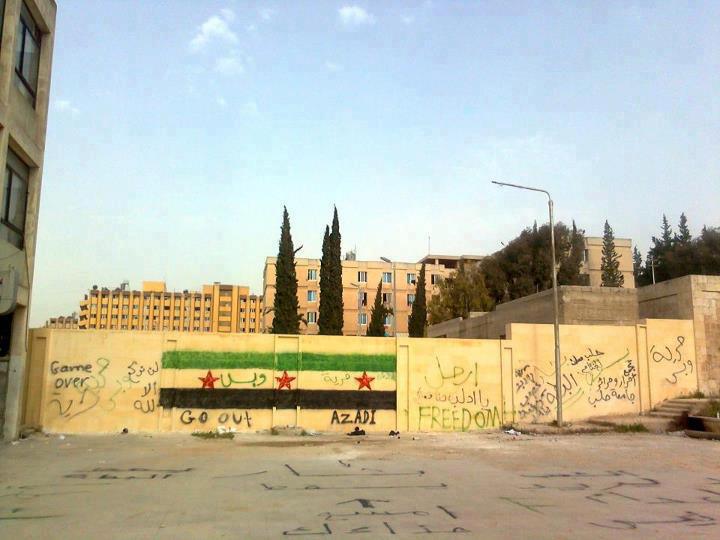
NAZI WALL: This wall in Syria separates student dormitories from a university campus. The Syrian government built the wall to prevent students from escaping to their dormitories after the demonstrations. We call it the Nazi Wall.
PHOTO: ZAHED
When you see your friends injured and dying between your arms, or when your friends are arrested and then thrown dead or barely alive in front of you the next day, you will not feel fear, you will feel anger. Not only did I have the desire to continue participating in the revolution against the regime, I was also motivated by the need to avenge my friends’ deaths.
I come from the town of Aleppo in northern Syria, where the regime has been very effective in silencing the opposition, as they have arrested most of the protesters there. But we, as university students, could use technology and science to spread the revolution. When we planned a demonstration, we did it in detail in order to minimise the number of martyrs and arrests. We kept in contact with one another in many different ways, mainly using social media. We used Facebook and Skype with fake accounts to organise our actions and to avoid being tracked by the regime. I myself had accounts with different names.
As the violence from the regime escalated, we became their targets. Learning how to construct missiles, bombs, automatic snipers and even tanks became our only way of survival.
We covered all grounds — there were even groups in charge of evacuating the injured, setting up secret field hospitals and arranging escapes for those who got arrested.
The social media group was the most important — it would film the demonstrations and distribute the films to international media agencies to provide the world with information about how the regime treats its citizens.
For us, this revolution meant everything. We put all we had into it. It was either victory or more repression and torture in the future for us and our families. We were willing to sacrifice everything, including our lives, to change our future.
Sadly, I have now left Syria as the regime had become too strong and we could no longer fight. By the time I left, there was no liberated area of Aleppo and a lot of activists had to hide or move out for their safety.
Nevertheless, I am still connected with the struggle via social media. I believe there is a long way to go before Syria becomes the home that a large part of the Syrian population and I are fighting for.
I had to choose between imprisonment or leaving the country. It was not an easy decision. But I believed that I could still help my friends from abroad. Thus, I left my homeland and came to Sweden. And that is where I got to know Rasmus.
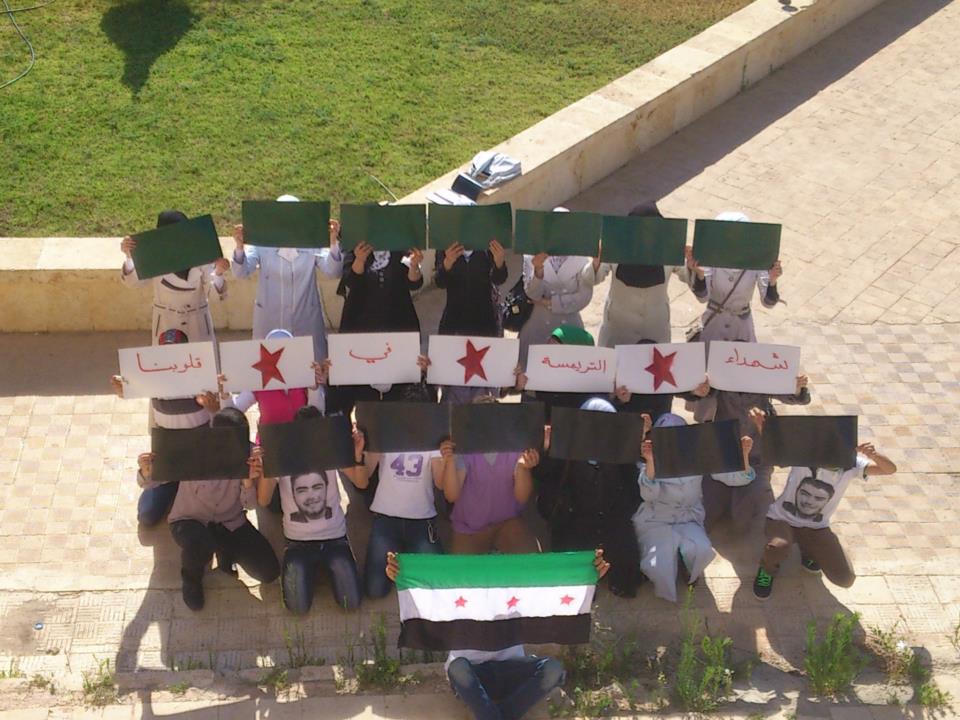
STUDENT PROTEST: This is a silent protest that took place on a Syrian university campus. The picture shows students holding placards depicting the Syrian flag. some of the protesters are wearing shirts with a picture of the latest martyr who was killed in an earlier demonstration.
PHOTO: ZAHED
The Story of Rasmus
My name is Rasmus Rodineliussen and I come from Sweden. It is a welfare state in Northern Europe that has given me many opportunities in life.
I am currently an exchange student in NTU, taking undergraduate courses in sociology and politics. I came to Singapore to gain different cultural experiences and a world-class education.
With me is my wife, who is also an exchange student at NTU, and our two-year-old daughter.
As a father and husband, I am very grateful for these opportunities — to be able to see my family thrive in a peaceful environment, and to be able to travel and see the world.
I met Zahed through mutual university friends in Sweden and during my encounter with him, the thought of how lucky my life is grew even stronger. This is after I learnt, firsthand, what reality could have been for my family and me, were I to be born in a country ruled by an authoritarian regime and wrought by violent demonstrations.
Zahed was a university student and a protester in Syria, one of the world’s most violent countries. This must have been a very hard reality to live in. It’s almost impossible for me to imagine Syria’s circumstances, as it is very safe and calm in Sweden.
Zahed is a quiet and polite person, but behind this facade is a man of steel. This is something you realise only after getting to know him, and after talking to him about his home and his experiences. When you hear his story you come to value the mundane experiences in everyday life that we tend to take for granted.
For instance, Zahed and I have different purposes in using social media. To me, Facebook is a place to share pictures and moments of my life with family and friends. But for Zahed and the other students of Aleppo, Facebook had a totally different meaning. It was one of their most important tools against the regime. While it is just a platform for me to connect with my friends and family, for Zahed and his friends, social media was a weapon.
My encounter with Zahed also opened my eyes to see another way in which students can participate in university. Even though Zahed and I had such different life experiences, we were able to establish a friendship where we are able to learn from each other about what it means to be a student in a different part of the world.
Before, I only thought of student participation in the form of campus organisations that competed over particular views and issues, and I found it rather silly. But when I heard Zahed’s story, I realised that student organisations are so much more, as they are also a way of keeping the intellectual youth active together.
Zahed’s story has led me to question the world that we live in. How is it that some individuals live in such hard and dangerous circumstances while me and the rest of the Swedish population do not need to worry about anything other than fulfilling our materialistic dreams?
It is here that my interest in social anthropology, the qualitative study of human culture and society, comes in. I want to use my academic skills in order to find the reasons for some of the world’s hardships, and by doing so, highlight them and propose ways to improve the situations in which individuals live.
One example close to mind is Batam, an Indonesian island located only 20 kilometres off the shores of Singapore. One of my professors in Sweden, Johan Lindquist, researched on how the lure of economic growth and fast cash made thousands of low-income workers go to Batam, only to end up stuck with big loans, no work and no chance of returning home without shame. They were, as the locals called it, malu (ashamed) to go home.
The situation in Batam has not improved as a result of this research, but the fact that their fates were examined and cast into the spotlight might, in the long run, prevent others countries from slipping into a similar fate.
And it is in this way that I believe my studies in sociology and comparative politics in Asia can help to create a better world. Next January, I am planning to conduct fieldwork in the region.
It is by taking the object of study’s point of view that we can understand why and how they got into the situation that they are in. And the best way to get this knowledge is by participant observation; through one of the methods of social anthropology.
My time here in NTU has given me the opportunity to better understand Southeast Asian society. It is important to me that I have a wide understanding of different parts of the world, to maximise what I can learn in my subject and to expand my goals for future research back in Sweden.
Thousands of Syrians have gone to Sweden since the civil war in Syria started, because Sweden has granted all Syrian refugees permanent residency as of October last year. Many of them are students like Zahed.
This is where my quest for a better understanding of other cultures becomes particularly important — the role of local Swedish students might be to help Syrian refugees adjust to the intricate ways of Swedish life and to help them accommodate to the foreign landscape; much like providing them with a safety net. Thus, Zahed and I believe that any participation to change the world for the better is important.
The important thing to remember is: What am I doing, why am I doing it, and who I am doing it for?


