


Previous Story
Je suis tired
Posted On 12 Jan 2015
Comment: Off
As France tries to get back on its feet following its worst terror-related violence in years, we need to question if freedom of speech is indeed worth its price in blood.
By Nazri Eddy Razali
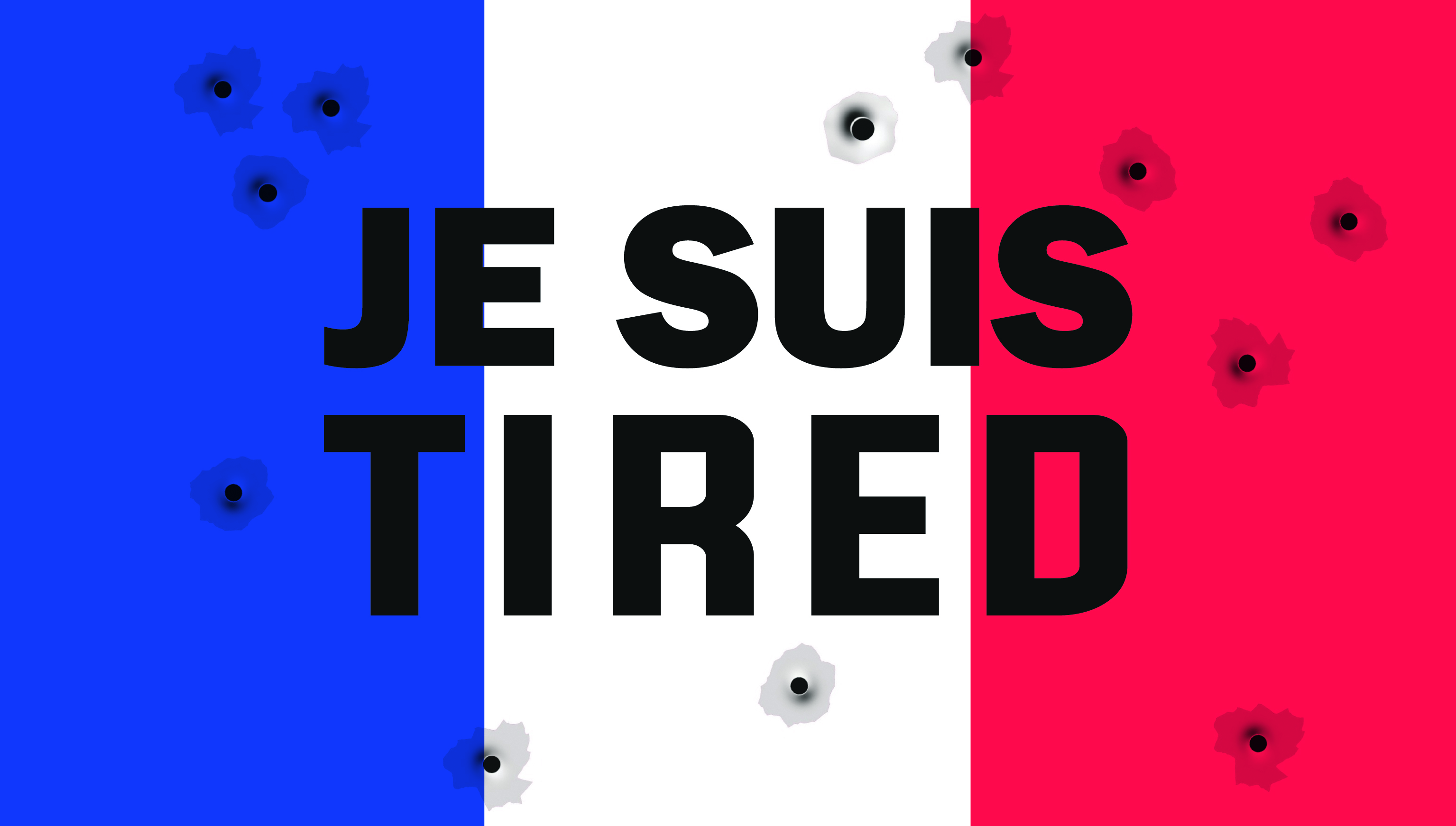
WORDS AGAINST WEAPONS: “I am tired” (translation).
GRAPHIC: KIMBERLY ANG
The scimitar and pencil stand poised, facing each other. A few flourishes later, the pencil lies diced and defeated. After all, how could wood and lead ever hope to challenge the might of steel, fashioned to kill?
The scimitar’s victory is short-lived however; each fragment of the fallen pencil defiantly respawns as individual pencils in their own right, ready to face the tyranny of the scimitar again.
So it goes in the cartoon drawn by The Straits Times’ cartoonist, Miel Prudencio Ma, in response to the terror attack on the French satirical publication Charlie Hebdo by three gunmen.
The attack, which took place on 7 Jan, left 12 people dead, including the publication’s editor, Stéphane Charbonnier.
The trigger for the unfortunate turn of events appears to have been the Parisian publication’s insistence on republishing a 2005 Danish cartoon that satirised the Prophet Muhammad, while creating another of their own despite having previously faced violent threats from Muslim extremists.
And it’s not the first time Charlie Hebdo has been a victim of terror attacks. As recently as 2011, their office was firebombed as a result of publishing a special issue containing content that mocked the Islamic faith.
At that time, Charlie Hebdo remained unfazed. Such was their will to defend their freedom of expression that Charbonnier famously said, “I’d rather die standing up than live on my knees.”
As soon as news of the shooting broke, condemnations of the attack came swiftly. Author, Salman Rushdie, whose own book The Satanic Verses resulted in him experiencing death threats, led the charge. “I stand with Charlie Hebdo, as we all must, to defend the art of satire, which has always been a force for liberty and against tyranny, dishonesty and stupidity,” he said.
Around the world, silent vigils were held outside French embassies. Aside from lighting candles, placards with the words ‘Je suis Charlie’, which is French for ‘I am Charlie’, were also carried by crowds as a sign of solidarity with the victims.
Even the Muslim world was quick to distance itself from the attack, with Saudi Arabia calling it a “cowardly terrorist attack that was rejected by the true Islamic religion”.
And while the world still reels from the attack, the question of whether freedom of expression is really worth one’s own life is most definitely worth pondering upon.
Freedom through speech
The ability to speak one’s mind has always been paramount in a liberally inclined country such as France. After all, how can other freedoms be protected if its expressions are stunted by communicative limitations?
The art of satire is largely built upon such a spirit. Through the use of humour, wit, and ridicule, satire aims to highlight the shortcomings of its subject matters to the public, albeit without being overtly confrontational.
However, this can only work if the subject abides by the sensibilities of the satirists, and is willing to accept the criticism.
This is clearly not the case in the Charlie Hebdo attack. The Muslim extremists’ stance was clear from the very beginning: do not publish the comics, or face the consequences.
Charlie Hebdo saw pandering to the demands of the extremists as a sign of defeat and a compromise of their freedom of speech, and they published the comics anyway.
It has become clear that many also feel the same way. One of the popular ways through which solidarity has been shown for the victims of the attack is through the reposting of the contentious comics on social media.
This act of defiance serves to show that the people would rather choose to assert their freedom and brave the consequences rather than to have their liberties curtailed by the spectre of extremists.
The other side of the coin
The primary reason for the terrorists’ rage towards Charlie Hebdo was due to what has been perceived as flagrant disrespect for Islamic customs. In Islam, the depiction of the Prophet Muhammad is forbidden as it encourages idolatry.
While there can never be a reason strong enough to justify the unlawful killing of another human being, it cannot be denied that the publication of such images has served to marginalise the Muslim community in France, both radical and otherwise.
The irony here is all too glaring — in Charlie Hebdo’s attempt to defend its freedom of expression, the freedom of others to feel respected has been infringed on.
As if the guilt of being associated with the errant few is not enough, the phenomenon of “moderate” Muslims having to denounce these acts of terror highlights their fear of being judged because they share the same religion as these Muslim extremists. Some Muslim individuals have taken to social media to denounce the actions of the gunmen, using the hashtag #notinmyname to emphasise that the gunmen’s actions were not representative of the whole Islamic faith.
It should be simple enough for others to comprehend that the actions of a very small minority can hardly be representative of a religion spanning 23 per cent of the global population. The majority shouldn’t need to feel ashamed for the few.
And now, the Muslim community is expected to also stand and watch as the images depicting their Prophet go viral, all in the name of making a political statement against those who misrepresented their religion to begin with.
In our rush to condemn the atrocities committed by the few, it is easy to forget that hate can still implicitly be felt by the majority of Muslims.
Charlie Hebdo will be releasing a million copies for their upcoming issue which will be published this week, as opposed to their usual 60,000 copies. One of its columnists, Patrick Pelloux, said the decision will show that “stupidity will not win”.
Fighting stupidity is all well and good, but let us not forget that humans not only think, but feel too.


