
Previous Story
Exchange student woes
Posted On 02 Feb 2015
Comment: Off
Lack of hall space, cultural barriers top the list of issues faced by exchange students in NTU
By Saranya Mahendran, Tan Yuan Ting
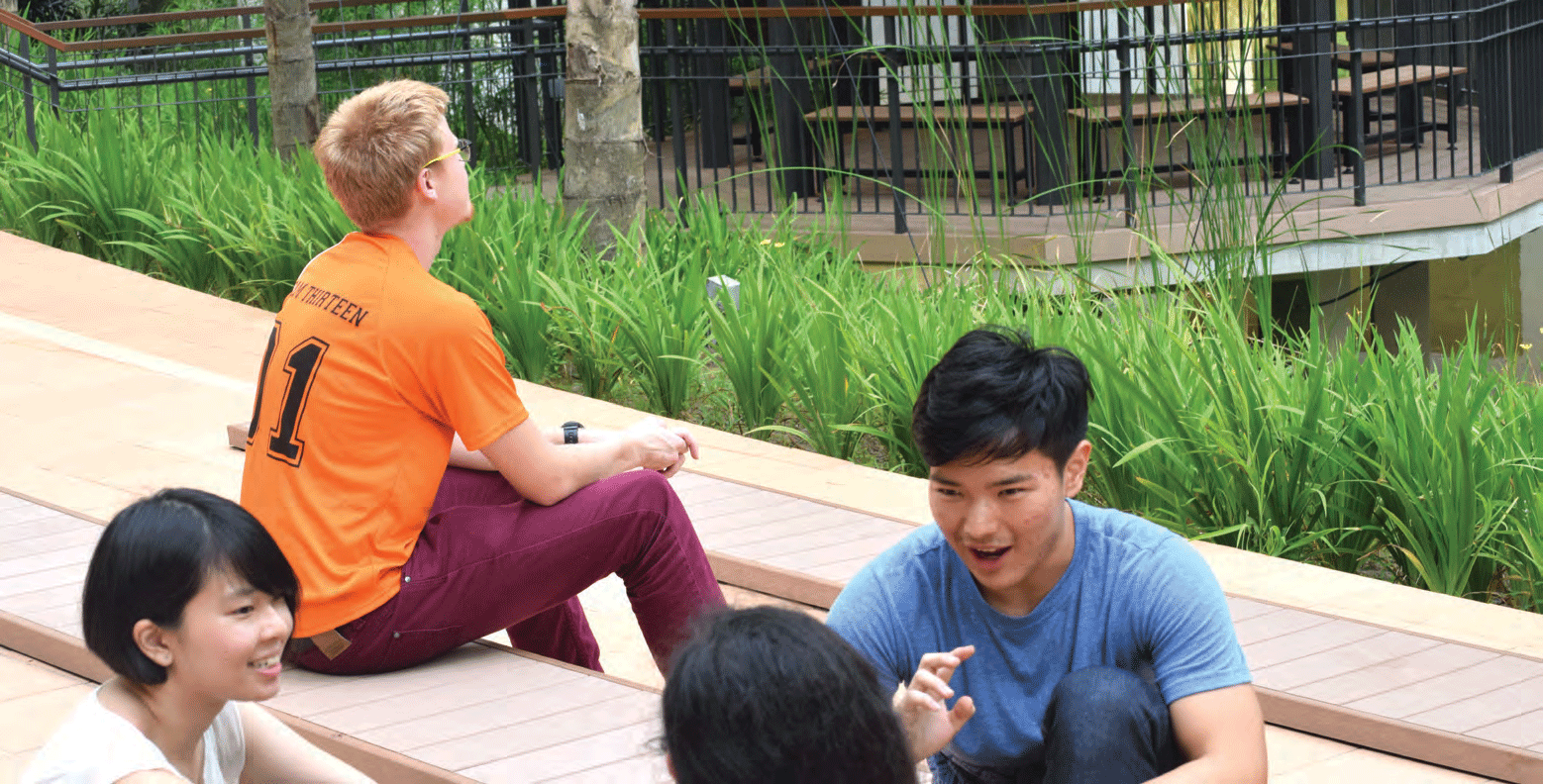
THE GREAT DIVIDE: Many exchange students say they feel ostracised when forming project groups, as local students tend to assume they will not work as hard. (PHOTO ILLUSTRATION: S. GOWRI)
Life on an exchange programme for many foreign students in NTU has not been as smooth-sailing as they expected, with the uncertainty of and difficulty in getting accommodation in a Hall of Residence being the biggest concern.
Last semester, about 70 per cent of 840 exchange students were not allocated a room, leaving them to pay exorbitant amounts to secure accommodation elsewhere in Singapore.
In an official email to exchange students last May, staff from Global Exploration and Mobility (GEM) Trailblazer, an exchange programme by NTU, warned exchange students about the low success rate of getting a place in hall.
The email said that only 30 per cent of incoming exchange students would be allocated on-campus housing “due to the housing crunch”.
Johanna Lim, a third-year exchange student from Scotland’s Strathclyde Business School who currently resides in Hall of Residence 12, found this to be very unfair.
“There are a lot of exchange students who can’t afford living outside campus because the rent is so expensive,” she said.
Students living on campus can expect to pay from $225 to $375 per month, while students living off-campus will have to pay $500 to $1,200 for accommodation per month, according to the GEM Trailblazer website.
The allocation of hall places is subject to availability and takes place through a random balloting system. The Nanyang Chronicle understands that a system is in place to ensure a fair number of local and exchange students get rooms in hall.
Other factors that contribute to the lack of accommodation in halls are the rooms set aside for other groups of students, including all freshmen and those under NTU’s scholarship programmes.
In an email interview, Professor Er Meng Hwa, Vice President for NTU’s Office of International Affairs, said: “This (lack of housing for exchange students) is not unusual because similarly, not all of our NTU students on overseas exchange programme are guaranteed on-campus housing in our partner universities.
“As we build more halls in the future, we would be able to accommodate more exchange students on campus.”
However, Lim thinks otherwise, stating that all exchange students in her home university have priority to dormitories.
She further added: “In NTU, there are a lot of local students who go home during the weekend and I don’t think they should get the (hall) room.”
The 21-year-old said that the hall rooms could be better allocated as she understands that a number of local students using their rooms only during the exam season.
Allocation anxieties
Compounding the issue, exchange students who are successful in their hall applications are only guaranteed one semester of residency. In contrast, local students get a full year.
Kristian Reed, on a year-long exchange in NTU, joined Hall 13’s Junior Common Room Committee (JCRC) believing that he would be guaranteed a second semester of stay in said hall he was assigned to. Local students in JCRC stand a good chance of being on the recommended list, better known as the rec-list, granting them a place in the same hall the following year.
Reed, now the Recreational Secretary of Hall 13, learnt in an email from the Office of Housing and Auxiliary Services (HAS) that this was not the case for exchange students.
The email said that exchange students were allocated halls by random selection each semester, “so as to give all exchange students (both existing and incoming) equal chances to be considered for on-campus housing”.
HAS also added that the involvement of exchange students in hall activities “would not increase their likelihood of getting rooms for the following semester”, as opposed to local students who would have higher chances of getting one.
Reed, a third-year student from the Norwegian University of Science and Technology, said: “Despite organising the Inter-Hall Recreational Games — working ten hours a day for the past two months — HAS said (they) cannot guarantee (me) a hall, regardless of my position.
“Luckily for me, I did get into the hall (in Semester 2). I understand that if they (HAS) could choose, they would provide halls to everyone, but they have the housing crunch.”
Breaching boundaries
Despite crossing international boundaries, some exchange students still face social barriers.
Lim felt that local students here do not mix as much with exchange students, in contrast with the situation in her home country, Scotland.
“In the first semester, I had two tutorials and basically I was on my own. In Scotland, full-time students are more willing to talk to exchange students, so they are more likely to mix around,” she said.
Some felt that the university should work on notifying exchange students about social events such as orientation camps.
Oliver Jeffers, 20, a third-year student from the Hull University Business School, England, said: “No one made me aware that exchange students were allowed to join. Not much information was given about anything.”
An exchange student from the University of Wollongong, who only wanted to be known as Jenny, knew about orientation camps and applied to join her hall’s freshman orientation camp, only to be rejected.
“At the beginning of the semester, I asked both my hall office and International Student Centre (ISC) about joining orientation activities as I was keen to meet local students and learn more about NTU.
“However, I was told that I was not allowed to join in as they were ‘for real NTU students only’,” she said.
In an attempt to bridge the gap between local and international students, the ISC organises various activities and events.
Prof Er said: “These activities,which include coffee sessions and luncheons, are open to all NTU stu- dents. So far, these have been well- attended by a good mix of local and international students.”
ISC regularly emails students to invite them to these luncheons and other events.
Not all fun and games
In NTU, it is common to see local students shy away from forming project groups with exchange students as some have the assumption that exchange students will not work as hard.
Grace Tan, 22, a second-year student from the School of Physical and Mathematical Sciences (SPMS) admitted that she would not risk working with exchange students.
“It really depends on the person. But if I have a choice, I would not take them as groupmates, because I think they may not be willing to work as hard as local students, as some of their modules are (graded) pass/fail.”
Gabriel Tan, 22, a second-year student from SPMS, said that the tendency for exchange students to travel out of Singapore plays a part.
He said: “It’s tough because exchange student may not be around that often due to travel plans but they are able to inject creativity and new perspectives which Singaporeans sometimes lack.”
Mr Jimmy Yap, a part-time lecturer from the Wee Kim Wee School of Communication and Information, shared his perspective as a faculty member who has taught exchange students.
“I rarely had exchange students who put in zero effort. Most of the time I find that exchange students work as hard as the other students.”
However, he agreed that the work ethic differs from student to student.
“There are certainly some ex- change students who come and try to do as little work as possible. They’re here just to escape the northern winter, soak in the sun and go on holidays to Krabi or Phuket. But even then, they are still putting in effort in class.”
Andrew Amaladass, 23, a third-year student from the School of Biological Sciences, shared a similar view.
Amaladass said: “I think it is a misconception that exchange students are not working hard. School is more than grades and the content you learn. It’s about the life skills you acquire along the way.
“Working with international students gives you new perspectives and ideas you may not have thought of, and personally, it is always nice to make new friends from other countries.”


