


Previous Story
Addressing the Dress
Posted On 17 Mar 2015
Comment: Off
By Shalom Chalson
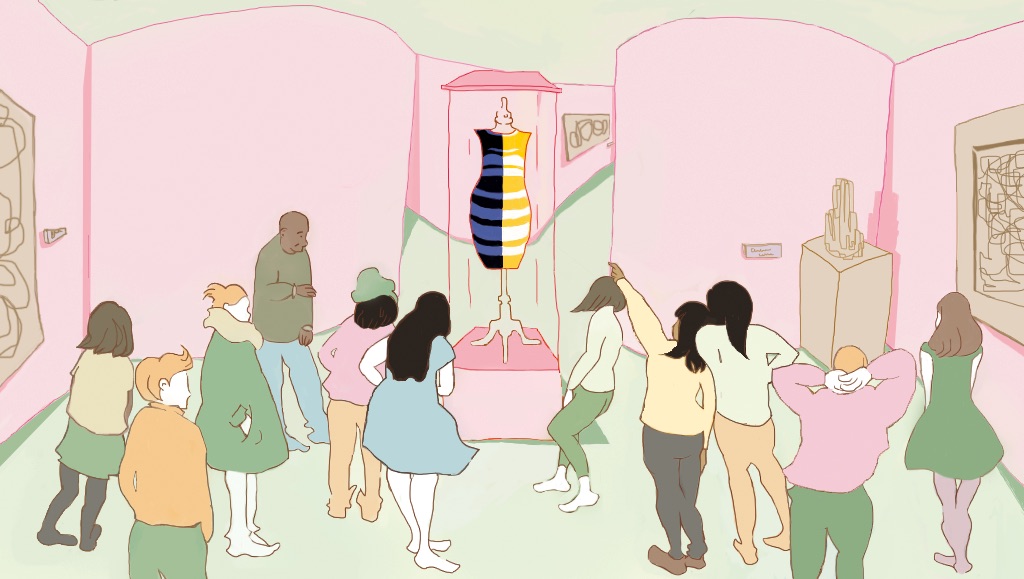
#DRESSGATE: Do you see the dress as blue and black, or white and gold? (GRAPHIC: JOLENE TAN)
Chances are that by now you would have heard of The Dress.
The online phenomenon has become a mark of divergence in society. As the photo of a cocktail dress made its rounds on the Internet, most who saw it were split into two camps.
It started when Caitlin McNeill asked followers of her Tumblr page to help ascertain the colour of a dress. Things escalated quickly and the responses she received came from the entire Internet instead.
A colourful debate ensued.
Some viewed the dress as white and gold while others saw it as blue and black. In complete irony of the inconsequential conflict, many netizens wound up in serious disagreement.
In a Facebook poll by the Nanyang Chronicle, 57.1 per cent of our online readers saw the dress as white and gold. 21.4 per cent saw it as blue and black, and the remaining percentage saw various combinations of the four colours.
The explosion of opinion from the online community centres around the surprise that one’s perception of an image could differ vastly from another.
Variation in experience is not a new phenomenon. Philosopher Thomas Nagel refers to it as the “subjective character of experience” in his influential paper — What Is It Like to Be a Bat?
Nagel argues that while we can imagine what it might be like to be a bat, we ultimately cannot escape our own subjective experience to understand what it is to be one. In other words, a conscious observation of the material world by an organism, be it a bat, a dog or a human being, will always be rooted in the subjective lens of a specific living thing.
This concept of subjective experience can be extended to understand how human experiences vary.
An individual’s experiences are said to stem from a single point of view — their own. Considering that a person’s viewpoint is shaped by his or her unique history, present circumstance and sensory faculties, each person’s resulting perception is bound to differ from another, however slightly.
Considering the vehement commitment to ‘white and gold’ or ‘blue and black’ by either side of the debate, many find such an idea difficult to contend with. Some even find it necessary to label the other perspective of the dress as wrong and claim their own to be correct.
Development in many disciplines of knowledge, such as science and technology, builds on information that is empirically tested and widely accepted to be true. For instance, the established normal boiling point of water played a role in the development of steam turbines. Due to the extent to which the certainty of facts is relied on in the world, from car engines to photosynthesis, it is only natural for certainty to pervade our individual perceptions too.
But absolute certainty, even in science, is impossible. Claudius Ptolemy’s geocentric concept of our universe was once widely accepted, but this has since been replaced by the model of a Sun-centred solar system after the Copernican Revolution. Likewise, philosophers have been arguing about perception for centuries and have yet to arrive at a consensus.
Nevertheless, next to science, technology, or even philosophy, trying to determine the colour of a dress seems trivial. Any reach for certainty or a right answer can easily be interpreted as narcissism.
Arguing over The Dress nonetheless signifies that not everyone perceives things in the same way, and that human beings are not as homogeneous as we may think ourselves to be.
Even so, our differences do not prevent us from relating to one another. We are able to draw on our own subjective experiences to identify similar feelings of pain and pleasure in others, and that renders us capable of empathy and mutual understanding.
And that is the beauty of being human. For as many connections as one can find, there exist just as many subtle differences.
Expressive forms that depend on creativity are a testament to how human beings contend with their individual differences and relate to what they have in common with others. Poetry, film, art, or any other product of the imagination may make references to existing works or previously explored ideas, yet each new piece has the ability to present fresh and unique perspectives.
Quentin Tarantino’s works, for example, borrow aspects from the Western genre, John Wayne’s devastating swagger, Japanese martial arts films, and grindhouse movies of the 80s. By taking the old and making it new through his subjective interpretation, Tarantino manages to keep his films original while referencing material that audiences have already been exposed to.
Thus, in discussing The Dress, the actual colour of the apparel hardly matters. What really matters is that those who have seen it were puzzled by some aspect of the issue, be it its colour, philosophical or psychological importance, or whether it was a fashionable dress to begin with.
Most who have seen the photo of the dress have surely formed personal impressions of it. Some see it as blue and black, or white and gold, while others, like Lady Gaga, see it as “periwinkle and sand”.
The very fact that the range of responses to one dress is limitless, is the indication of the kaleidoscopic quality of the human condition.


