
Previous Story
Half of NTU’s modules to be online
Posted On 06 Apr 2015
Comment: Off
Students will soon be able to spend less time on campus after NTU announced plans to make half of its courses available online
By Saranya Mahendran
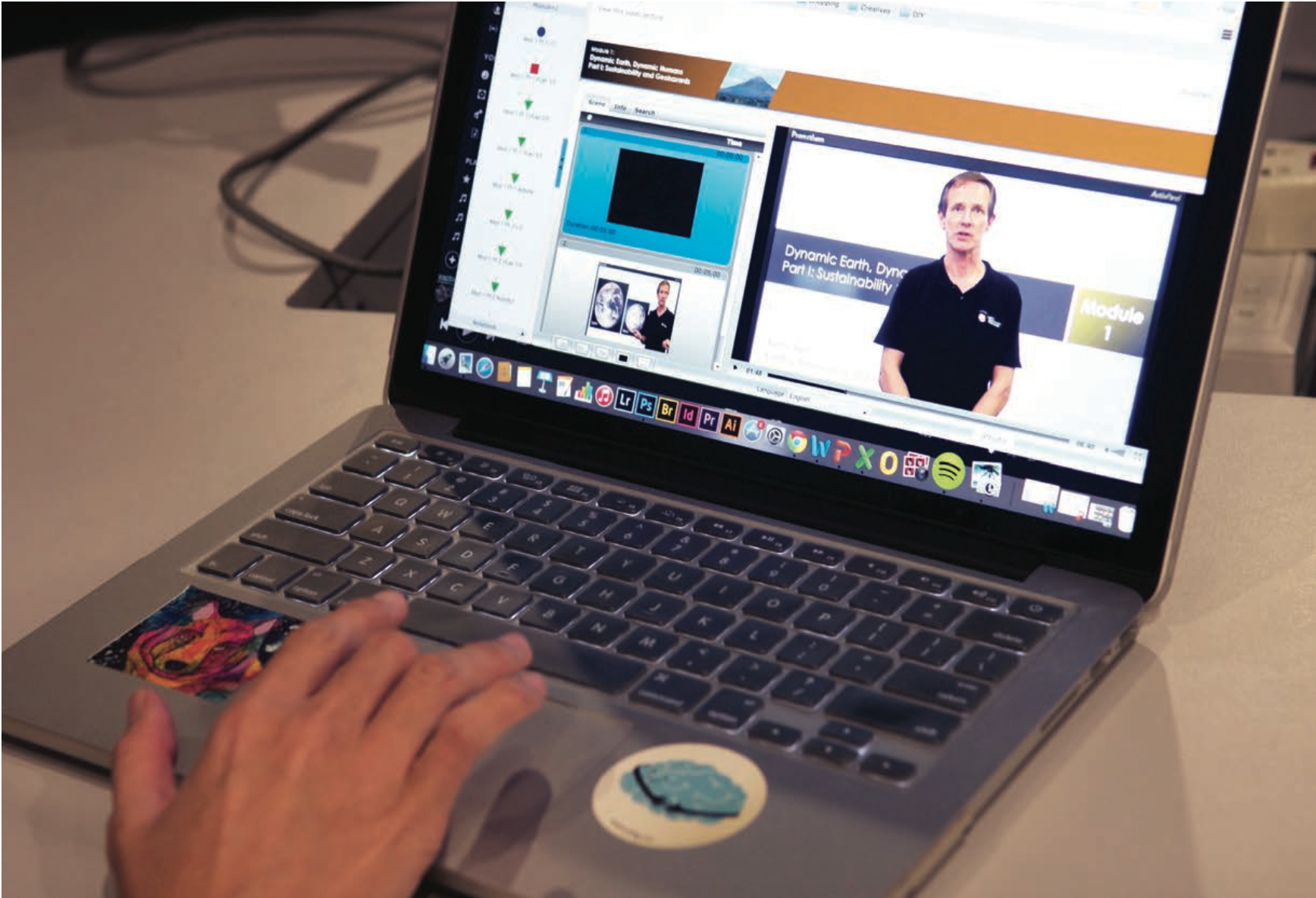
LECTURE THEATRE FOR THE FUTURE: NTU is looking to increase the variety of courses which can be conducted online in an interactive format. The university pointed out that these courses will not be replacing classroom tutorials, and will instead help to maximise learning effectiveness during tutorials.
PHOTO ILLUSTRATION: ALICIA GOH
The university has announced that it will spend $70 million to convert half of all its courses to an interactive online format in the next five years.
Announced at the Higher Education Planning in Asia Forum on 23 Mar, the new online courses will feature quizzes and animation among other elements, and will replace the older, less interactive online materials on NTULearn.
Instead of a regular two-hour lecture, students can watch videos online that are no more than 30 minutes. Clicker quizzes will be swapped for online quizzes and assignments.
Professor Kam Chan Hin, Senior Associate Provost (Undergraduate Education), told the Nanyang Chronicle that these online lessons are part of NTU’s “flipped classroom” approach, where students can review course content in advance through online materials before attending tutorials.
The various schools in NTU are currently identifying more courses that are suitable to be switched to the online format. However, courses which require hands-on learning, such as those with laboratory work, will not be converted.
With the onus on students to take the initiative to attend the on-line courses, graded quizzes will provide an incentive to remain attentive.
Prof Kam said: “Students will be able to score a small portion of marks from the online quizzes in addition to scoring for the graded written assignments and exams.
“Those who go through the online lessons consistently will have an edge over those who do not.”
Time for change
The switch was welcomed by the majority of students, who cited greater work flexibility and saving time on travelling as things they were looking forward to.
Goh Shan Jin, 22, a second-year student at the School of Humanities and Social Sciences (HSS), said: “For students who work part-time outside (of school), the flexibility that online courses give will help them greatly. In terms of work, employers usually prefer to hire people who can work a minimum of two days a week or more, and this can be quite hard to fit into the average NTU timetable.
“Hence, with online courses, not only will these students be able to better manage their commitments in and out of school, they will also have more free time.”
Brianna Lee, 21, a second-year student from the School of Biological Sciences, said: “I think this plan is good. In fact, I would be very happy because I live in Bishan. It makes no sense to me to spend three hours travelling to a two hour lecture.”
However, several students were concerned that they would lose out on more enriching face-to-face interactions in lectures.
Rahimah Rashith, 23, a third-year student from the Wee Kim Wee School of Communication and Information, said: “I think it facilitates learning when you are there for the lessons physically. When a teacher raises a concept to you online, you may not understand the explanation and it takes time to clarify.
“This wastes a lot of time.”
Rahimah added: “Discussing work online is just like text messaging — you can spend the entire day on it because people get to reply at their convenience. When everyone has to be physically present at a group meeting, things can get done much faster.”
Lim Zheng Wei, 24, a second-year student from HSS said that he does not believe he can learn as effectively online.
“It depends on what course you are taking. I major in Sociology and professors from my course always encourage people to debate and give different viewpoints.
“To have a one-way lecture online would not be as useful because you’d just read the readings and won’t learn as much.”
Self-regulated learning
Acknowledging the importance of face-to-face communication in learning, Prof Kam pointed out that the online lessons will replace lectures but not tutorials so that there will still be time set aside for questions and discussions.
“Through such interaction in class, students will learn more in depth, benefit from hearing each other’s diverse viewpoints and understand how to work with their classmates to solve complex problems,” said Prof Kam.
He added that the online courses are meant for students to learn course content at their own convenience before coming to tutorials for questions and discussions, in order to achieve more effective learning.
To date, over 143,000 people have subscribed to NTU’s three Massive Open Online Courses (MOOCs) on Coursera.
Despite the popularity of NTU’s MOOCs, final-year student Tan Fan Zhi believes that traditional teaching has benefits that should not be overlooked.
The School of Mechanical and Aerospace Engineering student said: “NTU’s plan is good but it’s sad that there’s not going to be that teacher-student interaction, which has been so ingrained in our education experience so far, be it in our primary or secondary school.”
He added: “You usually get to interact with the teacher, but to take that out and put 50 per cent of that online makes me wonder if all lessons are eventually going to take place out of school.”


