


Previous Story
Online VS Offline Bystanders
Posted On 10 Apr 2015
Comment: Off
By Annabel Tan
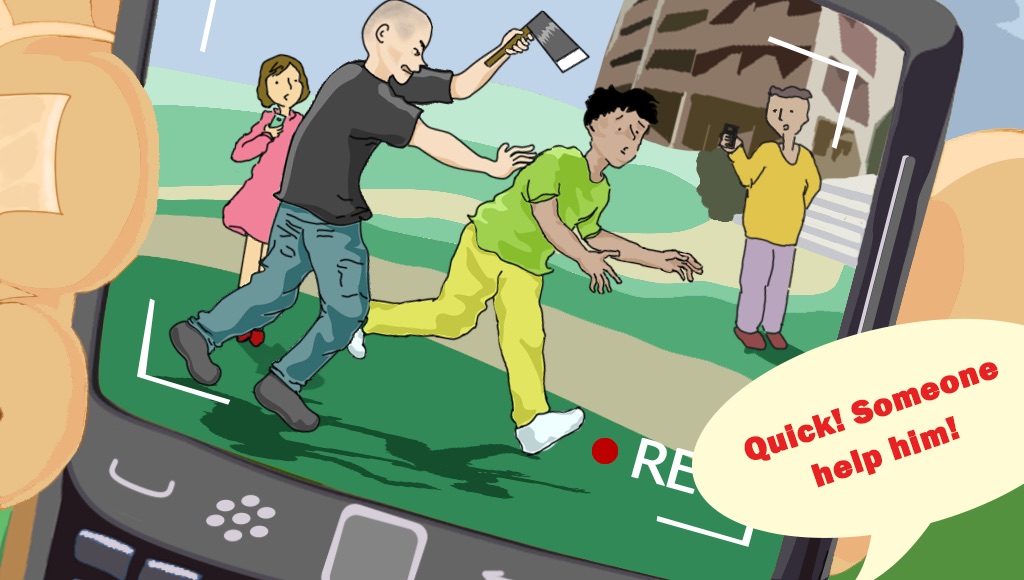
FIGHTING APATHY: Active intervention may be more helpful than being passive witnesses.
(GRAPHIC: ZHENG QIMING)
Imagine it’s break time between classes. Suddenly, two students get into a fight and a knife is drawn. As a bystander, what would you do?
Would you run away or intervene? Or would you stay and simply watch the situation unfold
Judging from the recent slashing incident at the Institute of Technical Education (ITE) College West, many would choose the last option. Or, a third one: stay, watch and take a video of it happening.
In the video, which has since gone viral, two teenage boys circle each other in the school piazza, with one wielding a 35-centimetre bread knife. Students sit in the surrounding stands and watch the drama unfold. Although a security guard attempts to break up the fight, the victim is reported to have suffered wounds on his left arm.
Many netizens criticised the students for not trying to stop the attacker, calling their behaviour passive or even apathetic. Perhaps for some, there was also morbid curiosity as to how the conflict would play out uninterrupted. But realistically, if put in that situation, the likelihood of these critics intervening in the fight might be small.
Essentially, there are two types of bystanders here — offline and online. Offline bystanders are physically present at the event in real time, while online bystanders are those who belatedly watch the event unfold on the Internet through viral videos or news sources. We’ve all probably been either before, but depending on the nature of an incident, one group may make a greater impact.
Bystander apathy
The recent spate of conflict between offline and online bystanders suggests a few reasons for this friction. The first is the inertia offline bystanders face when it comes to offering help upon witnessing trouble unfolding.
Often, onlookers choose not to get involved when there are other people around. In fact, the greater the number of witnesses there are, the less likely one of them would help, as individuals believe that someone else would assume responsibility and intervene.
This has been called the bystander effect in social psychology, and was first demonstrated by John Darley and Bibb Latané in 1968.
Psychologists have submitted several variables contributing to this phenomenon. One of them is the diffusion of responsibility mentioned above; the second is social influence. This happens when a bystander observes that no one else seems to be helping and infers that there is no real need to take action.
For instance, the onlookers in an unconcerned crowd at ITE College West probably thought the fight was not as serious as it would turn out to be. The security guard’s presence may also have led the witnesses to think that more qualified help was on hand to diffuse the situation.
Even though an intervention might have prevented the attacker from eventually slashing the victim, there is more to the lack of action than meets the eye.
Despite their claims that they would surely intervene if they could, online bystanders often forget that the situation is not as simple as it seems.
By proffering advice aided by hindsight and distance, online bystanders often appear more willing to help than eyewitnesses. In the ITE College West case, some online bystanders even commented that by not intervening, the offline bystanders were equivalent to accomplices as they allowed the crime to happen.
Certainly, the bystanders should have tried to stop the perpetrator or at least help in some way, instead of just watching or worse — recording videos for their 15 seconds of fame on social media. But stepping in would also put their lives at stake.
Keyboard vigilantism
Apart from that, there is a crucial difference between being a bystander in offline and online environments that makes acting as the latter much easier — anonymity.
The anonymity online, or rather, what we presume to be anonymity, allows online bystanders to hide behind their screens and bravely stand up to injustices.
Additionally, in comparison to eyewitnesses, being a ‘keyboard warrior’ gives one some measure of preparedness in their responses.
Yet this also means that online bystanders can be vital and helpful in certain situations, especially when there are no offline bystanders.
After media reports emerged about a Vietnamese tourist who was scammed out of S$550 at Sim Lim Square while trying to buy an iPhone 6 last November, more than S$15,000 was crowdfunded in over a week to buy him a new phone.
But there are also some online bystanders who react negatively and harshly.
After netizens watched shopkeeper Jover Chew bully factory worker Pham Van Thoai on video, they wanted to teach him a lesson. They circulated unflattering pictures of Chew, and spread his phone numbers and Identity Card details online. Some even used these personal information to have fast food delivered to his address, leaving him obliged to pay for the meals.
To some, this is apt punishment for Chew. But when it comes to harassment, has online vigilantism gone too far? Despite Chew’s despicable actions, a line should be drawn.
Justice with empathy
Calling someone out on their mistakes and drawing attention to them might help to prevent similar cases from happening in the future, but harassing them is responding to injustice with malice.
Furthermore, it cultivates a spiteful society, online or otherwise.
With both positive and negative manners of intervention, the role of the online bystander can be tricky. It is good to be active, but there are boundaries.
Responding to others in a crisis is not merely about getting involved, but also a matter of how bystanders take action. The reactions of bystanders can aggravate the problem or be part of the solution.
Due to norms governing societal behaviour, individuals may not realise their ability to interfere when wrongdoing is observed. It does not take being in a position of authority for someone to do the right thing.
Rather than wait for others to act first, have the courage to act on instinct. The few seconds one takes to decide to act can make the difference between life and death.
Regardless of the medium, if people are guilty of criticising passive bystanders, they ought to be the change they want to see. Rather than just pointing fingers, one should remember to be more compassionate, and empathise with those around us when there is a situation that calls for our response, both online and offline.


