


Previous Story
Correct, Not Politically Correct
Posted On 13 Apr 2015
Comment: Off
By Shalom Chalson
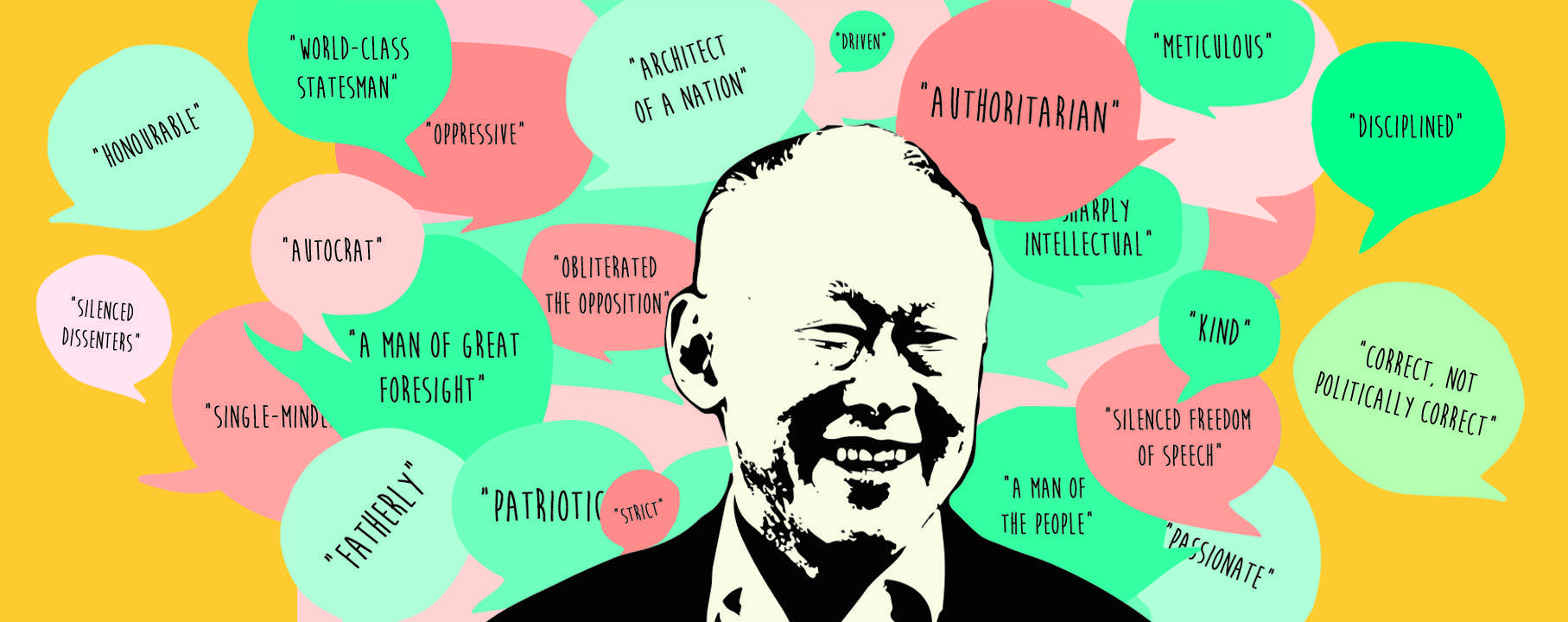
LARGER THAN LIFE: Even in death, our former Prime Minister continues to invoke a wide spectrum of opinions.
(GRAPHIC: KIMBERLY ANG)
When Singapore’s first Prime Minister Lee Kuan Yew passed away on 23 Mar, the state declared a week of national mourning — and mourn our nation did.
In the first seven days after his passing, an outpouring of affection and gratitude for the man considered to be one of the founding fathers of Singapore overwhelmed our country. The queues for the public to pay their last respects to the late Mr Lee at Parliament House ran for hours.
Regular television programmes at Mediacorp were disrupted to make way for tributes documenting Mr Lee’s indispensable contribution to Singapore’s progress as a nation. Foreign media and dignitaries have similarly venerated him as a “lion among leaders”, as current Prime Minister of India Narendra Modi described.
However, other works punctuate this outpouring of praise with views that his legacy is less than, or even far from perfect. Prominent examples include commentary from Singaporean writer Alfian Sa’at and various international newspapers like The New York Times and The Economist.
An article in The New York Times published on 24 Mar pinpointed the “loss of personal freedoms and government intrusiveness” as trade-offs “broadly accepted” for our country’s current standards of living.
Days later, an article in the Business Times titled By gum, the West is wrong about Singapore (shared on Facebook by the current Prime Minister, no less), claims that if “anyone has the right to complain about Singapore, it is the Singaporeans.”
Not entirely faultless
Views painting a more equivocal narrative or acknowledging the contentious aspects of Mr Lee’s governance have been called disrespectful of the recently deceased and his legacy. However, most of these merely held the opinion that faults should not be so easily swept under the rug for the sake of sentimentality.
Talking about how Singapore should accept difficult conversations and muddy the discourse on national history does not mean that Mr Lee’s efforts were entirely detrimental, nor does it imply that he is not deserving of respect.
It only means that Singapore should strive towards progressing without Mr Lee by learning from his shortcomings, as well as stomaching criticism where it is due. As the man himself is often quoted to have said: “I’m not saying that everything I did was right, but everything I did was for an honourable purpose.”
Furthermore, those critical of the haloed view of Mr Lee and the media’s incessant focus on it have suggested that this downplays the contributions of other political figures in the nation’s development.
Taking great offence at voices that are critical of a glorified perspective of Mr Lee during this period asserts that Singapore’s development can be solely attributed to the former Prime Minister.
On the contrary, it can definitely be argued that there were others who had contributed — politicians (opposition or otherwise) and generations of citizens who toiled alongside Mr Lee.
Salt in the wound
A few days after Mr Lee’s passing, Alfian shared a poem on Facebook which evoked images of ordinary Singaporeans who are often passed over by society. Although many deemed the charges of dissatisfaction as untimely, the poet’s point is a fair one.
His message of not letting collective grief readily discard other matters is worth heeding. The late Mr Lee would probably have appreciated the sensibility behind preventing his legacy from descending into a personality cult, which is what he had stressed time and again should be avoided.
Yet, while the discussion on the angles taken in writing national and political history is an undoubtedly important one, perhaps it is a conversation for a different time.
Death, in most cases, is a great loss for those close to the deceased. But in this case, a nation mourns the death of one who helped nurture it into the way it now thrives.
Though talk of change is not comfortable at the present moment, a time will come when it is necessary. Conversations will include voices of the past, present, and the future, and they will define our nation.


