


Previous Story
Acceptance and unity important for Singapore’s progress
Posted On 04 Feb 2015
Comment: Off
Deputy Prime Minister Teo Chee Hean took on students’ questions on employment, family, aspirations, kampong spirit and many more in a two-hour dialogue session during the Ministerial Forum last evening.
By Janell Chu and Cara Wong
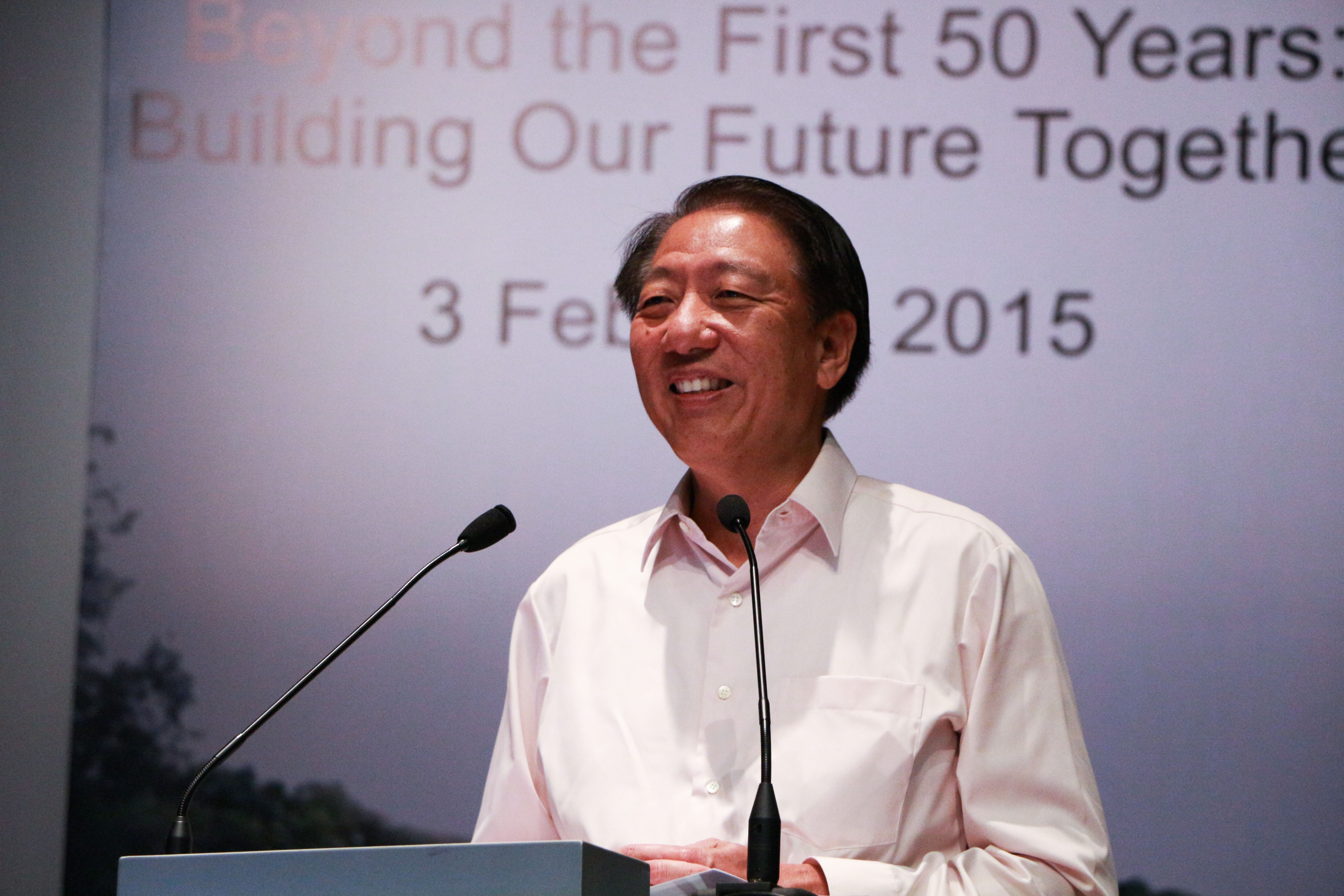
LOOKING TO THE FUTURE: Mr Teo paid tribute to the contributions of the Pioneer Generation while urging students to work for the future. PHOTO: TANG HAO
Acceptance and unity were two recurring themes that emerged during the Ministerial Forum’s dialogue session with Deputy Prime Minister Teo Chee Hean yesterday evening (3 Feb).
Mr Teo was speaking to an audience of about 500 students at the auditorium in NTU’s School of Art, Design and Media. Student leaders from other universities like the National University of Singapore, Singapore Management University and Singapore University of Technology and Design were also present.
In line with Singapore’s Golden Jubilee, the topic for this year’s forum was “Beyond the first 50 years: Building our future together.”
The forum started with a speech by Mr Teo, who acknowledged the contributions of the pioneer generation and spoke about Singapore’s past challenges, as well as the journey to the present. Mr Teo also expounded on three important attributes of our pioneer generation — namely, self-reliance, willingness to invest in the future and readiness to work for the community — and encouraged students to embody them.
The speech was followed by a dialogue where Mr Teo answered students’ queries for close to two hours.
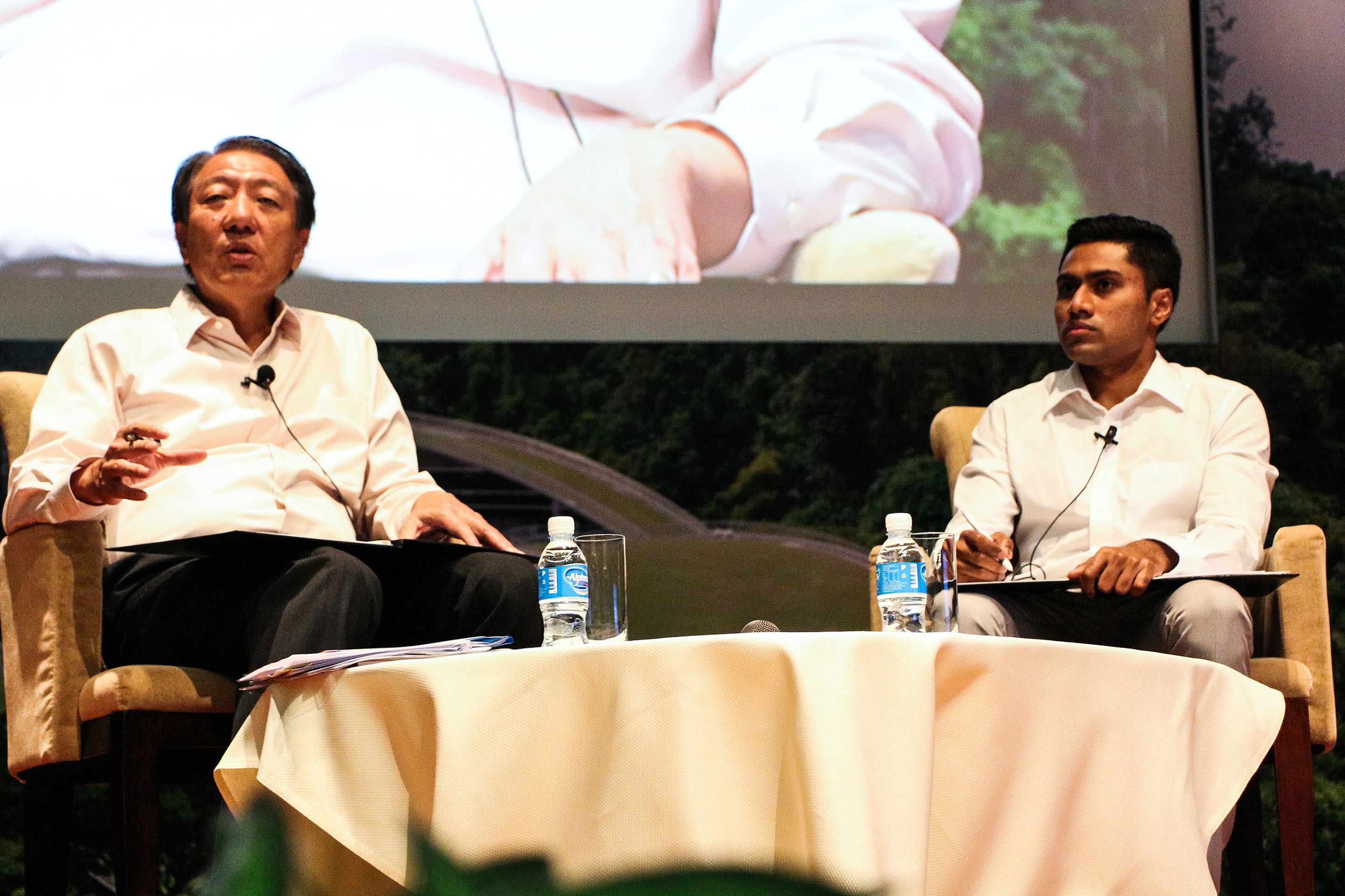
HOT TOPICS: Mr Teo Chee Hean tackled a wide range of questions at the forum, with main issues on the agenda including foreigners in the job market and maintaining cohesiveness in the Singapore society. The forum was moderated by Kubaren Algasamy (right), a final-year-student from the School of Biological Sciences.
PHOTO: TANG HAO
In addressing questions posed by students, Mr Teo constantly reminded them to embrace diversity in the workforce to ensure a more sustainable future for Singapore’s economy.
Among the questions asked was one by Eric Valega Prawirodidjojo, 18, a first-year student from the School of Computer Engineering, regarding concerns about foreign workers competing for local jobs. Mr Teo responded by presenting a forecast on the potential shrinkage of the workforce, should the workforce be solely supported by local workers.
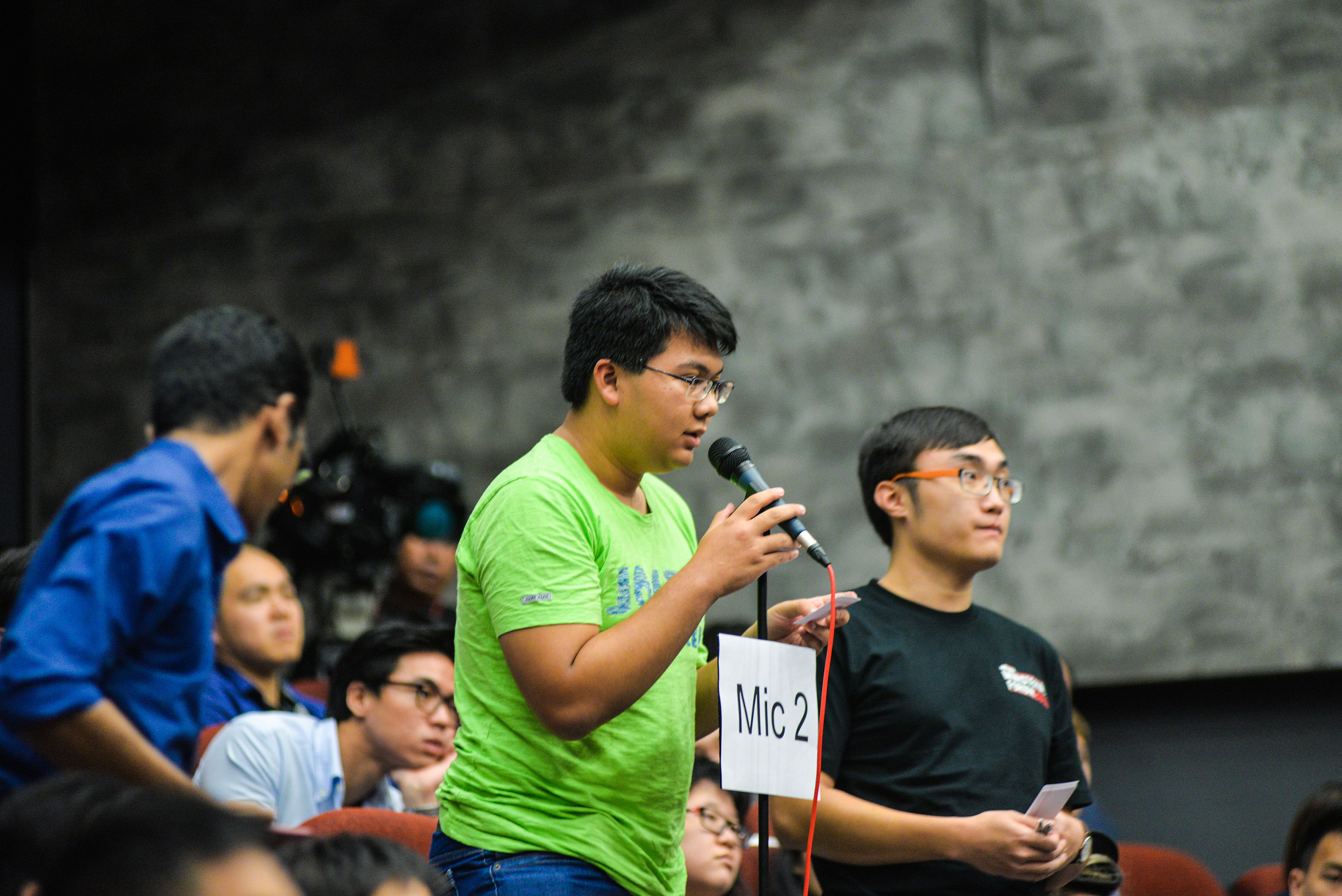
JOB SEARCH: Eric Valega Prawirodidjojo, 18, brought up the issue of locals competing with foreigners for jobs. PHOTO: KRISTAL TAI
Mr Teo pointed out that by 2030, there would only be 0.7 citizens entering working age for every one citizen exiting. He also cited the need to attract foreign workers to fill jobs that Singaporeans are unwilling to take up due to the higher level of education now as compared to the past.
“If all of us become bosses, who are we going to be bosses of?” asked Mr Teo.
He noted that the foreign workforce is one of the key elements in attracting and keeping “exciting companies” here.
“No one will move their company here if they can only hire all Singaporeans. There is a need for a complementary workforce,” he said.
In addition, Mr Teo presented a table showing “startling” youth unemployment rates in countries such as Spain, adding that maintaining employment rates should be something that Singaporeans strive for as a society.
According to Mr Teo, unity in diversity is crucial in bringing the society together, and Singaporeans should be ready to work for the community — not only for themselves — in the next 50 years.
Willie Wee, 23, a third-year student from the National University of Singapore Business School, asked Mr Teo what the government could do to help build kampong spirit. This prompted Mr Teo to counter Wee with a question of his own: “What can people in Singapore do for themselves and their neighbours?”
In light of the growing prominence of extreme ideologies today, Mr Teo stressed the importance of remembering our common aspirations in order to maintain a cohesive society. While extreme ideologies seek to accentuate differences between people, Mr Teo urged the audience to remember these common aspirations and not to let “negative forces” stir up their emotions.
Help being offered to lower-income households was another prominent topic covered during the forum, with two students posing related questions.
Mr Teo mentioned that Singapore chose the Workfare Income Supplement route over the minimum wage law and this supplements the income of lower wage workers without disincentivising the employers.
The Workfare Income Supplement Scheme provides more income and CPF savings to lower wage Singaporean workers provided they work and stay employed.
In particular, the scheme helps lower income, older workers supplement their CPF, as they are qualified for higher wage supplements.
Another noteworthy issue raised was on Singapore’s current stance towards unconventional family structures.
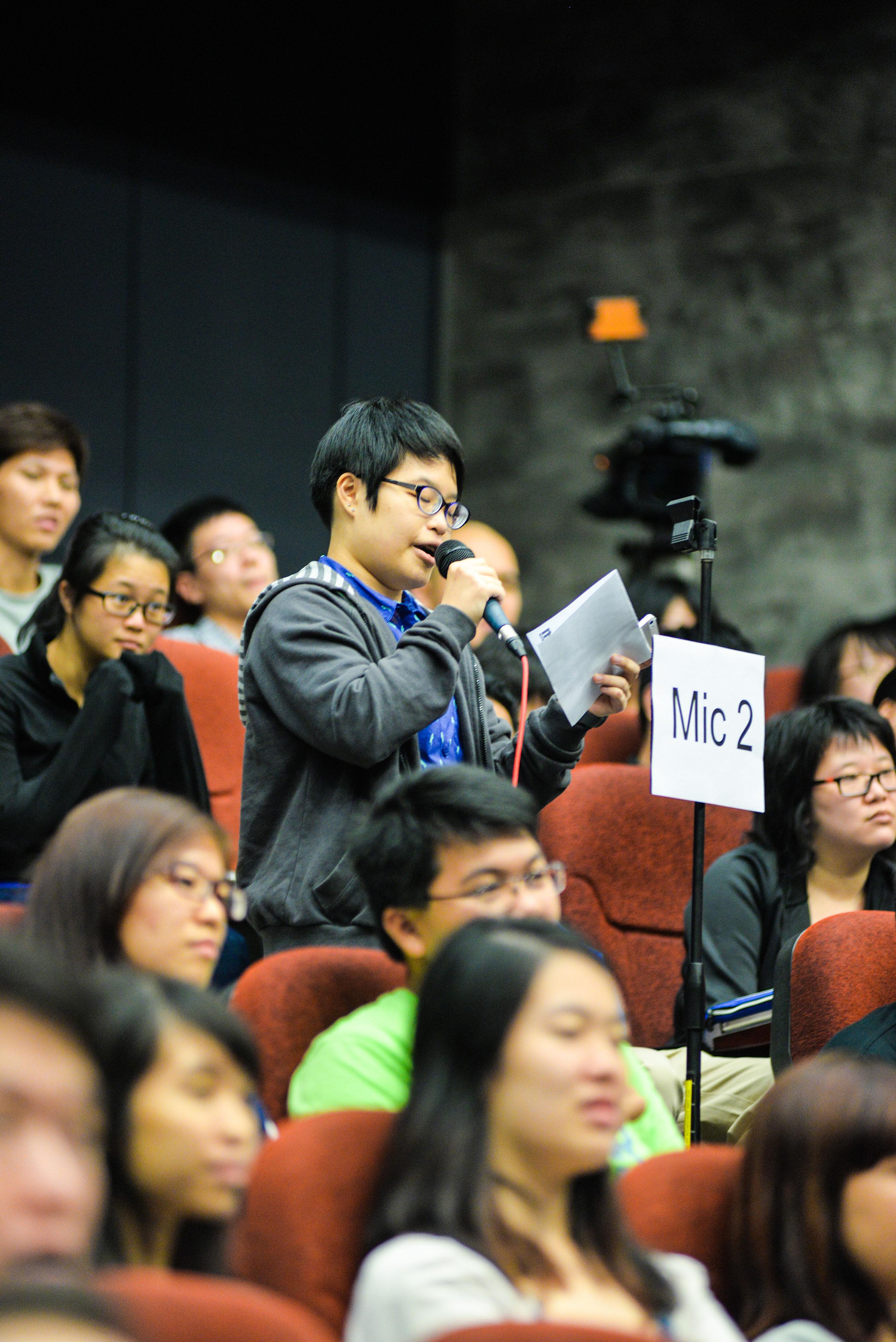
HOUSING CONCERNS: Kay, a first-year student from the School of Humanities and Social Sciences, raised a query about Singapore’s housing policy. PHOTO: KRISTAL TAI
A first-year student from the School of Humanities and Social Sciences (HSS), who only wanted to be known as Kay, asked Mr Teo about how ‘acceptable’ family structures influence housing policies. Citing a recent case of a single mother being rejected in a HDB flat application, Kay questioned if the Singaporean society was moving towards a more conservative stand on family structures.
In response, Mr Teo said that many societies found that the conventional family structure was most balanced in bringing up children effectively. He added that a stable and strong family is a bedrock to a stable society.
Room for improvement
While students whom the Nanyang Chronicle spoke to expressed satisfaction at the topics discussed at the forum, some admitted that they were looking for more in-depth answers.
Firqin Sumartono, a fourth-year student from HSS, posed a question regarding the government’s efforts in raising birth rates here, but admitted that she did not get the answers she was looking for.
The 23-year-old said: “I thought the answers were long-winded for a very simple question. I was hoping to hear about the specific schemes that the government has already implemented or is going to implement in the upcoming Budget 2015.”
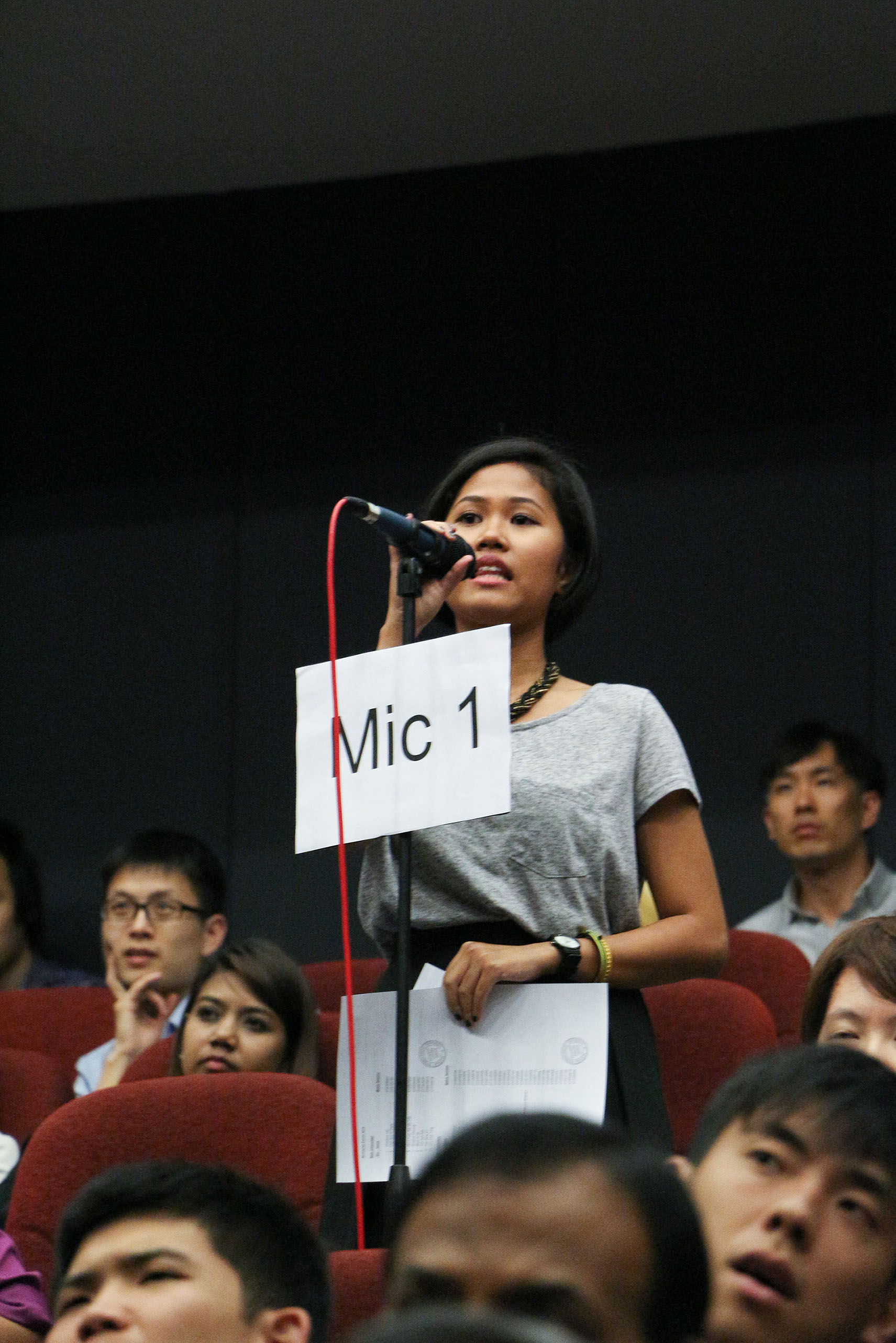
RAISING BIRTH RATES: Firqin Sumartono, 23, posed a query about the government’s plans in bringing up the birth rates. PHOTO: KRISTAL TAI
A couple of students pointed out that they would have liked to hear Mr Teo elaborate more on foreign worker policies.
Eric, who raised the query on job competition between foreigners and locals, mentioned that he would have liked to hear more about how the government manages foreign professional workers. According to him, Mr Teo had focused mainly on blue collared foreign workers when answering his queries regarding employment opportunities for foreigners.
He added: “As a foreigner myself, I would have liked to clarify my questions with him since I was hoping for more information on the professional workers, not blue collared workers.”
Another student of foreign nationality, Chen Pai, 23, a third-year student from School of Mechanical and Aerospace Engineering, added: “I feel that it’s currently not very fair for a foreigner who wants the (job) opportunities, and can do it, but is not even allowed the chance to try. For example, in a recent job fair I attended, quite a number of the jobs that I was interested in, I was told it was only open to Singaporeans. And my friends faced similar issues too.”
However, in comparison with the previous years’ Ministerial Forums, Firqin was impressed by this year’s range of topics.
The 23-year-old noted: “The questions were good and did not only revolve around issues such as employment and immigration, which I thought was the case in previous ministerial forums.”


