Previous Story
De-stress or Distress
Posted On 23 Sep 2013
Comment: Off
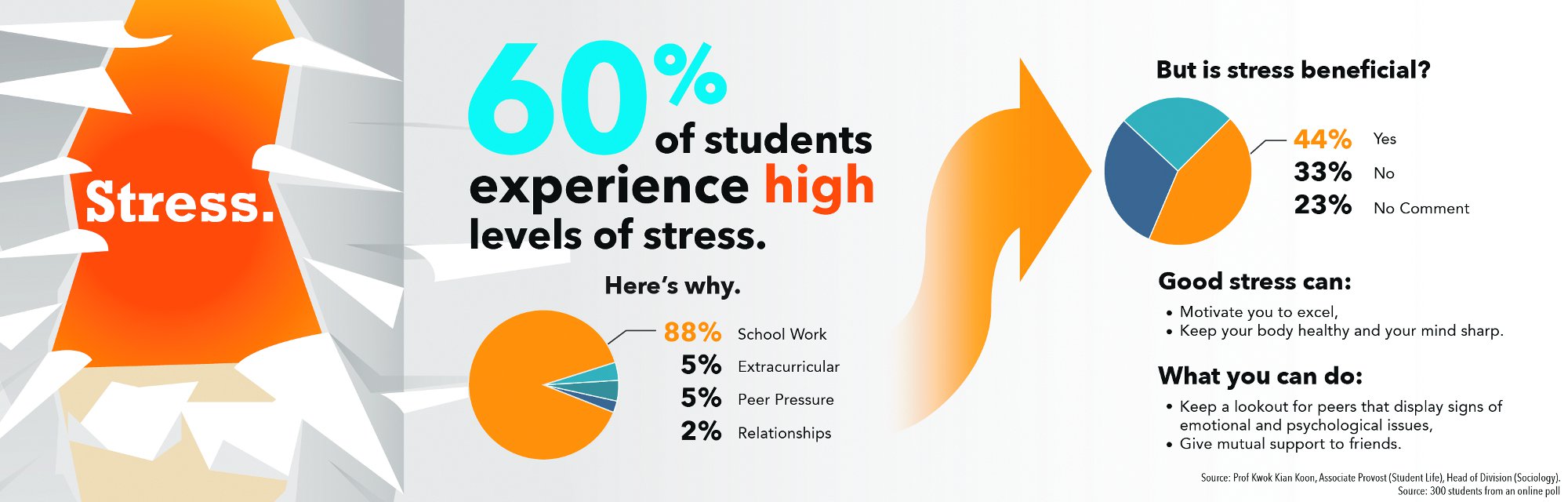
As the academic semester approaches its halfway mark, students are increasingly overwhelmed by schoolwork. The Nanyang Chronicle finds out why.
By Elissa Teo and Kerri Heng
Infographic: Jonathan Chan
The middle of the school term is a stressful time for NTU students, as project deadlines draw near and tests are due. In a poll by the Nanyang Chronicle, as many as 88 per cent of students cited schoolwork as their top reason for stress.
Tit Jie En, 22, is one of them. He said: “I am especially worried after seeing that some of my friends have completed projects, while I haven’t.”
The third-year student from the School of Materials Science and Engineering is among the 300 students who participated in an online survey conducted from 9 to 20 Sept about stress levels in the fifth week of school.
Stress was defined in the poll as feelings of worry and anxiety due to one’s environment.
Students ranked schoolwork as the most stressful, followed by extra-curricular activities and hall commitments, relationships, family, and work issues.
Engineering students seem to have it the worst. 26 out of the 49 students who reported “very high” levels of stress were from the engineering schools. Ken Chin, 22, a third-year student from the School of Electrical & Electronic Engineering (EEE), said: “Even though there are about three quizzes and assignments in total throughout the term, the final exam still counts for a whopping 80 per cent.”
Another reason for stress is peer pressure.
Lim Jie Sheng, a second-year student from the School of Physical and Mathematical Sciences, feels pressured to study harder after seeing his friends studying in the libraries even when it wasn’t examination period. “I feel like I have to study as well because I do not want my GPA to suffer,” the 23-year-old said.
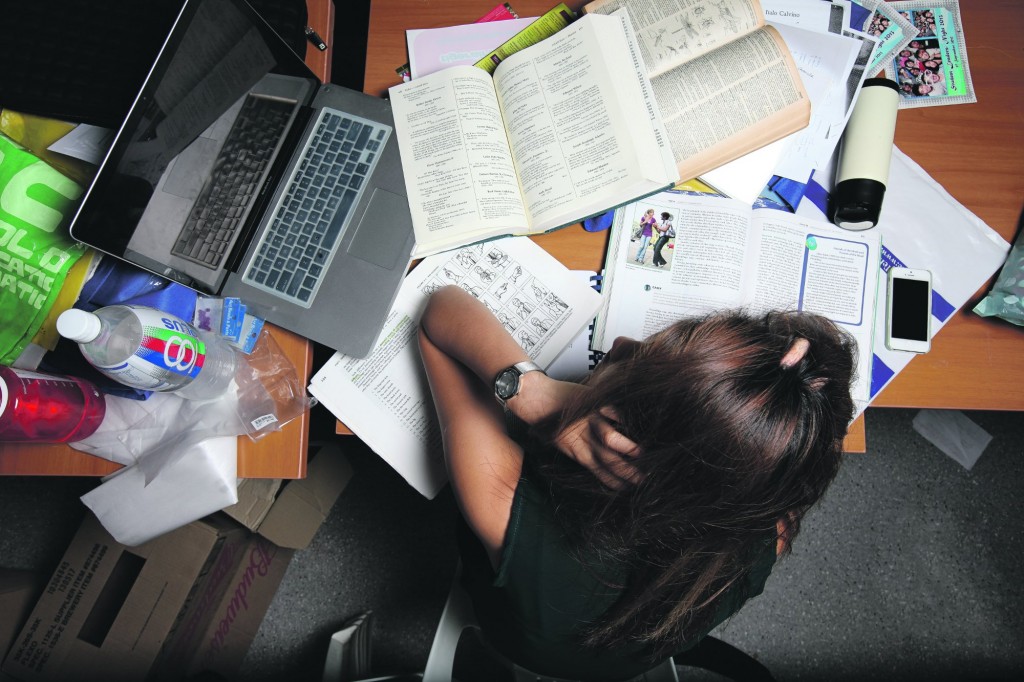
CRUNCH TIME: 88 per cent of NTU students say schoolwork causes them the most stress.
PHOTO: LIM MU YAO
For freshmen, the new study environment makes it harder to cope and six out of 10 freshmen said this caused them the most stress.
Heng Siang Wei, 21, a first-year student from the Nanyang Business School, said: “I am still trying to catch up with the assignments and lectures. It’s quite difficult to do so especially after two years of National Service.”
The findings from the Chronicle poll mirror national trends of increased stress levels in students.
According to the recently published Singapore Social Health Project report, Singapore’s education system, which emphasises performing well for tests, caused high stress levels and lowered creativity among students. The report was done by the National Volunteer and Philantrophy Centre.
Theo Thong Thai, 22, a second-year student from EEE, said that academic results are emphasised greatly in today’s society. That is why his stress increases when tests and exams approach, he said.
More than half of the students polled, however, welcomed some pressure.
“Some stress is good because it helps me to get things done and complete assignments ahead of deadlines,” said Jaime Goh, 20, a second-year student at the Wee Kim Wee School of Communication and Information.
Professor Kwok Kian Woon, Associate Provost (Student Life), said stress is not all that bad if “it spurs you on and keeps you on your toes”.
“But bad stress is when a student tries to solve all his problems on his own and does not know of available support groups like the Student Wellbeing Centre,” he added.
The Student Wellbeing Centre, started the Peer Helping Programme (PHP) in 2009 in collaboration with the NTU Psychology Society. The programme is made up of “confidants” — students who offer support and encouragement to peers showing signs of psychological distress.
Confidant Head Jonathan Ramsay, 30, said: “Our intake of new helpers this year was our largest ever, and we’re hoping that our capacity to help, both formally and informally, will continue to increase.”
He added: “We know our service can only be effective if people know about PHP, which is why we’re organising regular events like Stressbusters, which we run in tandem with the Student Union’s welfare package distribution.”
Yim Chia Lek, a third-year student from the School of Humanities and Social Sciences believed one’s stress level boils down to the person’s mindset about stress. She said: “It’s the idea that we must get good grades.”
The 21-year-old said she spreads out her work and assignments to avoid stress from last-minute work.