


Previous Story
Dissecting the Hong Lim Park fracas
Posted On 06 Oct 2014
Comment: Off
How the protesters have overstepped boundaries.
By Ng Yi Shu
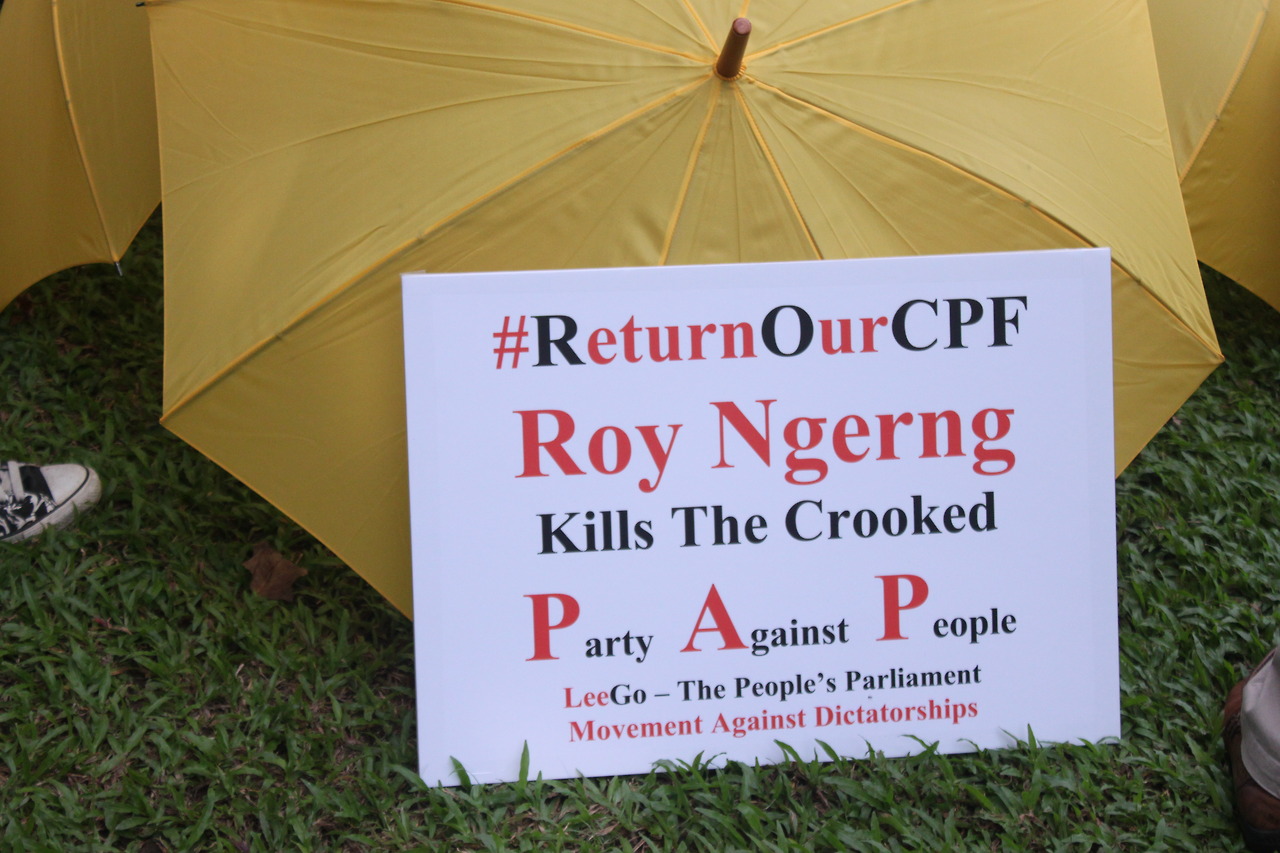
MISPLACED ANGER: The #ReturnOurCPF protestors reportedly directed unhappiness at a group of special needs children who were performing at the YMCA event PHOTO: Ng Yi Shu
Heckling has become the new buzzword in Singapore. This is after a group of protesters reportedly intruded into a Young Men’s Christian Association (YMCA) charity event at Hong Lim Park on 27 Sep. The mainstream media in Singapore reported that the protesters had “heckled” children with special needs, who were performing during the event.
The protesters, led by Ms Han Hui Hui, 22 and Mr Roy Ngerng, 33, had registered with the National Parks Board (NParks) to demonstrate against the lack of transparency in the use of Central Provident Fund (CPF) monies at the Speakers’ Corner in Hong Lim Park. Unbeknownst to them, NParks had allocated two separate lawns for two events on that same day –– one for Ms Han and Mr Ngerng’s protest, and other for a charity carnival by the YMCA.
The use of the word ‘heckling’ to describe the protesters’ actions has come into debate, with different videos online corroborating a variety of accounts that surfaced in the aftermath of the demonstration.
In one video, protesters were shouting slogans such as “Return My CPF”, just before a group of special-needs children, known as the Y Stars, began their performance.
Organisers of the demonstration further contended that they did not heckle the special-needs children.
Ms Han asserted that the protesters “went off immediately” when they realised that the special-needs children were performing. Complementing her statement, Mr Ngerng said in a Youtube video that he “didn’t know what was going on on the stage”, and claimed that the YMCA pushed the children onto the stage so “they could create news for themselves”.
However, Mr Ngerng’s claims were neither supported by video evidence nor by witnesses who were present at both events.
From the Merriam-Webster dictionary, heckling means “to interrupt by shouting annoying or rude comments or questions”.
Given the dictionary definition, The Online Citizen editor Howard Lee argued that ‘heckle’ was used inappropriately in this context, as the protesters “did not seem to have directed their words at the children performing”.
However, the chaos stirred by the protesters did impact the children as they had to re-start their performance after they faltered, according to a Straits Times report.
Moreover, Minister of State for Trade and Industry Teo Ser Luck, told the Straits Times that he had to console one of the children “frightened by all the heckling”.
Further illustrating the impact the protest had on the children, blogger Lee Kin Mun, popularly known as mrbrown, quoted an anonymous YMCA volunteer who was at the scene. The volunteer said that the protesters who marched around the stage “frightened the special needs performers” as well as “the old folks and other disabled children who were there to enjoy the performances”.
Thus, the use of the term ‘heckling’ in this case would be apt, given that the children were indeed affected by the protesters’ march into the event.
‘Double booking’ leads to discontent
The anger over ‘double booking’ centered around a common misconception that registration of the Speakers’ Corner meant that protesters could hold their demonstration across the two lawns in Hong Lim Park.
There is no law that demarcates different events that occur at the same time in Hong Lim Park.
In fact, two or more events have occurred simultaneously at the Speakers’ Corner before. For example, on 29 June last year, Pink Dot, an anti haze speech and a protest against the Cross-Island MRT line took place concurrently, without any encroachment by the respective event organisers.
The protesters of the anti-CPF demonstration were probably buoyed by the presence of a government minister at the location of their demonstration, and they decided to disrupt the YMCA proceedings, in hopes of attracting attention to their cause.
Mr Ngerng himself admitted that this was the case. In his blog, The Heart Truths, Mr Ngerng explained that the crowd did intend to capitalise on Mr Teo’s appearance to push the protesters’ message forward.
In previous protests organised by Mr Ngerng and Ms Han against various aspects of the CPF system, the People’s Action PArty was a target to be bashed. Slogans were chanted for a change of Singapore’s ruling party at the upcoming general elections in 2016.
The protesters seemed to have achieved what they wanted — someone to direct their protests to. They were photographed speaking to Mr Teo at the event, while several others were reported to have gone up to him, with one shouting, “Teo Ser Luck, return our CPF”, according to the Straits Times. Footage released by The Online Citizen also showed that Mr Teo was “confronted by angry protesters”.
But instead of igniting change in the CPF system, which they have perceived to be broken, Mr Ngerng and Ms Han have been labelled by Singapolitics commentator Mr Devadas Krishnadas as “anarchists”, by mrbrown as “insensitive w**kers”, and as a “total and absolute disgrace” by Minister of Manpower Tan Chuan-Jin.
The protesters’ focus on the faults of the CPF system has been ignored, mainly because of their own actions, which are deemed irresponsible and disrespectful by many Singaporeans.
The need to bridge a widening political divide
The Speakers’ Corner at Hong Lim Park is the only public space in Singapore where citizens can legally hold demonstrations and express political dissatisfaction without a police permit.
The Speakers’ Corner, established in 2000, only flourished eight years later, after regulations governing the use of the area were relaxed. Organisers now register for permission to hold their events at the Speakers’ Corner online, via a site run by NParks. Previously, event organisers had to apply for a police permit.
The site is now a space filled with anger and all sorts of political spiel. Former journalist Bertha Henson wrote in her blog: “(The Speakers’ Corner) was a place for people to ‘let off steam’, for those who feel disenfranchised or marginalised to say their piece, for non-mainstream groups to feel at home together.”
Perhaps it is time for us to consider being more constructive in our discourse.
Ms Han, Mr Ngerng and their fellow protesters’ anger towards the government, justified or not, shows a growing political divide — one that has led them to do whatever they felt was necessary to garner attention towards their cause.
Bridging this divide would be beneficial, but it will be difficult. People on both sides of the line need to look past the distrust and anger they have for each other to allow for more sustainable and constructive discussion. To enact constructive political change, we need to focus less on emotion and more on reason.
As students, what we can do?
What happened may be disenfranchising for some, especially for the average student concerned about grades and the next examination, rather than the future of politics in Singapore. But we need to see things beyond what happened at Hong Lim Park on 27 Sep.
Politics is more than what happens in Hong Lim Park; political frustrations need not be expressed in a confrontational manner. Perhaps we can look at other ways to engage in critical political discourse in Singapore.
As a start to critical discourse, we, as students, can begin by reading up to increase our awareness of what’s going on around us. Instead of reacting immediately towards breaking news, we should take time to think critically about the underlying causes behind the news. A thorough and well-informed understanding of current affairs and social phenomenon will enable us to take positive steps toward meaningful social and political action.
It is important to air our grievances, but it can be done amicably. Armed with in-depth knowledge on current affairs, we can engage our political leaders in public dialogue, instead of surprise confrontations. Avenues are open to us: Meet-the-people Sessions, community dialogues with our leaders and of course, social media platforms. We can even plan and organise peaceful rallies at the Speakers’ Corner, without encroaching on other events that may be ongoing at the same time.
As Mr Krishnadas wrote in his response to the protesters: “Let us stand up for Singapore by demonstrating to ourselves (that) we are not stupid, we are not anarchic, we are not gullible, we are not xenophobic and we are not socially careless, and what we are — active, informed, mature, considerate, welcoming and respectful.”
Let’s enact change without being confrontational.


