


Previous Story
E-scooters on campus: Are they safe or dangerous?
Posted On 28 Nov 2016
Comment: Off
By Sophia Tan
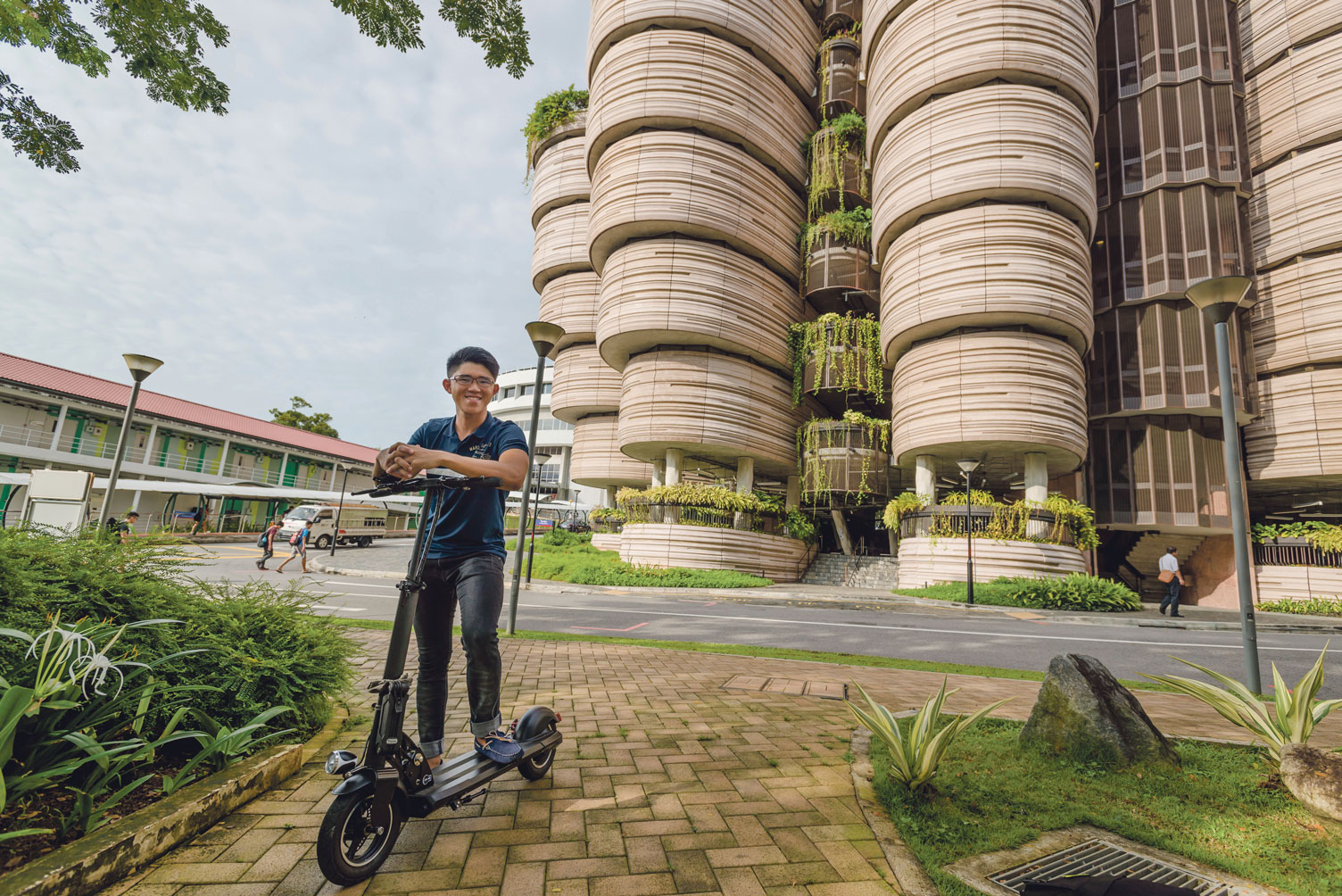
While some e-scooter users said NTU is one of the safest places to ride due to spacious pavements and low foot traffic, others said they have seen e-scooters being used on roads, which is dangerous and not recommended under LTA guidelines. PHOTO: ZHENG JUNCEN
Travelling to school has been a breeze for final-year School of Mechanical and Engineering (MAE) student Benjamin Oh ever since he purchased an e-scooter four months ago.
He takes a 45-minute scooter ride from Yishun station, which is 10 minutes faster than taking the bus.
“I love riding my e-scooter because it is so convenient and allows me to have better control over my travelling time,” he said.
Among the range of personal mobility devices (PMDs) like e-bikes and hoverboards, e-scooters in particular have become an increasingly common sight on campus in recent months.
Cheap and convenient
E-scooter users the Nanyang Chronicle spoke to said that unlike penny boards and segways, e-scooters are foldable and more convenient to carry around.
They also have an easier learning curve as they run on a motor.
“I have seen quite a number of riders over the past few months. The trend seems to be picking up in NTU,” said third-year Nanyang Business School student Andre Lee.
Part of the e-scooter’s draw is its affordability as a motorised form of transportation, compared to the cost of owning a motorbike or car, said Adjunct Associate Professor Gopinath Menon, who teaches transport engineering.
The University’s hilly terrain might also be a reason why students prefer using e-scooters instead of bicycles, which are less strenuous to ride, he added.
Narrow pavements
While it is not illegal to use e-scooters and other PMDs on campus, Office of Development and Facilities Management chief executive officer Paul Chain said students doing so put themselves at risk, as pavements on campus are too narrow for PMDs.
“It is difficult to enforce safety with 40,000 people on campus daily, and accidents are prone to happen when there is a lack of space for riders to manoeuvre,” he added.
The University follows the Land Transport Authority’s Active Mobility Advisory Panel guidelines on the use of PMDs.
These guidelines, which will be legally binding next year, allow students to use PMDs on footpaths.
However, users should not ride PMDs on roads or areas with heavy foot traffic, such as building corridors and concourses, according to the guidelines.
Safety concerns regarding usage of PMDs rose to prominence this year, after a spate of PMD-related accidents on roads and pavements were reported, with victims suffering severe injuries or death.
A 23-year-old died from falling off his e-scooter at East Coast Park in March, while a 53-year-old woman was left unconscious after being hit by an electric scooter at Pasir Ris Drive in September.
Divided over safety
Students the Nanyang Chronicle spoke to were divided over the safety of using e-scooters here.
Some, like second-year MAE student Gan Yin Ze, said NTU is one of the safest possible places to ride, as the pavements on campus are spacious enough to avoid accidents and has low foot traffic.
The 22-year-old, who bought his e-scooter this semester as an alternative to driving, said he will never use it outside of campus, as “roads outside the campus are too crowded and narrow”.
Despite falling along a crowded pavement near NTU before, Lee said that safety boils down to responsible riding practices by those who use PMDs.
The 24-year-old discovered the convenience of e-scooters after his hall neighbour encouraged him to test ride one.
It is now his main mode of transport on campus.
“PMD users need to be mindful of their surroundings. Pedestrians and vehicles come first and electric mobility devices should never have right of way,” he said.
“I am conscious of my surroundings and dismount whenever pathways get too crowded.”
But other students, like Tan Hwee Chin, 21, said e-scooters should be banned on campus because of riders who flout safety rules and ride on campus roads.
The final-year MAE student added that these devices were “too dangerous” for pedestrians to share the footpath with, and some riders were “reckless and inconsiderate”, worsening the problem.
The fact that e-scooters do not come with safety mechanisms such as bells or lights makes them especially unsafe, said second-year School of Art, Design and Media student Ong Li Wen, 21.
Ong said many of her classmates use e-scooters and hoverboards even in campus buildings, highlighting a lack of awareness about safety regulations.
A positive sign
Prof Menon, who is also a consultant with a transport engineering firm, said more students using e-scooters on campus is a positive sign of greater active mobility among the student body.
“It is great that NTU students have taken to this, as such devices reduce dependence on private motorised transport,” he said.
Acknowledging recent accidents that involved the use of e-scooters in Singapore, he cautioned riders to put themselves in the shoes of pedestrians.
“Students should be aware that the pedestrian is the vulnerable user and ride in a manner so as not to harass or harm pedestrians by keeping to speeds appropriate for the situation,” he added.