


Previous Story
Eating healthy on campus
Posted On 16 Oct 2017
Comment: Off
By Dayna Yin

PHOTO: BELICIA TEO
NTU students have a big appetite for knowledge, and an even bigger one for food.
With midnight suppers a mainstay of hall life, and tight assignment deadlines making it difficult for most to consider cooking an option, eating out becomes a vital part of an NTU student’s day.
“It’s a trade-off between academics and health,” said Calvin Goh, a second-year School of Mechanical and Aerospace Engineering student, who is also pursuing a second major in business.
He noticed that as exams and deadlines draw near, his schoolmates get less motivated to making an effort to eat healthier.
“I feel that even if my friends want to eat healthy, there is are a lack of options in school,” the 22-year-old added.
Salads are sold on campus at places such as food court Koufu at the South Spine and bistro-bar Pen & Inc at the North Spine, but they do not come cheap.
Lunch bowls at Pen & Inc are priced from $10 and above, while salads from the salad bar at Koufu may cost between $6 to $8, depending on the type of ingredients selected.
In addition, more affordable local dishes like yong tau foo and ban mian at canteens are not as nutritious as they seem — despite displaying the “Healthier Choice” label on signboards, both are surprisingly high in sodium and calories.
The “Healthier Choice” label has come under fire recently, according to a 9 Oct article published by the Straits Times. In the article, experts call for more discriminate use of this nutrition label to avoid misleading consumers.
According to the Health Promotion Board, a bowl of ban mian clocks in at 475 calories with 2,196mg of sodium — almost half of the recommended daily sodium intake. Even an innocuous-sounding order of yong tau foo without noodles can contain almost 1,800mg of sodium.
But the limited variety of healthy eats has not stopped students like Goh, a recreational bodybuilder, from getting sufficient macronutrients, or “macros” (a collective term for protein, carbohydrates and fat), every day.
Goh is one of a small number of health-conscious students at NTU who have developed healthy eating practices such as “meal-prepping”, calorie-tracking and home-cooking.
“Meal-prepping”, or planning and preparing meals in advance, has become a trend for the health-conscious in the past few years, with numerous websites and studies highlighting its health benefits.
According to a recent study conducted in April 2014 by the University of Paris and Avicenna Hospital in France, meal-prepping has not only led to healthier eating habits, but also lower levels of obesity in a population.
An avid home cook, Goh believes making his own meals is the easiest way to meet his dietary requirements as a bodybuilder. He also shares healthy recipes and bodybuilding tips frequently on his Instagram account, @skyterrorfitness.
The bulk of his diet consists of complex carbohydrates like brown rice and sweet potatoes, along with a variety of meats such as steak, salmon and chicken.
Getting creative by experimenting with healthier bakes like high-protein muffins help Goh hit his daily protein goal, while curbing his sweet tooth.
“Because guys generally have higher metabolism and higher muscle mass, we need to take in more protein,” he said.
Goh added: “I’m not into high-end health foods, so I try to be more cost-efficient in doing research, and tweaking online recipes to cater to my own diet.”
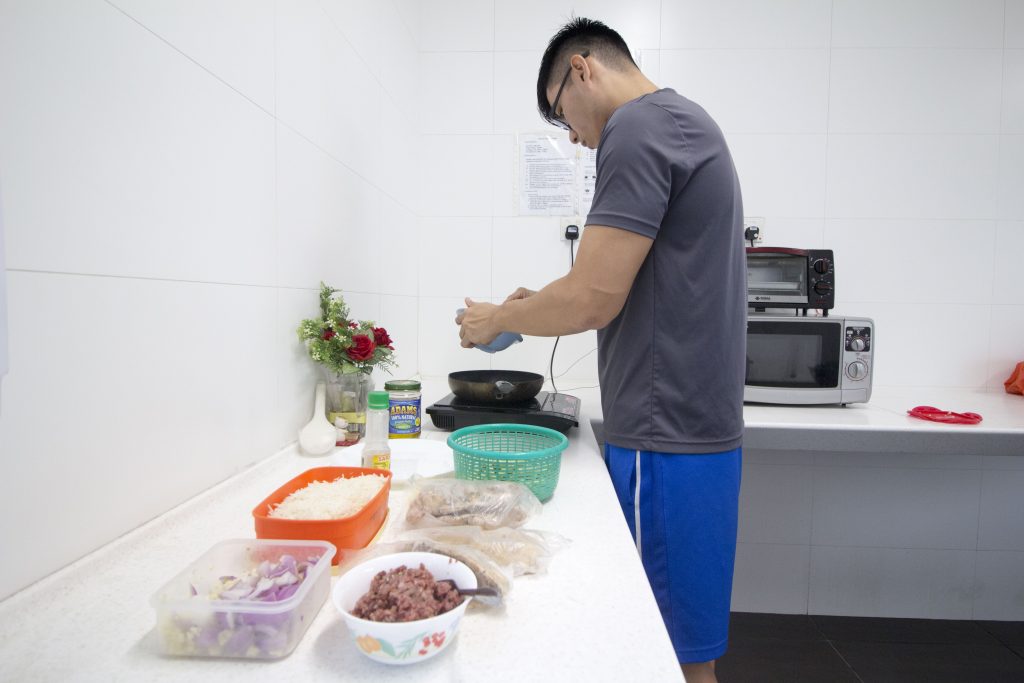
PHOTO: BELICIA TEO
Another student with a similar passion for healthy eating is Brandon Na, a first-year Sports Science and Management student.
Overweight as a child, Na feels that diet and exercise both played a big role in boosting his self-confidence and motivation for school.
For the past three years, Na has been an active meal-prepper.
He views it as an easy and cost-effective way of tracking his calorie intake — even while staying in hall.
“Because I buy everything in bulk, it’s cheaper than eating outside,” said the 22-year-old, who estimates that each of his home-cooked meals costs between $2 and $3 to make.
Na often prepares oatmeal for breakfast. For lunch and dinner, he serves up a healthier version of fried rice, cooked with chicken breast and less oil.
“It’s not that tough,” said Na. “I basically cook everything on the weekends at home and bring my meals (to school) to keep in the fridge. Then I just heat them up in the microwave.”
Though efficient and effective, students who practise meal-prepping must be aware of bacteria contamination risks, according to the director of NTU’s Food Science and Technology Programme, Professor William Chen.
This is especially so when it comes to storing cooked meals over the course of the week. Even though most refrigerated food is chilled to 4 deg C, bacteria growth is not stopped but merely slowed down, said Prof Chen.
He recommends freezing food instead, as temperatures zero and below are more effective in slowing down bacterial growth in food, allowing frozen food to be kept up to three months.
Prof Chen acknowledged that people often choose to refrigerate rather than freeze food, as it tastes fresher. But given the perishable nature of fresh food, bacteria growth is inevitable.
“Everything has a time span. Food safety is something we must be aware of,” he said.
How “super” are superfoods?
Incorporating superfoods into one’s diet is another health food trend to hit the nation.
“Superfood” is a label for premium exotic fruits and vegetables believed to be beneficial for health.
The açaí berry is one such superfood that has taken Singapore by storm.
This Brazilian fruit (pronounced as “ah-sah-ee”) is reportedly high in fibre and vitamin A, with its frozen pulp commonly consumed in “açaí bowls”, along with other fruits and superfood toppings.
Third-year School of Social Sciences student Cheryl Koh is a big fan of açaí bowls.
An active dancer and runner, Koh, 22, enjoys exploring different healthy food trends that complement her workouts and lifestyle.
“In all my smoothie bowls, I would go online and get all the superfoods, like açaí and goji berries,” she said.
She buys her superfood products off iHerb.com, an online grocery and health supplement store. Depending on the quantity and brand, they cost between $15 to $40 per order, with a pack lasting her over six months at a time.
Last January, she started an Instagram account, @allthatischeryl, dedicated to her healthy food recipes, as a passion project to learn about the specific benefits of ingredients she consumes.
She said: “I love food for the taste. If these superfoods happen to be nutritious as well, that’s an extra plus.”
But critics have warned that the term “superfoods” could be misleading.
Even though they are wildly popular among healthy eaters and have garnered much hype online, superfoods are not medically proven to be nutritious, according to a report by The Straits Times last April.
One example would be antioxidants, touted as having anti-ageing and cancer-killing properties. However, the European Food Safety Authority found in a 2011 report that these supposed benefits were nothing more than a “myth”.
Prof Chen cautioned students against viewing a single superfood as a “one size fits all” solution to a healthier diet.
Instead, he advocated exploring a variety of commonly available inexpensive foods. He recommended fermented products such as miso and kimchi, as they contain microbes that produce vitamins, amino acids and fatty acids as part of the fermentation process.
Fermented products are reportedly easier to digest, and are beneficial for gut health.
“You don’t have to spend more money to chase after a lifestyle without knowing the facts,” he said. “A mixture of everything is better.”