
Previous Story
Embrace change or end up on the wrong side of history, says DPM Tharman
Posted On 25 Sep 2017
Comment: Off
By Natalie Choy and Dewey Sim
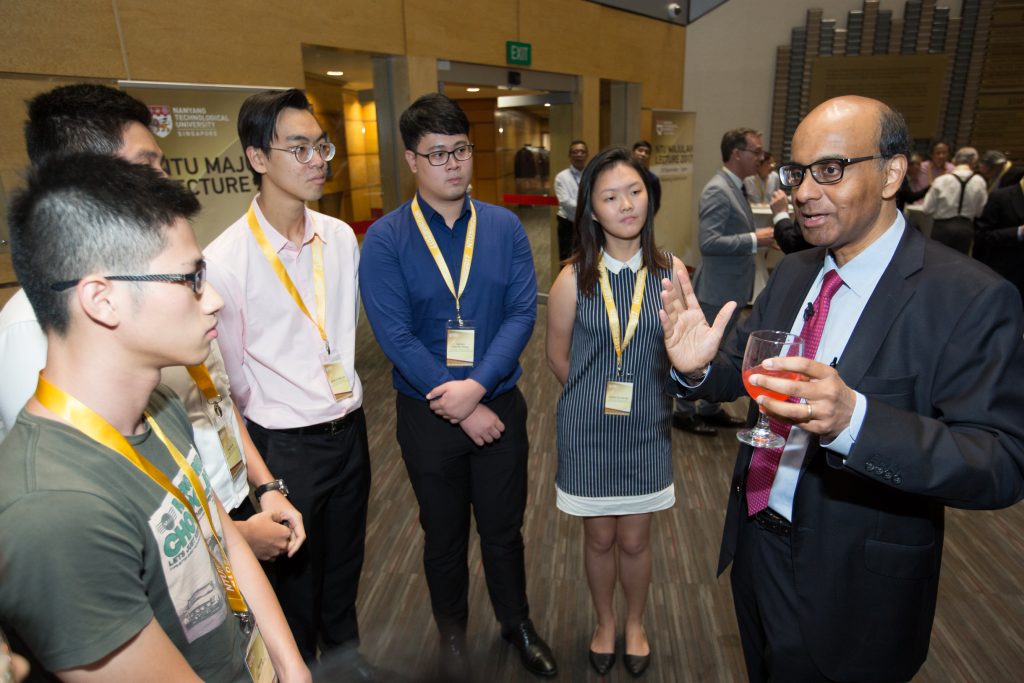
PHOTO: YEO WEI LUN
The mantra “if it ain’t broke, don’t fix it” cannot apply to Singapore’s education system, said Deputy Prime Minister Tharman Shanmugaratnam.
Instead, constant change and experimentation are needed to better prepare Singaporeans for future challenges.
“In education, more than in any other field, we will only know how well we are doing 20 or 30 years from now. If we don’t keep changing, we will end up on the wrong side of history,” said DPM Tharman, who is also the Coordinating Minister for Economic and Social Policies.
He was the guest speaker at the inaugural NTU Majulah Lecture — a new initiative that aims to address the uncertainties and challenges that Singapore faces in a globalised world.
The annual event also seeks to inspire NTU students by inviting public speakers from the government, business and civil sectors to share their ideas and experiences.
Speaking to a 1,500-strong audience at the Nanyang Auditorium, DPM Tharman said that Singapore faces the challenge of developing an innovative society while retaining a sense of togetherness.
He highlighted five key measures that the education system must adopt to prepare Singapore for the future.
The first measure is to give every child in Singapore a fair chance of success early in their education and to “help those who start off with a disadvantage”.
“As some would put it, you’ve got to mitigate the ‘lottery of birth’. People are born with advantages and disadvantages,” said DPM Tharman. “Fortunately, and this is the silver-lining, neurological studies show that neural growth is malleable to intervention, if it takes place early enough.”
The four other measures include creating “fluid and flexible” pathways as children grow up, reducing academic workload, promoting lifelong learning, as well as reinforcing Singapore’s multicultural identity in our youth.
On his point about multiculturalism, DPM Tharman said co-curricular activities in Singapore are too “ethnically-defined”.
“Football today is different from what it was in the ‘70s and ‘80s. You look at our national team, all very good players. But it used to be a much more multiracial team in those days. Volleyball, basketball, table tennis – the first thing that strikes people – ‘Chinese’ game,” he said.
DPM Tharman is hopeful about improving racial diversity in schools.
He cited how schools such as Dunman Secondary School and Jurong Secondary School have put in the effort to make sports such as volleyball more multiracial.
“Always lovely to watch the school dances, like a Malay dance,” DPM Tharman said. “But when you look closely and see there are two Indian girls, or two Chinese girls, that’s when you get ‘geteran jiwa’, the stirring of the heart,” he added.
Despite the slew of initiatives introduced to improve our education system, some NTU students believe that Singapore will still struggle to cope with challenges in the global economy.
Wu Yan Long, a first-year student from the Lee Kong Chian School of Medicine, attributed this to our small population size.
“My main concern is that we don’t have the critical mass to compete on a global scale,” said the 19-year-old. “You can get as many foreigners as you want, but other countries can do that too. There’s no comparative advantage.”
He said that Singaporeans will still lose out to bigger countries such as China and the United States who have more resources.
Lin Yi Chao, a second-year exchange student from the School of Computer Science and Engineering, is supportive of reducing workload in school.
Speaking on the education system of Singapore and China, the 20-year old from Xiamen University said: “I think it is a good idea to reduce academic workload because it creates more space and room for us to be creative.”
Lin added that cutting down on academic work to spur innovation will be beneficial in China as well, where its education system is largely focused on mathematics and computer science.
Concluding his hour-long speech, DPM Tharman reminded the audience to think about the National Anthem when reflecting on this new spirit in education.
“When you think of our Anthem, remember ‘Mari-lah kita bersatu, dengan semangat yang baru’ (with a new spirit),” he said.
“And that new spirit was not intended just for the day we became a new nation 52 years ago. Every so often we need that new spirit in our society, and that is how we go forward together.”