


Previous Story
Tales of an unconventional exchange: From Croatia to Mumbai
Posted On 24 Jan 2017
Comment: Off
By Gabriela Lim
Nanyang Chronicle Lifestyle brings you around the world with four NTU students who have visited unconventional exchange destinations with refreshing stories to share, from driving through torrential rivers to taking a dip in a smelly, murky river.
Gabriel Goh
Wee Kim Wee School of Communication and Information
Stuttgart, Germany
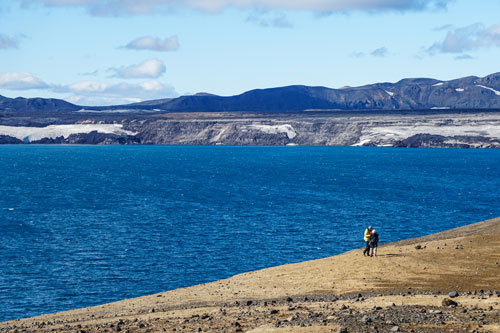
EYE-OPENER: The lake along the Laugarvegur Trek in Iceland was among the solo expeditions that Gabriel embarked on. PHOTO: GABRIEL GOH
Throughout my exchange at Stuttgart Media University in Germany, I found myself travelling to remote and untouched spots across Europe.
Iceland was a four-hour flight away from Stuttgart, but I really wanted to take on the Laugarvegur Trek, a 55km raw Icelandic mountainous terrain.
It had been a goal since I started planning for my exchange – one of the reasons why I chose Stuttgart.
The journey was a treacherous yet fulfilling one. Each uphill step was a battle against gravity, but the view at the top was worth the fight — until I had to go down the ravine and start the process all over again.
One highlight of the trek was when my luck ran out and the skies opened and it started to rain.
At this point, my eyes were tempted to pour out some as well.
Pulling into the final valley fatigued and stretched to the brim, I witnessed a true moment of magic.
A rainbow extending the entire breadth of the valley appeared. And with that, I pushed through the final lap — crossing three rivers, one of which was an intensely strong glacial river.
The rest of the six months was also filled with expeditions into the wild, travelling to parts surrounding Stuttgart with friends and occasionally, alone.
With two friends, I rented a car, maxed out our insurance and grabbed a Lonely Planet guidebook found at a Reykjavik campsite.
We were determined to see another side of Iceland instead of packing in with the usual tourist crowds, so we drove our car into a nice spot on the camp grounds, pulled on the hand brakes, reclined our seats and made it our home for nine days.
Living together in such a small space meant late night talks till the wee hours of the morning, where the three of us bonded over situations that we wouldn’t have been in had we chosen the comfort of a regular room with a proper roof over our heads.
These experiences included trying to cook a meal while braving a 100 km per hour glacial wind, and watching movies in the blackened out hull of the car.
The toughest challenge on the road was taking an F-road deep into a remote part of the central highlands to get to the Askja crater.
It’s not as easy as you might think. F-roads are not just ordinary levelled roads — they are trails of dirt, gravel and volcanic ash that require full concentration and skill to navigate.
Safe to say, we spent a good six hours traversing that route, with half of it in pitch-black darkness, and with parts of the journey spent driving through four rivers with turbulent undercurrents.
That’s the thing about Iceland — the further you go into the wilderness, the harder it’s going to be.
If you want to see more of Iceland in its raw beauty, then you have to prepare to get down and dirty to rough it all out and have your patience and stamina tested at an all-time high.
Sim Pin Yi
Nanyang Business School
Zagreb, Croatia
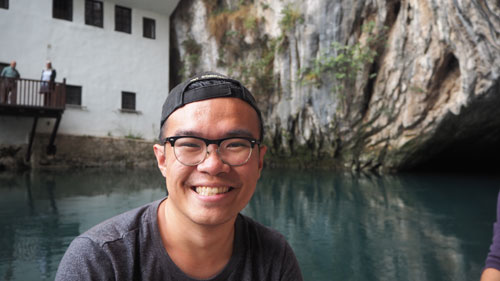
CAPTURING THE MOMENT: Pin Yi takes a selfie before entering a cave in Mostar, Bosnia, after an eight-hour bus ride from Zagreb. PHOTO: SIM PIN YI
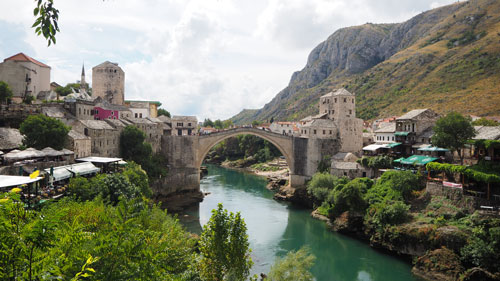
ECORATIVE LANDSCAPE: The Old Bridge in Mostar, Bosnia was the longest single arch bridge in the world for centuries. PHOTO: SIM PIN YI
Croatia is not a country widely visited by Singaporeans, and before I embarked on my exchange, I too, did not have much knowledge about this huge country. All I knew was that the country had a rich history.
The small city of Zagreb’s efficient transport system brought me to the coast, and gave me a chance to visit museums and memorials that detailed its struggle as a relatively small nation among the surrounding empires.
This meant that the rich culture was echoed in the infrastructure all over the city, almost as if stories were built into the walls.
Being in the midst of this culture was interesting to me, as Singapore is a vastly different city.
But as a guest to the country, I eventually learnt to recognise and adapt to the dynamics of the culture and appreciate its intricacies.
This exchange experience also gave me the chance to visit different places, such as Romania, Serbia and Bosnia — a total of 23 cities and 11 countries over four months, travelling through different parts of Eastern Europe.
Romania gave me my first experience with snow, which was a ridiculously chilly yet majestic one, while Bosnia offered a more scenic view of cobalt blue water, and Serbia showed me a raw glimpse into the lives of Serbians with the morning market buzz.
On one occasion, I visited the small town of Lublin — often mistaken as Dublin — in Ireland, on the invitation of a couple whom I met in Poland. I stayed in their apartment for two nights and explored their city with them. They showed me what living in a small town of just 348,000 people with a strong community bond is like.
This exchange in Zagreb School of Economics and Management has broadened my horizon not just through the extensive travelling, but also the interaction with the different people and their cultures.
I was the only one that embarked on this exchange to Zagreb from NTU this year, and being alone definitely pushed me out of my comfort zone.
Annabel Tan
Wee Kim Wee School of Communication and Information
Bangkok, Thailand
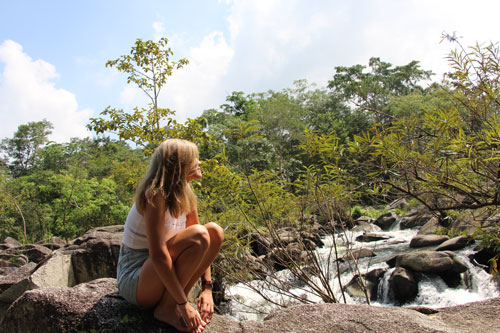
IN THE WOODS: Annabel soaks herself in the beauty of nature in Ratchaburi Province, Thailand. PHOTO: ANNABEL TAN
Bangkok is littered with popular tourist spots such as Chatuchak and Artbox.
But during my semester-long exchange, I realised that there is more to the city than its glitzy street shops and cheap bargains.
Instead, what I love most about the city is its grimy, raw side that is often overlooked.
The rough, old and dirty set of streets behind Chulalongkorn University’s dormitory was where I frequented the most.
It was a rundown area where the paint on the walls had faded and the metal gates had rusted. These streets were lined with old houses, laundromats and roadside food stalls. It was my favourite part of the capital.
After school, I would often stroll down the poorly and dimly lit streets, letting my nose take the lead as I searched for new places to dine at. Some nights, they would guide me to smoky grilled meats, and on other nights, I would find myself feasting on fragrant ginger-laced chicken rice.
It was also these solitary walks that brought me to local cockfights, where some villagers would put two roosters to fight and place bets on them, while the other villagers cheered and drank in jubilation.
There was a sense of community, much like what I imagined the kampung days of Singapore to be, and I felt at home.
The Thais like to say “ja yen yen’’, which means to take things easy. My Thai classmates and other locals I met lived by that mantra, and I started to follow their way of living as well.
Unlike in Singapore where the school’s common areas are filled with students’ heads bowed over their notes or laptops after class, the common areas in my Thai university were filled with students playing with the resident golden retriever, ironically named Cat, chatting over ice cream or painting banners for one of their many school events.
Very quickly, I saw myself becoming so much happier with these relaxing activities.
Before I left for Bangkok, I was afraid I would get homesick and never be able to settle in.
But these worries turned out to be unfounded because everyone I met was welcoming and did more for me than I ever expected.
The toughest part was not missing home, but having to eventually leave my second home and my newfound friends.
Eiap Tze How
School of Mechanical and Aerospace Engineering
Mumbai, India
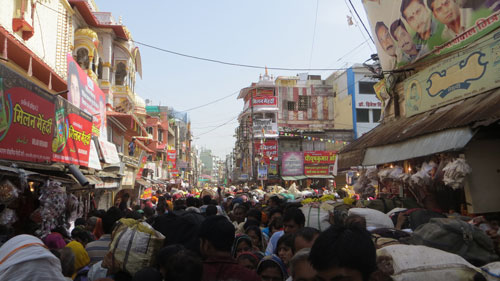
ROWDY STREETS: Families flock the streets of Ujjain, India during the Pitcher festival, known as Kumbh Mela.
PHOTO: EIAP TZE HOW
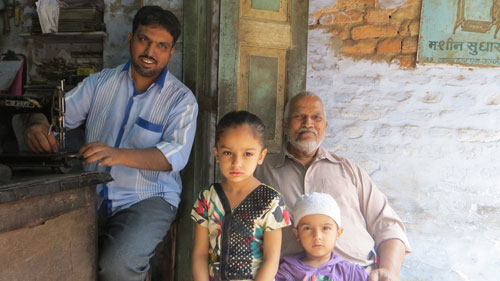
WARM ENCOUNTERS: Tze How stops by a shop in Ujjain, India where a family requests for a photograph to be taken. PHOTO: EIAP TZE HOW
I was told a few times that I was crazy for choosing India as my exchange destination, with my friends telling me that it is not a safe country.
It didn’t come as a surprise that many of my friends discouraged my decision, reiterating these stereotypical views of India based on high profile crime cases covered in the media.
But my experiences backpacking across India from Mumbai to Kolkata during my semester at the India Institute of Technology in Bombay proved that these generalisations do not do the country justice.
One of my highlights backpacking in India was in Ujjain.
I was attending the Pitcher festival, which is held once every four years, and known to be the largest peaceful gathering in the world.
I took a 16-hour train ride up north from Mumbai to visit the festival in May, with a German friend.
Pilgrims from all parts of India flock towards this small city of about 150 square kilometres for the festival, which lasts a month.
It is said that during this month, bathing in the sacred Shipra River, located along the west of the city, will cleanse the body of all sins.
To really immerse in the lives of the pilgrims, we took the chance to follow a huge group of them walking towards the river.
We walked for about 10km to see the river and the temples along it. Even though the river did not look clean, we decided to take a dip for the experience. While I am not a religious person and I may never understand their faith, it was quite an experience to be able to witness this festival.
The locals were also more than welcoming. On Holi festival night in March, there were only a few shops open, as it was a holiday.
My friend and I were roaming the streets in search of authentic Indian food when we came across a man and his daughter sitting by the steps of their house.
In an attempt to get directions to a convenient place with good food, we asked his 6-year-old daughter, who could understand English, where we could go.
But instead of directing us elsewhere, they invited us to their home with the most heartwarming smile. We could not say no.
Climbing up the flight of stairs, I wondered what they might have been planning to do to us. Perhaps we would be robbed for money.
Still, my curiosity led me into their humble house, which housed the family of six, but was the size of a typical small hostel room.
But their hospitality was top-notch, bringing us food and treating us more than mere strangers.
These were the humble ones in India that won my heart. They were not rich but they offered us a portion of their food. As technology becomes more advanced, we tend to forget about finding joy in the smaller things in life. The more we own, the less we give.
Despite covering almost 4500km by land, I cannot say that I have seen much of India; yet the experiences have made me more appreciative of what I have in my life.