


Previous Story
Frankly, My Dear: It’s not interesting to be a woman
Posted On 24 Mar 2016
Comment: Off
By Nicole Chia, Sports Editor
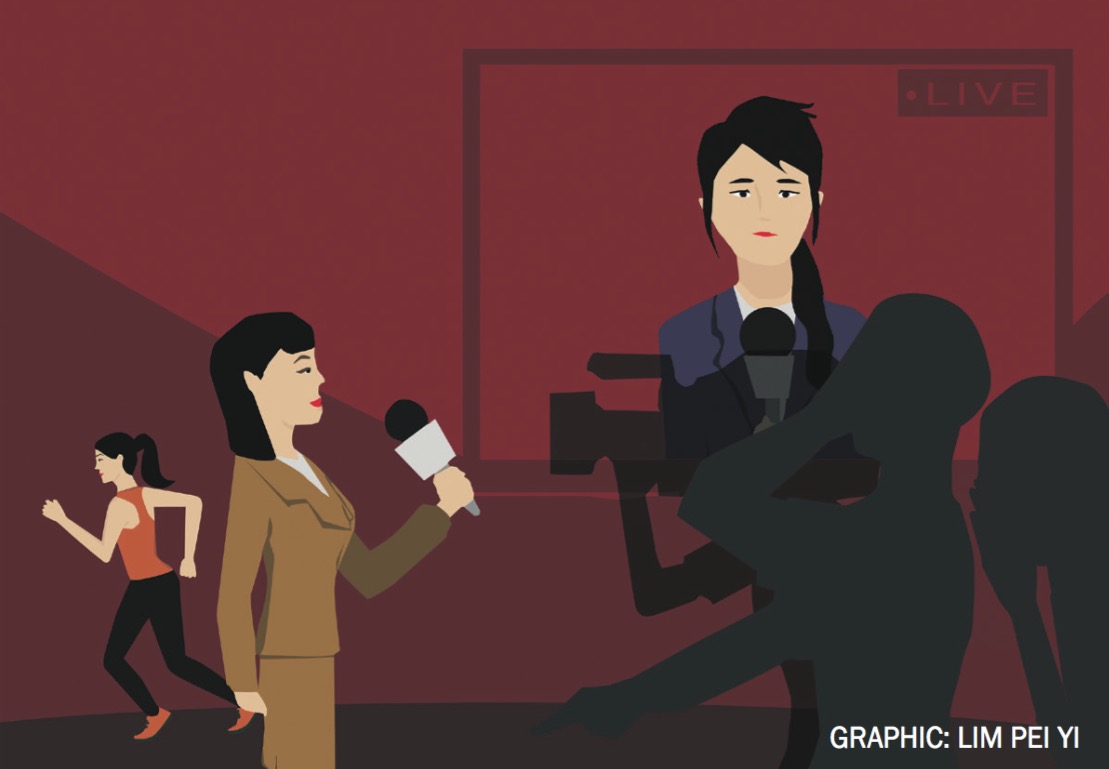
GRAPHIC: LIM PEI YI
The countless people I met throughout my six-month internship stint last year were different from one another in many ways, but their reactions to my choice of work were invariably the same.
“Interesting” was their response upon learning that I was a sports reporter at a local daily.
“Interesting,” they would say, eyebrows raised, when I told them of my intention to pursue a career in sports reporting.
Interesting, not because of the chance to speak to world-class athletes, or perks like exciting travel opportunities (which I was not privy to at that point in time).
To these people, it was interesting, because I was a female.
Once they got over the shock of meeting a female sports journalist, their next remark would be some variation of “I thought only men were interested in sport,” or “I didn’t know that the sports desk hired women.”
I was also advised against becoming a sports reporter by a well-meaning relative.
“It’s good that you like what you do,” she said. “But sports reporting is not suitable for girls, because you have to work till late.”
When I asked her why, the only answer she could give was: “Better for men, lah.”
How compelling.
This seemed to be a recurring theme. Why is the idea of a woman sports reporter so, for the lack of a better word, interesting?
I don’t know if these reactions are part of the reason there are so few women at the sports desks of local newsrooms.
Of all the full-time sports journalists I met from other local newspapers during my internship, only three were women. At the paper where I served my internship, there were no full-time female sports journalists during my term.
When more manpower was needed to cope with the demands of covering the 28th Southeast Asian Games last June, six more interns were roped in to help. Four were female.
A male colleague quipped: “Wow, it looks like the sports desk may have more women than men for the first time.”
But he was wrong. Even with the new additions, the male reporters still outnumbered their female counterparts by three.
On the other side of the world, however, the problem goes far beyond a lacking presence of female sports journalists.
In America, women in sports media are frequently subjected to sexist criticism and harassment, both online and offline.
Google “female sports reporters” and the first result that shows up is a link to an article titled ‘40 Hottest Female Sports Reporters’.
The next, a link to ‘The 15 Hottest Female Sports Reporters’.
This can be considered the “nicest” sort of sexist treatment that women in sports media face.
ESPN baseball commentator Jessica Mendoza became the first woman to analyse a nationally televised game in America last October. But this honour was marred by criticism from mostly male fans who tweeted about how they could not handle the fact that Mendoza, an Olympic gold medallist, was a “woman announcer.”
It is not only viewers and online trolls who behave so abhorrently to women in sport — two months ago, Jamaican cricketer Chris Gayle hit on Australian journalist Mel McLaughlin during a live interview.
These cases are recent, but they are just the tip of the iceberg when it comes to discrimination against women in sport.
Why is the thought of a woman commenting on sports so difficult to accept?
The idea that the world of sports is one where only men are welcome is archaic and, frankly, ridiculous.
Nearing the end of my internship, a supervisor asked about my future career plans.
When I told him about my dream of becoming a sports writer, he said: “That’s great! As long as you work hard and have the right attitude, you can definitely do it.”
That remark, I thought, was far more interesting.


