


Previous Story
Going Global, Staying Local
Posted On 14 Oct 2013
Comment: Off
Following the inaugural World Academic Summit held in NTU two weeks ago, Opinions Editor Andrew Toh sits down with President Emeritus of California Institute of Technology Jean-Lou Chameau, just after the university’s third consecutive year at the top of the Times Higher Education university rankings, and hears his views on universities and the state of education today.
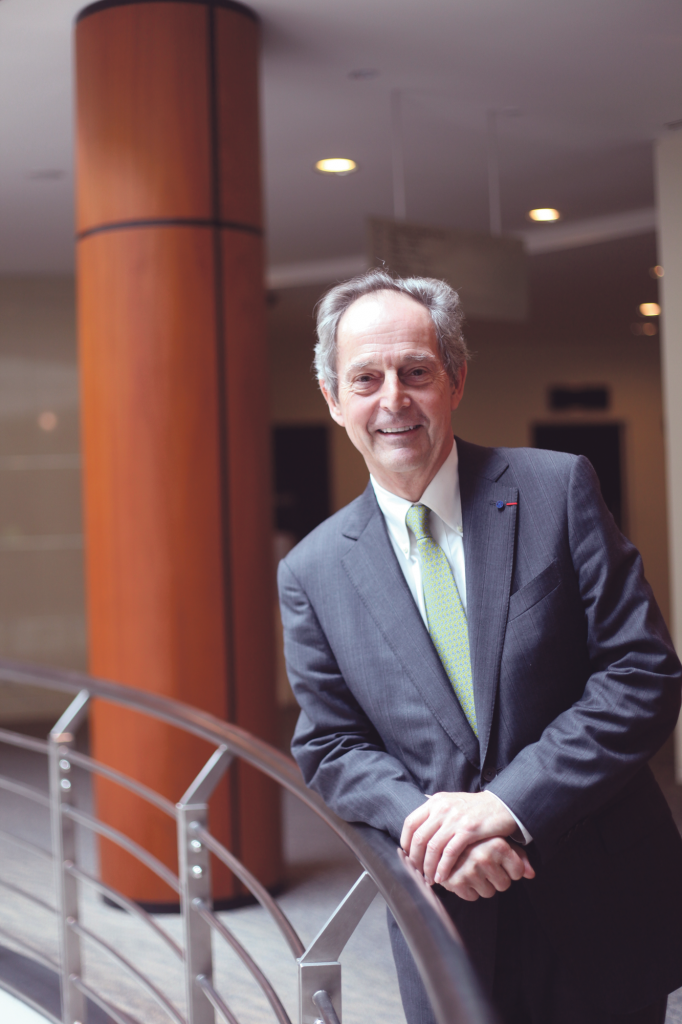
Photo: Lim Mu Yao, Photo Editor
Professor Jean-Lou Chameau is no stranger when it comes to running world-class institutions. In his extensive career as an academic, the 63-year-old has served as provost of the Georgia Institute of Technology and later as president of the California Institute of Technology (Caltech).
As president of Caltech, Prof Chameau cultivated a culture of excellence in research and learning in the institution that is the envy of universities around the world. Under his watch, Caltech rose through the ranks in the Times Higher Education (THE) World University Rankings and has been at the top of the charts for the past three years.
After seven years at Caltech’s helm, Prof Chameau left in mid-2013 to head the relatively new King Abdullah University of Science and Technology (KAUST) in Saudi Arabia as its second president.
He was in NTU last week for the inaugural World Academic Summit, which brings together world leaders from universities, government and industry to explore the role that world-class universities can play in fuelling the knowledge economy. The summit saw a range of topics being discussed — from the role that governments can play in supporting research, to how universities can respond in today’s global marketplace for higher education.
Pointing to the unprecedented growth in international collaboration between researchers over the last few years, Prof Chameau spoke of the need for the “internationalisation” of universities, and greater partnerships between universities across national borders.
“We’re in a world now where faculty and students — especially graduate students — are highly mobile and highly connected, and universities need to adjust to that,” he said.
“That’s an international DNA which I think is very attractive nowadays.”
At the same time, students also have to be able to apply the skills they learnt to meet local and international needs. That, he said, is where faculties and students need to “think globally, and deliver both globally and locally”.
He still looks back fondly on his time in Caltech, speaking of the culture of excellence in the university, where “there is something in the air there that is difficult to explain”.
Prof Chameau initially planned to complete his career at Caltech and retire in Pasadena, California, but when the opportunity came to head the research-intensive KAUST, the first of its kind in the Middle East, it was an offer he could not refuse. “It is always hard to leave. It was hard to leave Georgia Tech, and it was hard to leave Caltech.”
“But when you have the chance for a great undertaking in your life, I think it is an opportunity worth taking,” he said.
What made you move from Caltech, one of the most established universities in the world, to the relatively new KAUST?
In my life, I’ve been very fortunate. I’ve spent my entire career in the US. I left France when I was 22 and went to the US as a young man. And then I spent 36 years in the US — as a graduate student, as a faculty member, as a researcher and as a position of leadership in academia. During my time, I was very fortunate that Caltech became number one in the world.
I enjoyed that and I was able to contribute. Typically I would have kept doing that for a few more years and retire happy. However the opportunity of KAUST came up, and to me, it was an opportunity to create something from the start, to mould something into a great university. It is not often that you are asked to be part of something this important in life. And I find that the vision and goals of the university are truly outstanding.
What are the challenges of running a new university?
The challenge in some ways is the same as any other university. When I am asked what makes Caltech great, they think the answer is simple. It is actually very complicated. In order to be successful, you need to identify, recruit, mentor and support gifted, smart faculty and students. It was a challenge at Caltech, and it will be a challenge at KAUST.
At KAUST, there is another challenge, which is that it is new. And over time, you have to develop a culture of excellence, you have to develop what will become the KAUST culture. The cultures at Caltech and Georgia Tech were established over a hundred years.
So one thing that I believe is important and in my goal as president for the next few years is to start developing with the faculty, with the community and staff, a KAUST culture of excellence. It is different in that at the beginning, you have to pay more attention to it.
As president of an established university, is it more important to maintain the status quo than to introduce new developments?
On one hand, a place like Caltech or Harvard, they are always going to be among the best because they have the culture and are attracting good people. So in a sense, there is a little bit of maintaining the status quo.
However, if you look at the way things were changing in the past, you cannot remain at the top if you don’t always find ways to be at the leading edge of science and technology. Caltech is what it is because it is very disciplined in always saying: we need to be in emerging areas.
If we find that, say, in an area of research, there are dozens, maybe hundreds of universities doing similar research programmes, you start to think maybe it must be very important. However, if there are so many good people doing it, we say, let’s slowly diversify from this and go into a new area where there’s little interest and we develop something important.
So trying to be always ahead of the pack is what makes a great programme, so you can never stay in the status quo for too long. I could name certain universities in other places that had a higher reputation 20 or 30 years ago as compared to now.
How do universities adapt to the changing global climate?
Universities need to think globally, and deliver both locally and globally. The need to be global is because young people now are very mobile and highly connected. At the same time you need to deliver locally because over time you can make the country more prosperous, improve its healthcare, and contribute to the ecosystem.
I had an interesting experience a number of years ago at Georgia Tech in Atlanta. It was in the 90s and the strength of Georgia, and Atlanta especially, was booming. Many people were moving to the state and there was lots of industry development going on. In Georgia Tech, being global was important because the state allowed us to attract many international students to be educated as engineers at Georgia Tech. And the idea was to try to retain as many of them as possible, because there was a need in the economy for that workforce. So in a sense, you think globally yet you still deliver locally because you meet a local need.
And the balance is not easy because universities and faculties tend to do what is most interesting to them. That is great, but at the same time, the overall has to be good for the local situation.


