


Previous Story
Monkey sightings on the rise
Posted On 16 Oct 2017
Comment: Off
By Adele Chiang
She was walking along a corridor at the National Institute of Education when Rachel Koh, 20, spotted a wild monkey sitting on a grass patch.
Unbeknownst to her, the first-year Sports Science and Management student had already caught the attention of the monkey, who got up to follow her.
As Koh quickened her steps in an attempt to escape, the monkey gave chase, and started to pounce on her.
Terrified, she plastered herself against a nearby wall and used her hands to cover her face.
“I wanted to run away, but I was scared it would chase after me again,” Koh said, as she recounted the incident that took place a month ago.
A security guard then came over with a dustbin and tried to trap the monkey under it, but the monkey eventually leapt out of the bin and ran off, added Koh, who did not suffer any injuries.
Koh is one of many students who have encountered monkeys around campus in the past month.
On the same day, Bambby Cheuk, 20, who stays in Hall of Residence 12, spotted a monkey climbing onto a car’s windshield as a family was getting ready to drive out of the car park.
The second-year Wee Kim Wee School of Communication and Information student added that the monkey was “perched on their car”, preventing the family from driving off.
A video was later posted on NTU’s Facebook page, showing a monkey sitting on a table at North Spine’s McDonalds, licking up leftovers.
Another hot spot for monkey sightings is Hall 8.
A limping monkey often ransacks bins around the hall, leaving a mess behind, said Seraphina Poon, a third-year School of Physical and Mathematical Sciences student.
“It comes so frequently that my roomie and I named it Doris,” added the 21-year-old.
“My roommate’s father tried to shoo the monkey away once, but it was not scared at all,” said Poon.
According to a human-wildlife conflict campaign on the Animal Concerns Research and Education Society (ACRES) website, these monkeys often mean no harm and only attack when threatened. The public should avoid making eye contact with them or smiling with teeth, as these can be interpreted as threats, said the website.
ACRES also advised the public to keep a safe distance and refrain from feeding or shouting at the monkeys.
Other wildlife in NTU
But monkeys are not the only wildlife that have been sighted on campus.
Wild boars are often spotted at the forested hill beside Hall 16 Block C, where they can be seen closely from the fourth and fifth floors.
Hall 16 resident Kimberly Lai said she recently saw six baby boars from the fifth level of the block. She, along with some friends, had thrown them some fruits and biscuits.
ACRES advises the public not to feed these wild boars as it may cause them to become dependant on humans for food, causing them to remain in the area.
“This will spark off a chain of conflict situations (with humans) which may result in the animals needing to be trapped as an ineffective and cruel solution,” said an ACRES spokesperson.
He added that students should call a proper animal rescue organisation for advice and assistance instead of pest control when they spot a wild animal.
Bats have also been spotted around NTU.
Hall 8 resident Amy Ong was leaving her room when she noticed a baby bat lying at her doorstep.
“Its body was about the size of my thumb,” said the 21-year-old. “It didn’t look physically injured but I could tell it was really scared because it kept squeaking.”
Afraid someone would step on it, the third-year School of Art, Design and Media student picked the bat up and placed it in a cup. She then called ACRES, who instructed her to leave it on a nearby tree.
“It gripped onto the rough bark really well and climbed all the way up until I couldn’t see it anymore,” she said.
While encountering aggressive monkeys may make for a harrowing experience, most students seem to find that the wildlife around campus makes school life more exciting.
Said Lai: “I am sure the students from other universities do not get to feed wild boars in hall or see monkeys on the way to class. I guess this is part of the Pulau NTU experience.”
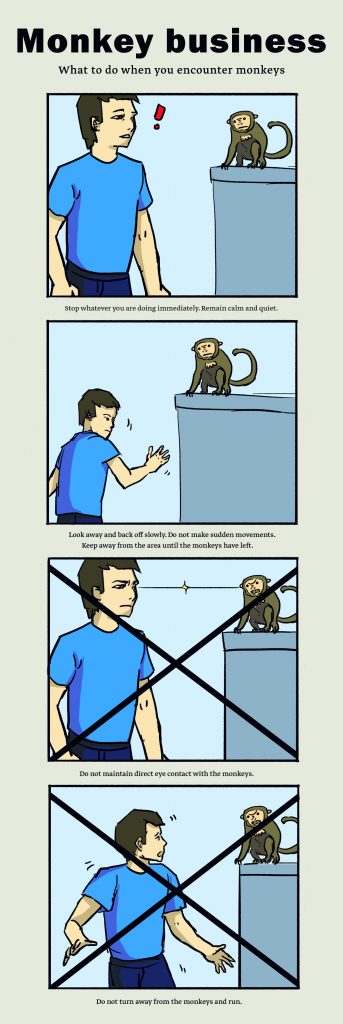
GRAPHIC: AMY ONG