


Previous Story
New Games, New Goals
Posted On 03 Feb 2015
Comment: Off
By Lim Ching Ying
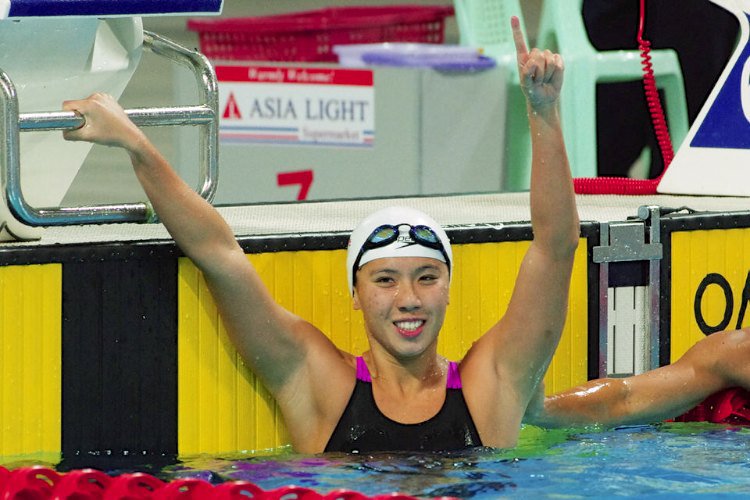
ANOTHER ONE TO HER COLLECTION OF MEDALS: Amanda Lim celebrates after her 50m freestyle win.
PHOTO: INTERNET
Come this June, Singapore will play host to the 28th Southeast Asian (SEA) Games for the first time in 22 years. Having already qualified for the competition, NTU’s national athletes Amanda Lim and Calvin Kang share with us their expectations, aspirations and loftier goals amid their rigorous preparation.
At the mere age of 22, Amanda Lim is one of the fastest female swimmers in Southeast Asia. Meanwhile, sprinter and Olympian Calvin Kang holds the national junior 100-metre sprint record of 10.53 seconds.
The pair have rubbed shoulders with the world’s best at international meets and have also managed to hold their own. Despite their successes, they remain hungry for more and have their sights set on another competition.
Their goal? Victory at this year’s SEA Games, in front of friends, family and a raucous home crowd.
Seasoned Winners
Lim, a third-year student from Sport Science and Management (SSM), clinched three consecutive gold medals in the 50-metre freestyle event and has already amassed 15 medals in the Games in total.
24-year-old Kang, also in his third year in SSM, holds a 4×100-metre relay silver medal from the 2011 Games. This year, he is hoping not just for a team medal, but individual personal bests or perhaps a record-setting run.
Time is more than crucial for these two athletes. The clock is ticking as the Games — which commence on 5 Jun — draw ever nearer.
Kang’s intensive training period is just beginning, with a competition scheduled each month while Lim recently returned from a training stint in Melbourne.
Time, again, is of the essence — down to the milliseconds — and they attempt to shave off their personal bests, and the number of training hours they clock in the pool and on land.
In Kang’s case, the digits determine whether or not he even qualifies for individual race events. His national junior record stands at 10.53 seconds for a 100-metre sprint. An ideal timing to secure a podium finish, he says, would be around 0.2 seconds faster.
And as for Lim, she victoriously set a new national 50-metre freestyle record just last year with a 25.09-second swim — bettering the previous record by almost 0.22 seconds.
Homeground advantage and pressure
Both athletes acknowledge the presence of homeground advantage: physically, in terms of acclimatisation, and psychologically, with regard to support from the home crowd.
Lim is no stranger to competing on home ground after taking part in 2009’s Asian Youth Games and the inaugural Youth Olympic Games in 2010. She recalls the cheers they heard when she entered the competition venue as “deafening”.
Adding that the support does not go unheard by the competing athletes, she said: “The whole atmosphere at the pool is just different and you just feel pumped hearing the crowd cheering for you.”
This also inevitably increases pressure on athletes to perform their best in order to give the home crowd a good show.
However, Lim explained: “Over the years, I have learnt to convert this pressure into motivation.”
“Running on home ground will be a new feeling,” added Kang.
But for any sportsman, no matter what competition, whether it’s in Singapore or not, it’ll be of the same intensity in terms of the level of competition and how much we put in.”
Post-SEA Games Goals
There will be no resting on their laurels after theSEA Games for these national athletes, who train intensively year-round.
Lim’s target meet this year, besides the Games, will be the biennial FINA World Championships in Kazan, Russia. Also, having missed the 2012 London Olympics, she will be gunning for the 2016 edition in Rio, which she calls “every athlete’s dream”.
Kang hopes to keep training for a few more years to get stronger, stabilise his timings and reach his peak as most sprinters do at a later age. For him, his preparation is not mindlessly centred on winning medals — although they are, of course, ideal — but rather, to constantly improve his timings.
“If the timing comes, the medal will come,” he reasons.
Sacrifices and advice for fellow athletes
Both athletes also have had to balance sporting commitments with their studies, in preparation for the Games.
Kang opted for a lighter load of three modules this semester in order to focus more on his preparations.
Lim added that while sacrifices were inevitable, NTU has been a constant source of support in her sporting endeavours.
“Juggling between school and training is never easy but I think NTU has put together a very supportive team of lecturers and advisors,” said Lim.
“In the end we just have to work out a way where everything fits.”
Kang describes his athletic journey as an ongoing and constant compromise. Family time and an active social life are tough to come by given the intensity of training — he trains six times a week — as well as overseas stints.
To him, setting clear goals and knowing one’s priorities is important. And whether one’s training is seasonal (for Institute-Varsity-Polytechnic, Inter-School or Inter-Hall), or throughout the year, mental strength remains imperative for every athlete.
“Consistency is very important in terms of the hours trained and your dedication,” says Kang.
This is my passion — I’m lucky to be able to do what I love, so my effort only increases over time.”
Lim concludes: “I always live by this quote: if it is to be, it is up to me. That is what drives me everyday.”