
Previous Story
New Hive’s small group hubs grow collaboration
Posted On 20 Aug 2015
Comment: Off
By Shaun Tan, News Editor
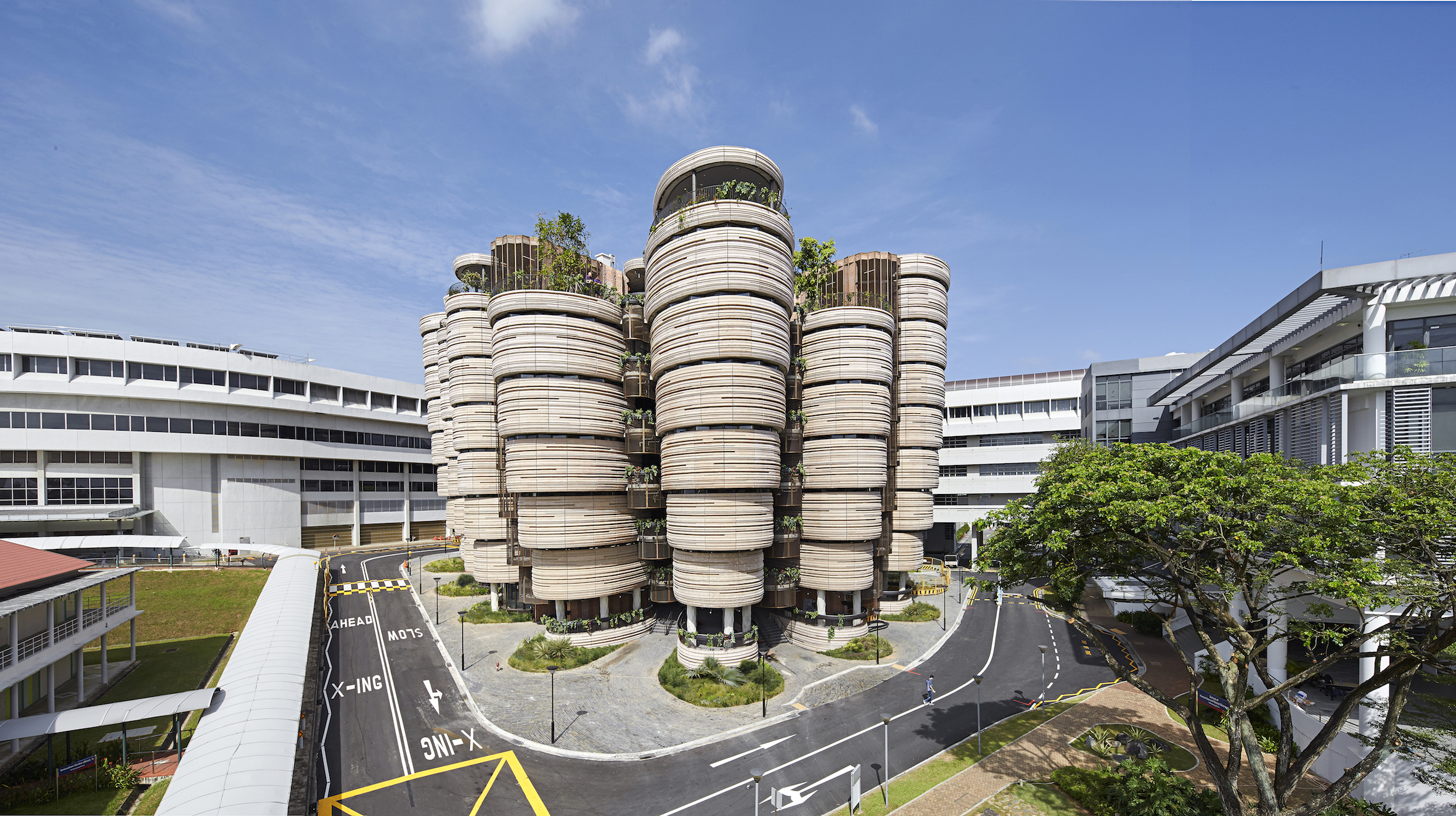
NEW DIRECTIONS: The Hive serves as home to 56 smart classrooms and a library. PHOTO: HUFTON AND CROW
NTU’s iconic new learning hub, which resembles stacks of dim sum baskets, has officially opened its doors this new semester.
The building, officially named The Hive by NTU President Professor Bertil Andersson in his convocation speech on 27 July, will support the “flipped classroom” teaching method.
In this approach, students learn content online and discuss questions in class. The $45 million learning hub, brainchild of British designer Thomas Heatherwick, who conceptualised the London Olympic Cauldron, was officially unveiled in March this year.
The Hive is home to 56 new generation smart classrooms, which aims to foster collaborative learning and student interaction.
Prof Andersson called The Hive a “sight to behold”, revealing that it was selected as a finalist in the World Architectural Festival 2015.
He added: “We expect it to be a hive of student activities and new learning pedagogies.”
Prof Kam Chan Hin, Senior Associate Provost (Undergraduate Education), said: “The advanced educational facility provides a tremendous opportunity to bring down the walls between the different disciplines.”
The eight-storey learning hub’s smart classrooms come with flexible clustered seating for small group discussions.
Each classroom is also equipped with electronic white boards, multiple LCD screens and wireless communication tools.
The Hive has already created a buzz among students.
Natalie Chong, 19, a first-year student from the School of Humanities and Social Sciences (HSS), said: “It’s very aesthetically pleasing and modern. Every time we walk past it, my seniors will point it out.”
“It’s a nice change from the factory-look of the older buildings. I hope NTU continues on the same path design-wise,” she added.
Faris Malik, 23, a third-year student from HSS, also welcomed the opening of The Hive. He said: “It really stands out in stark contrast to the existing architecture in NTU. It shows the university’s changing direction, like its fresh approach to education here.”


