


Previous Story
New Tools for the New Age Newsroom
Posted On 09 Apr 2014
Comment: Off
Media content is now produced and consumed differently as compared to previous times. Ashley Tay examines the factors involved.
By Ashley Tay
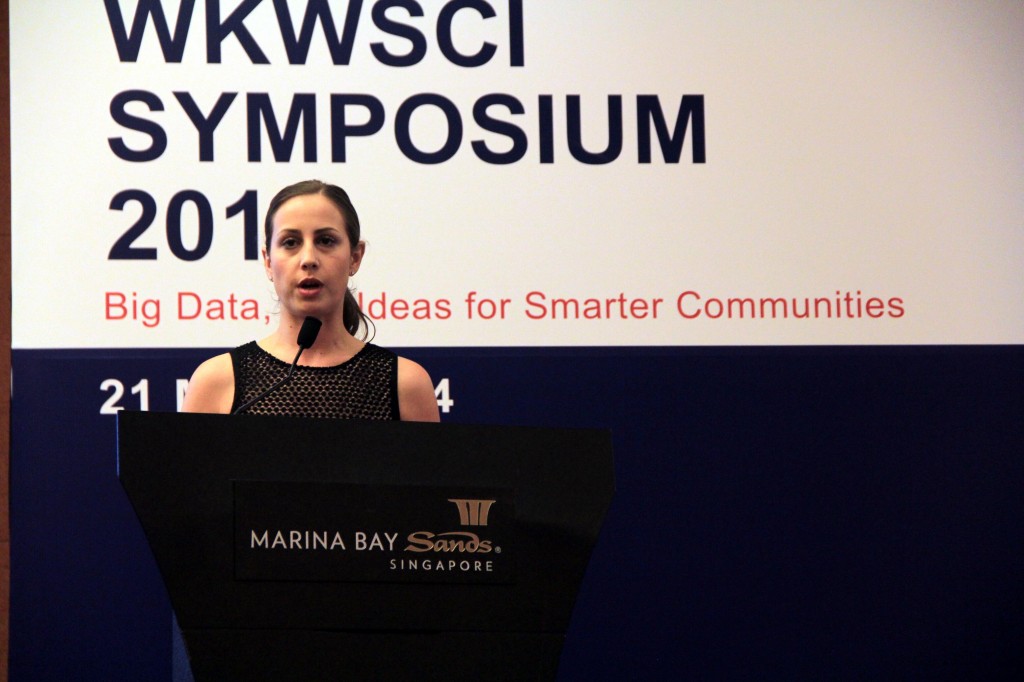
EVOLVING MEDIA: Storyful Bureau Chief Ms Asha Phillips addresses the audience during the WKWSCI symposium, held on 21 Mar.
PHOTO: PHAM QUYNH ANH
The advent of social media has not only significantly altered the way individuals consume media content, it has also changed how media content is traditionally produced. With the availability of social media on smartphones, readers today are empowered to produce and share their own media content at their fingertips. The escalation of such a trend has pushed journalists to rethink the way stories and information are sourced. Instead of going out to the field to search for real-time information, journalists can tap on existing information available on social media platforms, produced by online communities, in real-time.
News agencies depend on having the first scoops and the latest information, and Storyful, the world’s first social media news wire that sources, verifies, and distributes timely user-generated content, provides exactly that service.
Held at the Marina Bay Sands Expo and Convention Centre on 21 Mar, this year’s Wee Kim Wee School of Communication and Information (WKWSCI) symposium took a special focus on Big data. The term ‘Big Data’ commonly refers to huge data sets that are too complex to process and require the help of database management tools. Speaking at the symposium was Ms Asha Phillips, Asia Pacific Bureau Chief of Storyful, who shared her insight into their business of citizen journalism.
Storyful has successfully managed to get hold of videos which documented the Boston Marathon Bombings last year, and more recently, a video which documented Russian aircraft flying into Crimea in the Ukraine Crisis. The success of the social media wire has led to its acquisition by News Corp (the world’s second largest media group as of 2011 in terms of revenue) for US$2.5 million (S$3.13 million) in December last year. Since then, content curated by Storyful goes into News Corp’s global newsrooms, including The Australian, The Wall Street Journal and The New York Post. Storyful’s content also goes to third-party agencies such as The New York Times and Reuters.
Storyful deals with a sheer amount of information on a daily basis and its production growth is estimated to climb. It is projected that in a single ‘Internet Minute’, 100,000 new tweets are being tweeted, 277,000 users are logging into Facebook and at least 30 hours of video are being uploaded on YouTube, according to Intel, an American chip making corporation.
The everyday person with Twitter can now easily be a potential source for breaking news.
“There’s so much noise going on out there, so what we’re trying to do is find that news nugget within the millions of tweets that are sent every day,” said Ms Phillips.
To source for newsworthy content, Storyful curates Twitter users into lists according to their geographical locations and monitors interest groups and community groups — such as activist movements — on Facebook.
Apart from the challenge of sieving through information, Storyful also faces the challenge of verifying the content that they find.
“The important thing for us is to not only look for the content but to actually go through the steps of understanding who took the content, that person’s history and to find out everything there is to find out about them publicly on their public profiles. We also look up the date and the time, even down to the very minute, and we also verify the location,” said Ms Phillips.
She acknowledged that journalists do not necessarily have all the knowledge and resources to verify information. Often, journalists at Storyful enlist the help of Internet communities to validate the accuracy of specific content.
“What we’re doing is tapping into data that is already publicly available, using technology that we’ve built and also harnessing crowdsourcing, so we do go out to the community on Google+, Facebook and Twitter to ask for help if we need it,” she said.
With more social media applications being produced and more users jumping on board the social media bandwagon, it is undeniable that the traditional newsroom will soon have to make room and include online communities in the process of newsmaking.
In September 2013, Storyful officially launched a Chrome browser extension, Storyful MultiSearch, which allows news agencies to tap into online communities. Storyful MultiSearch allows reporters to search through Twitter and YouTube for keywords, enabling them to sieve through large amounts of online data with one click, saving time during a breaking news story.
That being said, Storyful isn’t the only company that has been employing the use of social media. For instance, NBC has created its own Twitter account which releases curated and verified real-time news. Sulia, a subject-based social network that connects you to sources who are knowledgeable on subjects you are interested in, has also developed its own Twitter lists of professional and amateur sources that would aid in the verification of stories. Some news agencies such as BBC have also created an internal division that would specifically look at verifying user-generated content from social media.
In a Storyful blogpost, Storyful’s Chief Executive Officer Mark Little addressed a conundrum faced by many journalists in this new age of newsmaking. Though depending on social media platforms may seem like a great leverage, it also poses as a great threat to the role journalists play in delivering content, and begs the question if there is still room for journalists in today’s newsroom.
It seems inevitable that journalists now have bigger shoes to fill with a changing media landscape. Apart from being tasked to source and report stories on their own accord, journalists now have the added responsibility to consolidate credible information from various social media sources, and present it as a compelling story for their readers.
Another reason why newsrooms perceive social media as a great threat to journalism is simply because the nature of their businesses run on dishing out the first scoops. And with social media, the prospect of getting the news first seems bleak, as the average joe is now equally equipped to do likewise.
The newsrooms’ ‘scoop’ mentality has resulted in the reluctance of many newsrooms to hop on board the social media bandwagon. Mr Little attributes the inability to shake off this mentality as an issue of pride.
“Perhaps the problem is that too many journalists still believe they are the rightful ‘owners’ of breaking news,” he said.
Mr Little went on to urge newsrooms and reporters alike to rethink their roles in the age of social media. Instead of trying to ‘own’ a story, reporters are now called upon to manage a massive amount of information on the Internet.
“To practice ‘true Journalism’ in this new age, we need humility. We need to understand that we no longer have a monopoly over words or images,” he said.


