


Previous Story
NTU First to Use 3D Electron Microscope
Posted On 28 Oct 2013
Comment: Off
New telescope will help scientists better understand proteins and enzymes related to cancer.
By Esther Lam
NTU is now the only place in the world where scientists can see particles half a million times smaller than a grain of rice.
And it’s thanks to a new 3D microscope — the Tecnai Arctica — installed in the Cryo-Electron Microscopy (Cryo-EM) Laboratory which opened at the School of Biological Sciences on Thursday.
The Tecnai Arctica, a large microscope almost the size of one room, was created by US-based microscopy company FEI. Dr Peter Fruhstorfer, vice-president of FEI’s life sciences business unit, said the company chose to install the 3D microscope in NTU partly because of the new Lee Kong Chian School of Medicine, which took in its inaugural cohort this August.
“Hopefully with our creation, the medicine school will help to push new boundaries in science and gain recognition in biomedical and life sciences,” he said.
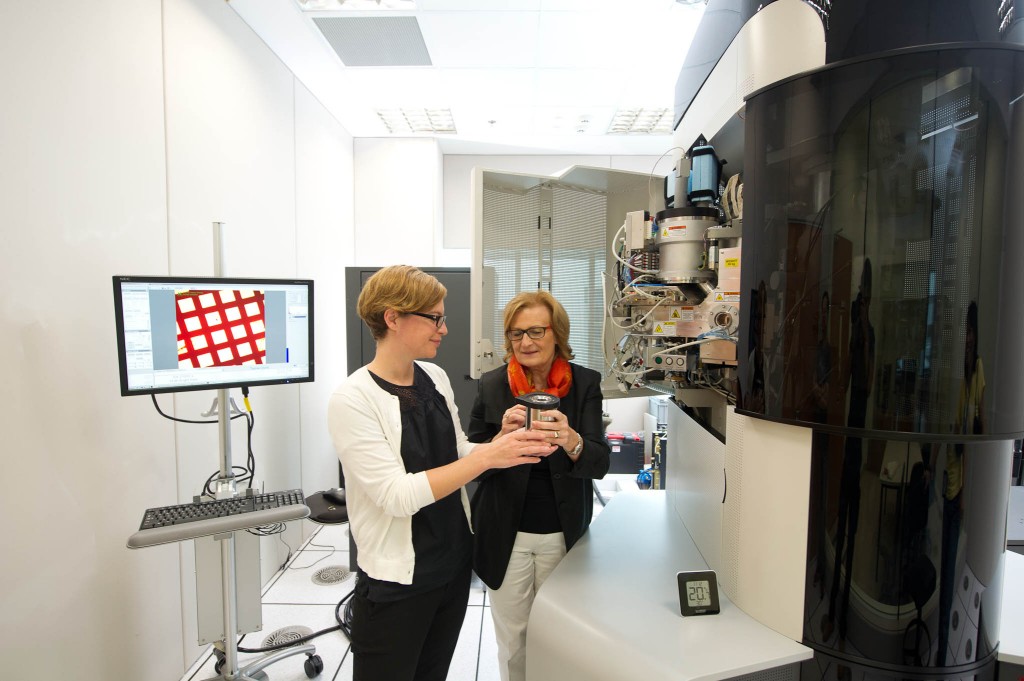
CUTTING EDGE: Asst Prof Sara Sandin (left) and Prof Daniela Rhodes (right) working with the new Tecnai Artica Cryo-Electron Microscopy microscope at NTU.
PHOTO: NTU
The Cryo-EM Laboratory is dedicated to cancer research, and the Tecnai Arctica will be used to view components of cancer cells that are otherwise too small to be analysed by other microscopes. The Tecnai Arctica does that by using a technique called single particle analysis (SPA). During the SPA process, a particle is first frozen to preserve its original structure. Then, thousands of images of that particle are taken and combined to derive a high resolution 3D model.
This 3D model essentially creates a virtual replica of the particle, which scientists can use to further test and dissect without affecting the original particle.
The expert of the SPA technique, who is also in charge of the Cryo-EM lab, is NTU Professor Daniela Rhodes, a molecular biologist. She said the Tecnai Arctica will help her team of scientists better understand the inner workings of proteins and enzymes related to aging and cancer.
“This means we can start to look for and to develop solutions to treat such conditions,” said Prof Rhodes, who is also a member of the European Molecular Biology Organisation.
Prof Rhodes recently received a S$24 million research grant from the Ministry of Education, and the grant will be used to maintain the Cryo-EM Laboratory.
NTU President Professor Bertil Andersson said the new laboratory will place NTU in “a very good position to push the frontiers of biomedical science and medicine”.
“Our ultimate goal is to utilise our research findings to help tackle major problems in human health and disease,” he said.


