


Previous Story
NTU Membrane Invention Produces Cheaper and Cleaner Water
Posted On 03 Oct 2014
Comment: Off
Invented by NTU Associate Professor Darren Sun, the self-cleaning membrane boasts an operational lifespan twice that of current technologies in the industry.
By Shaun Tan
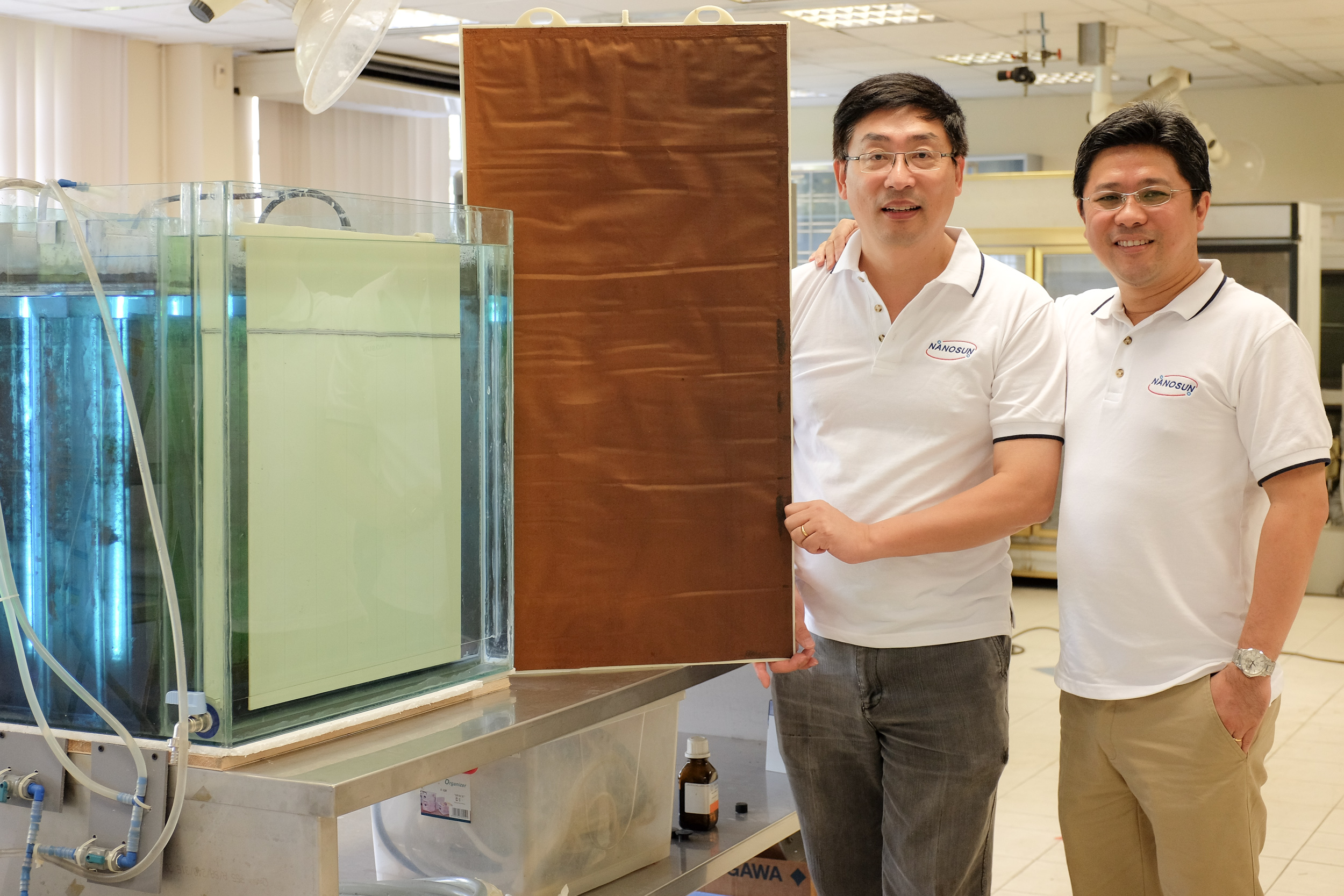
CLEANER WATER: Associate Professor Darren Sun (right) and Adjunct Professor Wong Ann Chai (left) with their 3D printed innovative multi use membrane.
PHOTO: NTU
Drinking water could soon be cheaper and cleaner, thanks to an invention by two-year-old NTU start-up Nano Sun.
The invention, a self-cleaning membrane, boasts an operational lifespan twice that of current technologies in the industry, said its developer, Associate Professor Darren Sun from NTU’s School of Civil and Environmental Engineering.
Dr Sun spent the last 17 years researching and testing the membrane, which he patented in 2008.
Wastewater treatment and desalination plants currently use polymer membranes to purify water, which come with their “fair share of limitations.”
“They have a short lifespan of two to three years, and are prone to issues such as biofouling, which clogs up the surface of the membrane and thus reduces water flow,” said Dr Sun.
The membrane created by Nano Sun has a lifespan of about five years. Its key difference is that it is made of titanium dioxide, a chemical ingredient commonly found in sunscreen lotion.
Unlike plastic-based membranes, the titanium dioxide membrane does not break down under extreme temperatures, or when exposed to ultraviolet light.
Water also passes through titanium dioxide more readily than the plastic membranes currently used in the industry. It also has natural antibacterial and anti-clogging properties, allowing it to clean itself.
“Water treatment plants will be able to reduce their operation costs, as our new membrane will last longer and have less clogging issues,” Dr Sun added.
Nano Sun’s groundbreaking creation is also the first to be manufactured with 3D printing, making it “fast and sustainable”. 3D printing is an additive process which fully optimises materials used in manufacturing, unlike the traditional subtractive process of producing membranes, which generate a lot of waste.
As part of NTU research, the team — comprising Dr Sun and Adjunct Professor Wong Ann Chai from NTU’s Nanyang Business School — received funding of $2 million from the Prime Minister’s Office and national water agency PUB in 2006. Further funding of $2 million from investors in 2013 enabled the start-up of Nano Sun.
Nano Sun has secured a deal with PT Pelaksana Jaya Mulia, a large Indonesian firm, to produce 10,000 cubic metres of clean water daily. It is also working with an industrial paper mill in Guangzhou, China, to optimise its wastewater treatment processes.
Both contracts will help save up to $3 million over the next five years, and could potentially be used in household water filter systems and water treatment plants in Singapore.
Currently valued at $80 million, the company is currently “in talks with local water agencies and companies” to put the technology on the market, added Dr Sun.
First published: 3 Oct
Updated: 8 Oct


