


Previous Story
NTU rises to become Asia’s top university
Posted On 06 Nov 2017
Comment: Off
By Jasmine Hoe
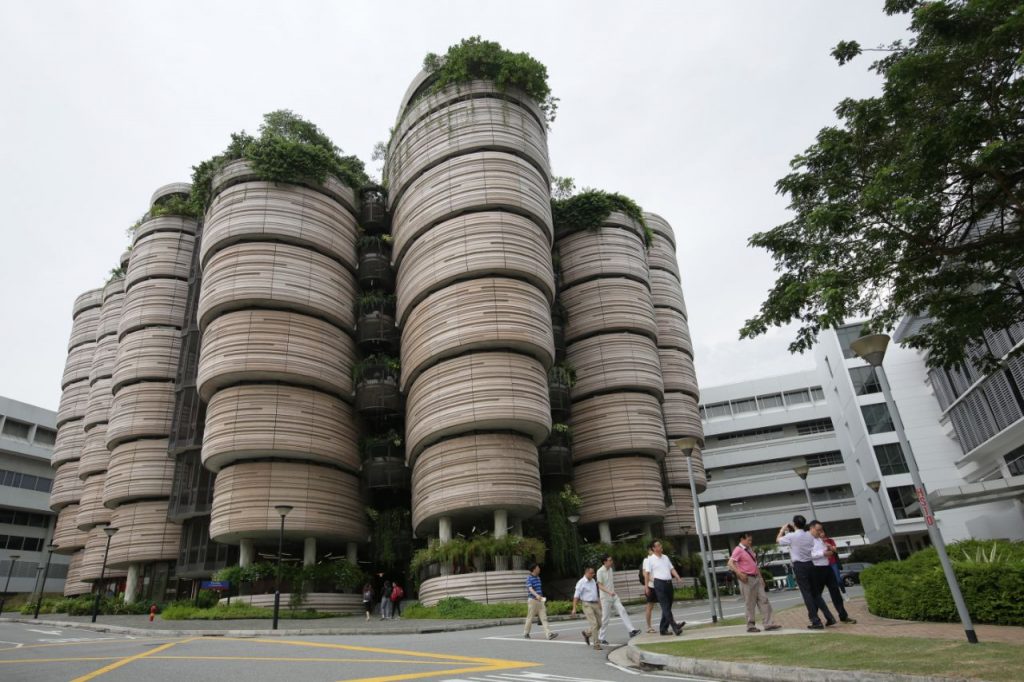
PHOTO: YEO WEI LUN
NTU has climbed two places this year to take the lead as Asia’s top university in the Quacquarelli Symonds (QS) Asia University Rankings.
This comes after NTU’s impressive performance in the QS World University Rankings in June, where it was ranked 11th in the world — the highest position ever attained by an Asian university.
The QS Asia University Rankings is based on a methodology that constitutes 10 performance indicators. The QS World University Rankings, on the other hand, is based on only six indicators.
Both look at criteria such as academic reputation, employer reputation and citations per faculty, but the QS Asia University Rankings also takes into account the proportion of staff with PhDs and the number of research papers per faculty.
NTU achieved a perfect score for the proportion of international students and quality research indicator. The university has also improved its scores for papers per faculty and student-faculty ratio in the QS Asia University Rankings.
For the second consecutive year, the university is also Asia’s best performer for citations per paper, which assesses the impact and quality of scientific work done by universities.
Students that the Nanyang Chronicle interviewed said NTU’s new ranking has a positive impact on the student body.
Elizabeth Yee, a second-year student from Nanyang Business School, said that rankings are important for the university’s image, as prospective students might take that into consideration when applying for university.
“I did consider it (rankings) when I was choosing between NTU and NUS. I feel that NTU should strive to maintain (its) current image,” added the 20-year-old.
Some feel that NTU’s ranking will boost their job prospects.
“Employers generally have a good impression of NTU and I think it had to do with our consistently good ranking,” said Ms Janice Coel, who graduated from the School of Biological Sciences this May.
“That’s why I feel NTU has to keep improving, and keep pushing itself to stay afloat in this competitive market,” added the 23-year-old.
Second-year School of Humanities student Geraldine Fung said she is proud of the university’s progress over the years.
“We’ve come a long way from when we ranked quite far below NUS,” added the 20-year-old.
While this achievement is an academic milestone for NTU, some students feel that the rankings do not affect them personally.
First-year School of Physical and Mathematical Sciences student Elizabeth Kwok said rankings of the individual schools in NTU are more important than the university’s overall ranking.
The 20-year-old believes that potential employers place more emphasis on that. “It depends (more) on the school I come from,” Kwok said.
Second-year Sports Science and Management student Tan Kun Lan said: “I feel that university rankings are mostly done by comparing the research papers professors have done, which doesn’t really affect me.”
“Ranking is of minimal importance as things like results, attitude, the way you carry yourself as a person are much more important,” added the 20-year-old.
In a recent press release by NTU, President Bertil Andersson highlighted that Asian universities will face the challenge of developing high quality teaching and research programmes, on top of establishing strong partnerships across the region.
“If Asian universities maintain their momentum, they can potentially become the world’s leading dynamos for learning, knowledge generation and innovation by 2050,” added Prof Andersson.