


Previous Story
NTU Wakeboarding Club riding through the waves
Posted On 17 Mar 2016
Comment: Off
Led entirely by freshmen, NTU’s Wakeboarding Club is looking to cement its position in the tertiary scene
By Ignatius Koh
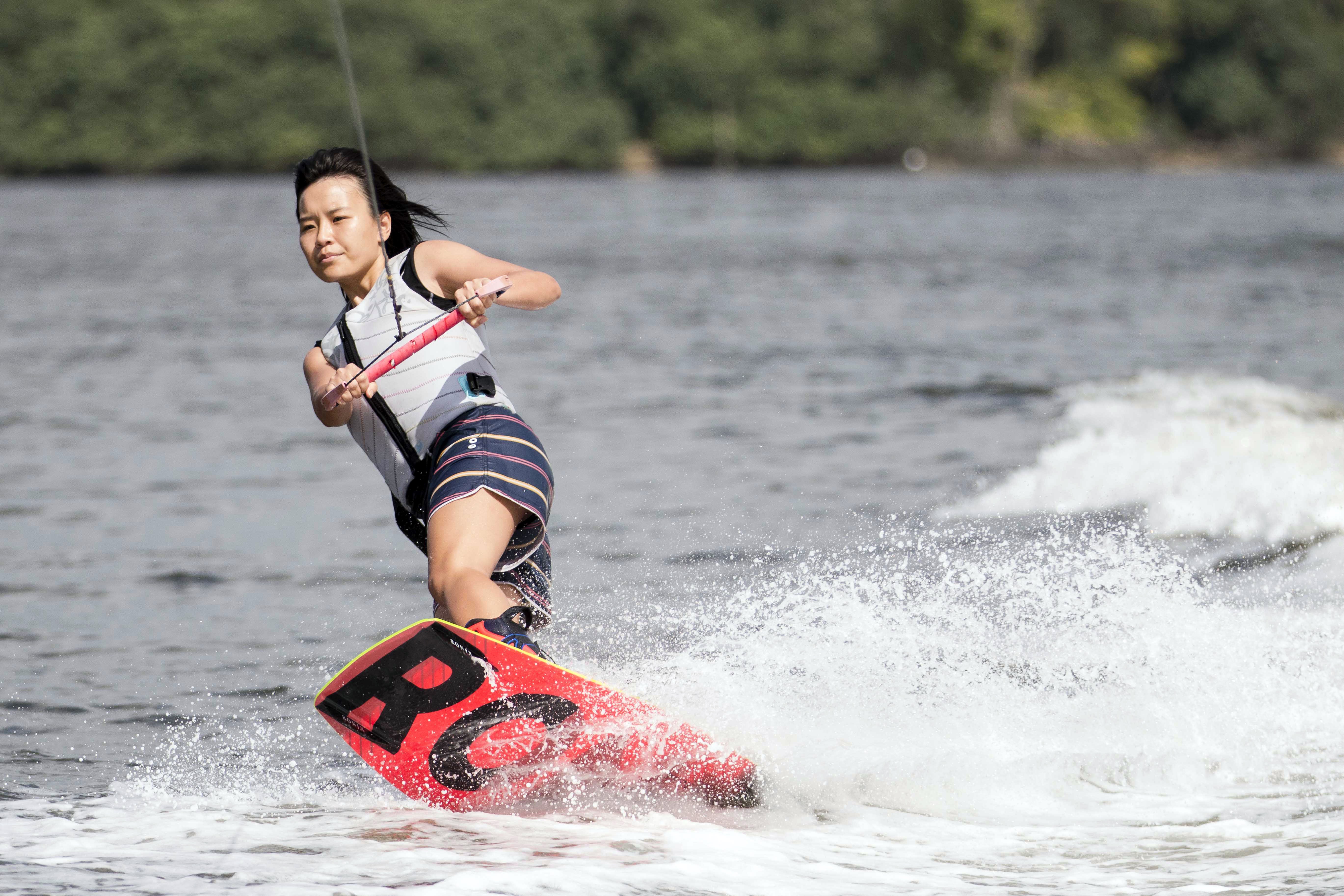
NTU Wakeboarding Club president Jessica Tsang (pictured) hopes students do not feel intimidated by the idea of performing wakeboarding tricks. PHOTO: NICHOLAS YEO
They took up the challenge despite their lack of experience. Thrust into leadership roles just two weeks into their university lives, the NTU Wakeboarding Club’s Executive Committee — comprising five first-year students in all — hopes they can steady the boat after a rough start.
Wakeboarding, a water sport, involves riding on a board and performing acrobatic movements while towed behind a motorboat.
Each NTU wakeboarder now pays $45 for a 20-minute training session on water.
Due to the costly nature of the sport, the club’s membership dropped to an all-time low last year.
“It feels like we’re starting the club from scratch,” said president Jessica Tsang, 21, a first-year National Institute of Education student.
The club was formed in 2012 and has 35 members now, of which 18 are exchange students — a far cry from the six members it had just a year ago.
Only four wakeboarders represented NTU at last year’s Institute-Varsity-Polytechnic (IVP) Games, where they failed to win a medal.
But with a complete Executive Committee and more athletes this year, the team is confident of a podium-finish at the Games in July.
“It won’t be easy, because the other schools are more experienced,” said Tsang. “But I think third place is possible if we train really hard.”
Team captain Ho Jia Wei, a first-year student at the School of Mechanical and Aerospace Engineering, had only started wakeboarding six months ago after being introduced to the sport by the club’s seniors.
“There are some good riders in the team this year, so I have to put in more effort to keep up with them,” said the 21-year-old.
Although 25 of its current members are new to the sport, Tsang insists lack of experience is not a problem.
“On the boat, the experienced members advise the newbies on how to balance themselves, and to relax,” she said.
The difficult part of wakeboarding, she said, is getting the technique right.
“It can get scary when everyone is watching,” said Tsang, who has been wakeboarding for four years.
She said men usually take a longer time to balance than women.
“The men tend to resist the pull of the boat, which causes them to tire out faster,” said Tsang.
Guiding the team is coach Mr Frankie Ng, 41, a silver medallist at last year’s Southeast Asian Games. Mr Ng declined to be interviewed.
Apart from water training once a week, the wakeboarders train on land once a week for two hours.
To improve their stamina, the team does sprints and running intervals, and static exercises such as push-ups and pull-ups to build muscle endurance.
A podium finish at the IVP Games will give the club a higher chance of being promoted from Tier 2 to Tier 1 of the Sports Club’s categorisation, which will increase their funding.
This will attract more students to join the club, said team captain Ho. “There are a lot of people who are willing to try wakeboarding, but it is an expensive sport and they are put off by the price,” said Ho.
While the high cost of the sport has deterred some local students, the novelty of wakeboarding has attracted foreign and exchange students, who are willing to fork out money to try the sport.
Turkish student Iskender Omer Burak, 23, a first-year PhD student at the School of Electrical and Electronic Engineering, joined the team because he wanted to try something new.
Burak said: “Wakeboarding is a new sport that allows me to explore the possibility of competing for NTU.”
“The excitement dominates the experience more than the stress of the cost,” he added.
To encourage more people to join the club, Tsang addressed a common misconception.
“Wakeboarding is something most people think is out of their league, because there are many tricks involved,” said Tsang. “But these can be picked up progressively.”
“It’s different from what they expect, which is why I think it’s a sport worth trying.”


