


Previous Story
Of Minds and Men
Posted On 08 Apr 2015
Comment: Off
By Shalom Chalson
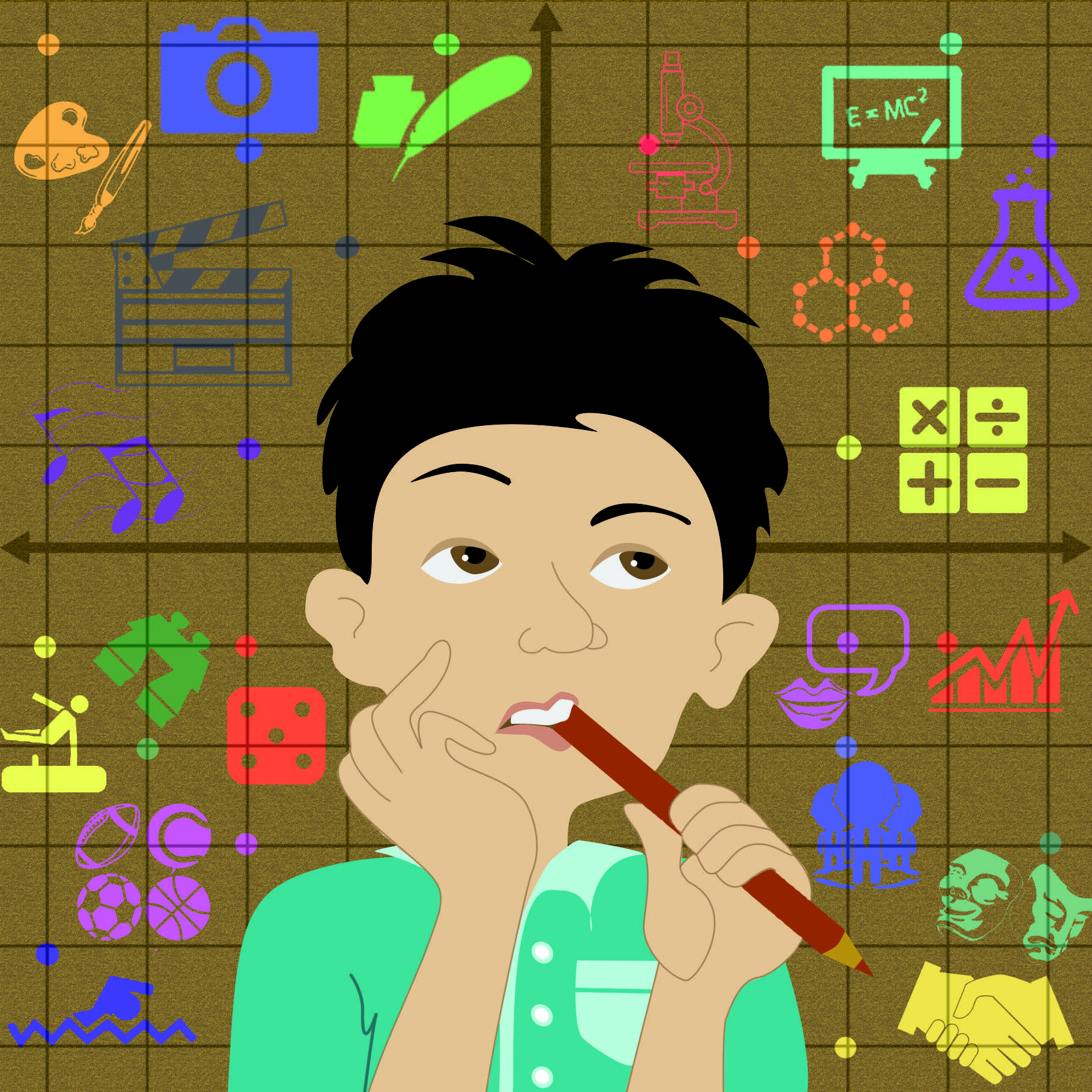
MULTIPLE INTELLIGENCES: Dr Howard Gardner proposes that there should be more than one definition of talent.
(GRAPHIC: ZHENG QI MING)
What is the difference between a bird and a lion?
According to a letter to the Straits Times by a parent, published on 5 Feb, the correct answer to this question reads: “The bird has feathers but the lion does not have feathers.” If a student’s given answer fails to make explicit that a lion does not possess feathers, it would be marked as incorrect.
With several concerned parents highlighting the rigidity of marking schemes in primary school science examination papers, the issue of rote learning (the memorising of information through repetition) was recently thrust back into the national spotlight.
They were appalled that students who gave logical answers were awarded fewer marks simply because they did not use key phrases required by the marking rubrics.
One parent, Ms Ashley Chan, questioned if science lessons were guiding students to regurgitate “model” answers for good grades rather than encouraging them to be inquisitive.
Although this is certainly not the first instance where an aspect of Singapore’s education system has been criticised for being too stringent, perhaps these fresh calls for flexibility signify the need to reexamine the Singaporean definition of intelligence.
The education system in Singapore suggests that a person’s intelligence is measured by favourable academic performance, the rank of schools one has attended, and the level of education one reaches.
Overly anxious parenting and a pervasive tuition culture here reinforce this notion, reflecting a common perspective that stellar grades will secure excellent prospects by leading to a well-paying job.
Excellence in academia, be it in grades or acceptance into a ‘good’ school, thus becomes the main goal for students. Consequently, an education becomes less about learning for knowledge, and more about regurgitating terms, rules and facts.
If relying on rote learning to excel is endemic in our education system, it may endorse a restrictive mindset on what it means to be intelligent outside the sphere of education, particularly in the workforce.
Unfortunately, when a lack of qualifications becomes detrimental to one’s career development, it would seem that a student’s success within Singapore’s education system shapes our nation’s general understanding of what it means to be intelligent, and thus capable.
Although a person may rely on skills acquired through rote learning to be competent at work, one’s job capability certainly draws on more than these skills alone.
Beyond memory
School-based qualifications often privilege rote learners because they produce observable measures of aptitude. These students excel through a great amount of memorisation and association, which are undeniably aspects of what it means to be intelligent.
In only rewarding the people who are skilled in a certain way, there seems to be an assertion that everyone should aspire to develop one standard of intelligence. However, these skills are not the only measures of intelligence.
Dr Howard Gardner, an American developmental psychologist, proposes a more expansive definition in his theory of multiple intelligences.
The theory categorises intelligence into multiple areas, or modalities. These modalities are fairly comprehensive, meaning that they are capable of including talents possessed by most people. They include logical-mathematical, intrapersonal, and interpersonal, among others. What schools usually test are the cognitive intelligences: logical-mathematical and verbal-linguistic.
Perhaps qualifications based on observable modalities are frequently looked to in the workforce because they make an accessible and standardised gauge of a person’s thinking skills and, by inference, their potential. However, focusing on only one area of intelligence to define an individual’s capability restricts all opportunities to only a portion of society.
Economic success is easier to come by for those who excel in the traditionally perceived standard of intelligence, while those who are more inclined in other modalities might face a more difficult time in finding success.
But other aspects of intelligence, such as existential or interpersonal intelligence, are heavily utilised in creative fields. Without a broader understanding of intelligence, Singapore neglects to nurture individuals who could contribute artistically and creatively.
Fostering a culture based on the best each individual has to offer in his or her field is pivotal in growing a nation that seeks integration and development as a collective.
Measuring up?
While traditional forms of intelligence are cultivated through long-established practices, other forms of intelligence require more unorthodox teaching methods.
Developing these areas of intelligence would require reshuffling resources. It would mean training teachers to specialise in new subjects (such as extensive dance classes to develop musical-rhythmic and bodily-kinaesthetic skills), tweaking existing syllabi and curriculum, and creating new modes of assessment — all of which will require valuable time and money.
Yet, investing in all types of talent should not be seen as a bad thing. Adopting a more holistic approach to intelligence does not necessarily require denying the use of the original definition.
In fact, Singapore does prize certain aspects of intelligence that fall outside of measurable grades and qualifications. Street smarts and resourcefulness provide a level of ingenuity to entrepreneurship and innovation. Such qualities should be of equal value as paper qualifications because they play an important part in problem-solving on the job or developing creative business ventures.
This would aid growth in jobs based on innovation, such as start-up businesses or the arts. By encouraging such a shift in perspective, Singapore would deepen its relevance in cultural and innovative sectors, thus making itself more competitive globally.
Furthermore, job creation and stability in more unconventional industries may proliferate a broader system of measuring someone’s worth. This would help to reduce anxiety related to honing unique skills or talents and having fewer job prospects that one may experience in the current education system.
Ultimately, Singapore as a whole would stand to gain from expanding its measure of intelligence. Just as there isn’t only one correct answer to the difference between a bird and a lion, there is no model answer to what defines a person, intellectually or otherwise.


