


Previous Story
On The Side Of Right
Posted On 04 Nov 2013
Comment: Off
In conjunction with the Nanyang Chronicle’s 20th anniversary, Opinions Editor Andrew Toh sits down with Associate Professor Cherian George to hear the media intellectual’s views on the Singapore media scene, and the changes he foresees.
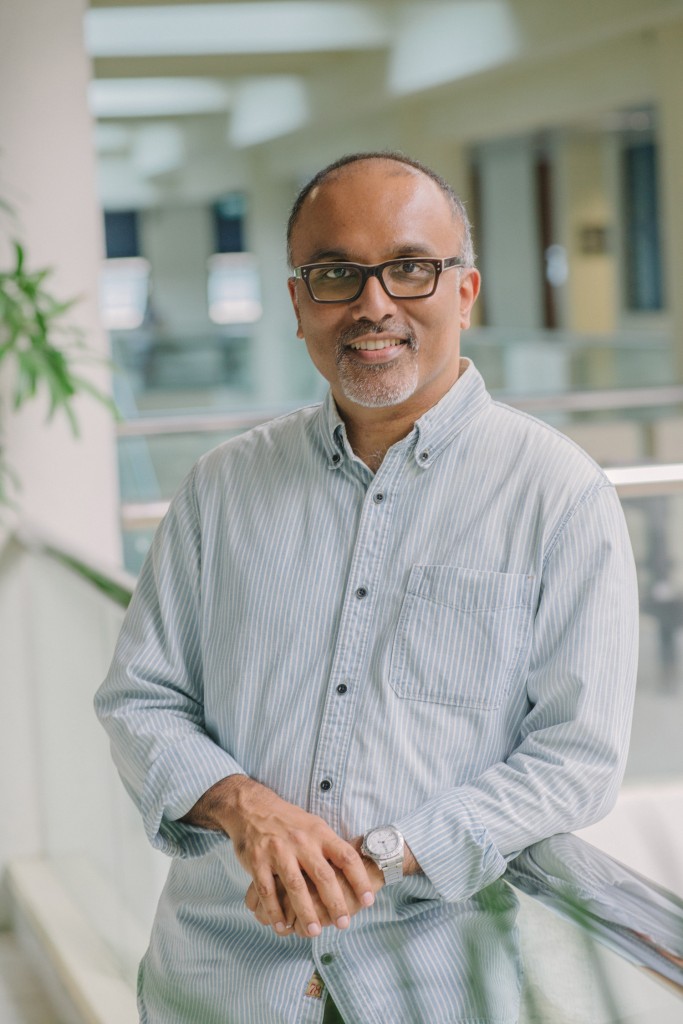
Photo: Matthias Ho
He often courts controversy for his views, having been lambasted in the past by ministers for his pointed writing on governmental press controls.
But that hasn’t stopped Dr Cherian George, arguably Singapore’s most prominent media academic, from continuing to study and speak out against the perceived media controls in the country.
He feels it is vital for Singaporeans to voice their concerns on policies that strike close to home.
As he points out: “Any citizen in a democratic state has an obligation to speak out on issues that matter to the public and affect them directly.”
The 47-year-old was the subject of nationwide attention earlier this year after he was denied tenure by NTU’s Academic Affairs Council.
The incident marked the second time his tenure application was turned down by the university, after the first in 2009 that coincided with his promotion to Associate Professor. This means that the outspoken professor, who was formerly acting head of the journalism division in the Wee Kim Wee School of Communication and Information (WKWSCI), has only one year left in NTU before he would be asked to leave.
But even before his various run-ins with the authorities, Dr George was already showing a penchant for journalism in his childhood days.
When he was nine, he would spend his holidays producing his own newspaper for his family, handwritten on paper taken from his exercise books. Woodsville News, as he called it, was named after the street where he lived, and carried headlines such as “Mother goes to the market”, or “Sooty taken to the vet”.
He obtained his Master of Science degree from Columbia University Graduate School of Journalism, and his PhD in Communication from Stanford University, before going on to join Singapore’s flagship newspaper, the Straits Times, in 1989.
While there, he wrote mainly on domestic politics and media issues, and briefly served as the art and photo editor. He was twice awarded the company’s Feature of the Year award which recognises reporters for their journalistic excellence.
Dr George has been known to be a critic of the government, often speaking out against media controls in Singapore.
During his time as a journalist in the Straits Times, he had on several occasions run afoul of the government, having been accused in one incident of contempt of parliament, after writing that the speaker was overly strict in his time-keeping during the budget debates. He was subsequently given the chance to retract his statement, which he accepted.
Dr George has also written three books on press and politics in Singapore, with the most recent one published in 2012: Freedom from the Press: Journalism and State Power in Singapore.
Outside of the classroom, Dr George continues to be kept busy by his committment to the Asia Journalism Fellowship as its director. The Fellowship, which is the result of a partnership between Temasek Foundation and NTU, gathers journalists from more than a dozen countries for what Dr George calls a “one-of-a-kind sabbatical programme for mid-career journalists”. For three months from April to June, the fellowship provides journalists with capacity building workshops as well as networking sessions to get to know one another.
Dr George has not given any hints on his plans after leaving NTU, though he said that he would remain in WKWSCI until February next year.
–
What made you choose to stay and work for the Singapore press despite your credentials?
I think the choice, both as a journalist and as an academic, was between working in a freer and more professionally-conducive environment, but one where I was not really invested in the outcomes, versus an environment that was more professionally challenging, more restrictive, but where I deeply cared about the issues and about the people around me.
So up till this stage in my life, at least, my answer has been that I would rather work in a society where I grew up in, where I feel for the people and the students around me as fellow Singaporeans, despite the obstacles.
Of course, if the obstables become insurmountable or I am no longer welcome — that’s another story.
What motivates you to speak out against press controls in Singapore despite the negative attention you’ve received?
I think as academics, we have a greater obligation than most citizens to contribute to public debate because we are in a very privileged position.
An academic is supported by public funds to inhabit this world of ideas. There are not many professions that are given the time and resources to read, think and share ideas.
It is a great blessing to be able to do so, and with it, there is an obligation to be mindful of the responsibilities one has. Working in the world of ideas isn’t a luxury for self-indulgent purposes. It’s really to serve your society.
So that’s the big answer. As someone who was and is a journalist, and who lives and breathes journalism, this is an issue I care about. When I sense through my own direct experience, and through my research, that the media situation in Singapore could be a lot better for its citizens, there is no choice for me but to speak out on these issues.
What kind of changes would you like to see made in Singapore’s media laws?
The most important task is to review the licensing system, which is an extremely backward law from the early 20th century that doesn’t belong in the 21st century.
In a modern democracy, the executive branch of the government shouldn’t have the right to dictate who gets to publish a newspaper and who doesn’t.
This is not to say that media regulation is not necessary. The media need to operate within the law, and when they cross the line, they need to be held accountable.
But what we have in Singapore is a system of prior censorship whereby not only does the government have the ability to punish bad speech, it also has the ability to make sure the speech doesn’t take place in the first place – by deciding who gets to publish newspapers and who doesn’t.
(Continue reading on the next page)
Pages: 1 2


