


Previous Story
#RIPLKY
Posted On 06 Apr 2015
Comment: Off
By Ang Hwee Min and Lo Yi Min
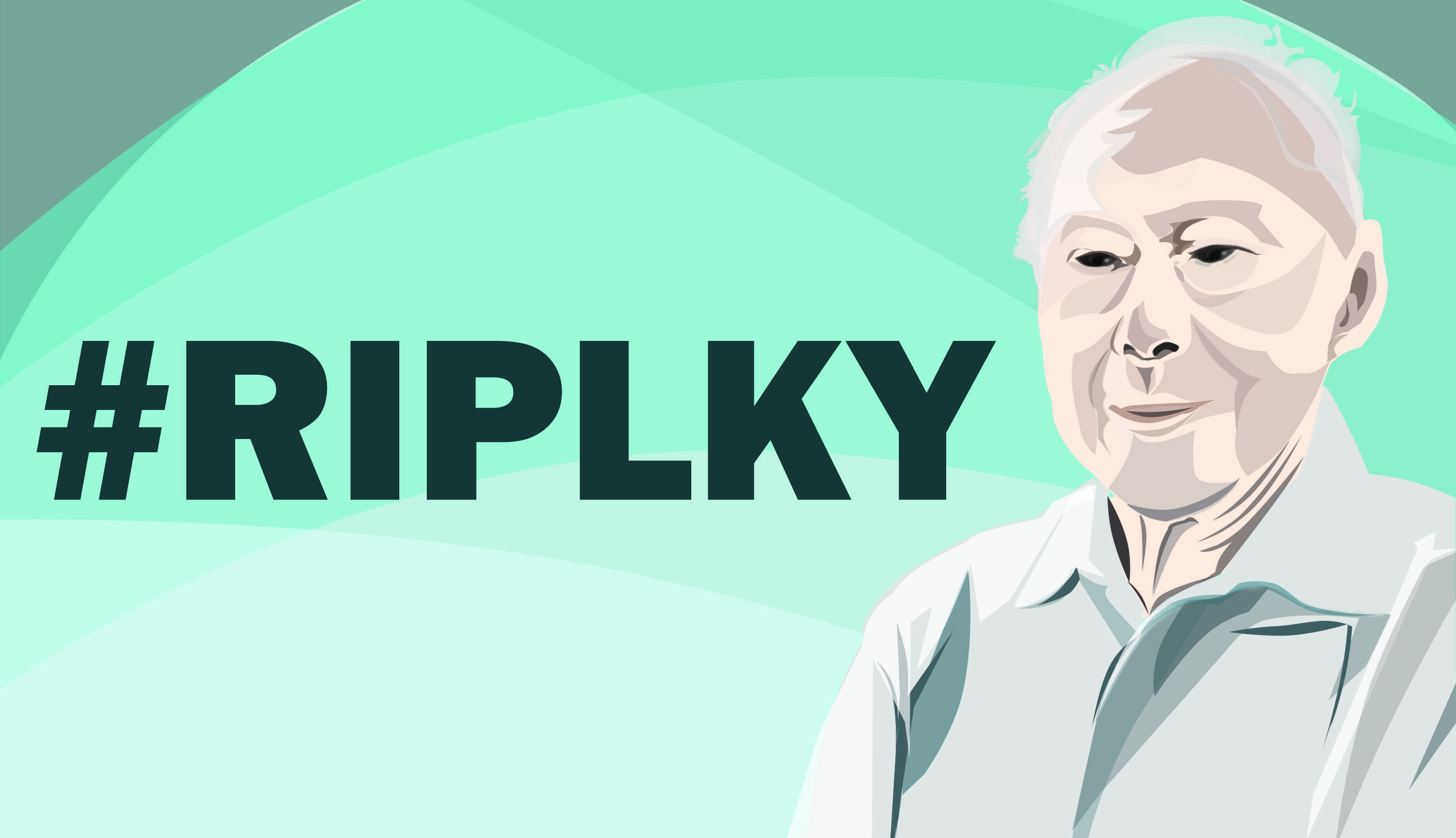
NO YEW NO US: The flood of appreciation and respect on social media websites is astounding and heartwarming at the same time.
(GRAPHIC: PHOEBE TING)
Singapore’s former Prime Minister Lee Kuan Yew has been widely regarded as a significant contributor to the nation’s development. Unsurprisingly, his passing on 23 Mar spurred the sharing of many eulogies. They took different forms and came from varied sources, including international newspapers; Mr Lee’s own family, including Prime Minister Lee Hsien Loong, and other family members; and ordinary Singaporeans whose lives had been touched by the man.
Tributes online included Instagram dedications, Facebook status updates, with hashtags such as #RememberingLKY and #thankYew being used to track posts. Articles posted on the social media accounts of news outlets were shared over and over again, their discussion threads bursting at the seams. Among the dedication posts, a few went especially viral, including a portrait of the late Mr Lee by local artist Ong Yi Teck, 20, created through hand-writing the former’s full name 18,000 times.
In light of the deluge of messages on social media sites honouring Mr Lee’s achievements and all he has done for Singapore, it was easy for many to write off the posts as watered-down and superficial, or attention-seeking — as much of the content found online can be.
In their online eulogies, many of the more adventurous and tech-savvy youth paid tribute to his legacy by according it with verses of grandeur on Facebook and artistically composed, carefully filtered photographs on Instagram. Just as quickly, many criticised the supposedly shallow method of eulogising, asserting that the outpouring of affection and gratitude was merely a sign of a generation being washed along by collective grief.
Eventually, however, the ever understanding public decided that hopping on the tribute bandwagon was merely natural — coming from a generation with purportedly little attachment to a political figure none of them had the chance to grow up directly under.
Initial impressions
Yet, it must be acknowledged that the lack of firsthand experience does not and should not prevent the said generation from appreciating the far-reaching influence of the man who shaped Singapore into the city they live in.
This behaviour resembles a verse in Walt Whitman’s Song of Myself.
The American poet wrote in his famous poem: “You will hardly know who I am or what I mean. But I shall be good health to you nevertheless, and filter and fibre your blood.”
Perhaps, generations that came after the late Mr Lee relinquished his post as Prime Minister have never directly encountered his brash, no-nonsense governance, but they have certainly learnt of the man with “iron in him” who has kept the body of Singapore in good health.
Finding himself a place in politics, the Cambridge-educated lawyer led the transformation of a newly-independent nation from a port city populated by migrants to the thriving metropolis we are now, through pragmatic policies often described as “authoritative” by Western media.
His heavy-handed leadership remains salient in the minds of international critics. This style of governance in the founding years of post-independence Singapore appear to reflect the qualities of our first Prime Minister himself, a view cemented by national discourse and many textbooks.
In an article published on the website of The Guardian on 23 Mar titled Lee Kuan Yew Leaves a Legacy of Authoritarian Pragmatism, the author writes that Mr Lee “moulded Singapore in his own image”, resulting in what our nation is today. This is the sentiment echoed equally by those singing praises and those critical of his method of governance, even among later generations.
Mr Lee’s Cabinet’s policies have shaped us as a pragmatic yet idealistic nation, blessing us with advantages like bilingualism, clean streets, and successful public housing plans. From challenging Mother Tongue lessons to photogenic HDB flats, the youth of Singapore have only experienced the fruits of his labour, without seeing Singaporeans of the yesteryear toiling for survival.
Filling in the blanks
Despite not knowing much of the specific details on how and what he did for our country, one cannot escape the resurfacing of these narratives in public discourse since his passing. Singaporeans who came after his time as Prime Minister also happen to be the ones most exposed to social media sites.
The generation of instant gratification took to the sheer volume of background information on the late Mr Lee like fish to water. With numerous news reports and op-eds floating around in cyberspace, those who have consumed them have naturally gained a better understanding of our former Prime Minister.
These articles not only tackled his journey in politics, but also humanised a man we all knew to be a stout-hearted individual. They highlighted his relationship with his family, and gave rise to long lost anecdotes painting Mr Lee in a different wash of colour.
We now relate to this public figure not only through his role as a politician, but also through his role as a father and husband.
Changing tides
As a generation who has only heard of the Third World port Singapore used to be, the youth of today may be chided for blindly acknowledging the efforts of a founding father with overflowing gratitude and reverence.
However, in retrospect, perhaps the appreciation shown demonstrates that national identity lies beyond how our nation is built. Grounding our impressions of Mr Lee in his private life allows for a sense of relatability, and further magnifies the respect Singapore holds for him.
Grounding our impressions of Mr Lee in his private life further magnifies the respect Singapore holds for him.
Seeing Mr Lee as more than the man who — with the help of others — cultivated our nation strengthens the narrative that appreciates the value of his leadership. It adds meaning to our collective history, and possibly gives the youth of today enough depth to resolve themselves from some measure of distaste that others have pressed upon them.
But as tears fell as heavily as the torrential downpour on the day of Mr Lee’s state funeral procession, it is safe to say that this is a generation that has inherited the capacity to look to its roots with nuanced understanding.
As a Mandarin idiom goes,“When you drink water, think of its source”. Let it not be said that the youth of today are grateful for the wrong reasons.
To be able to objectively learn from what we know of Mr Lee Kuan Yew outside of his political life shows that Singapore’s narrative is ready to sail on to its next chapter, one beyond the shadow of his legacy.


