


Previous Story
SRC helps regulate training schedules for Inter-Hall Games
Posted On 28 Nov 2016
Comment: Off
By Fiona Mei Robinson
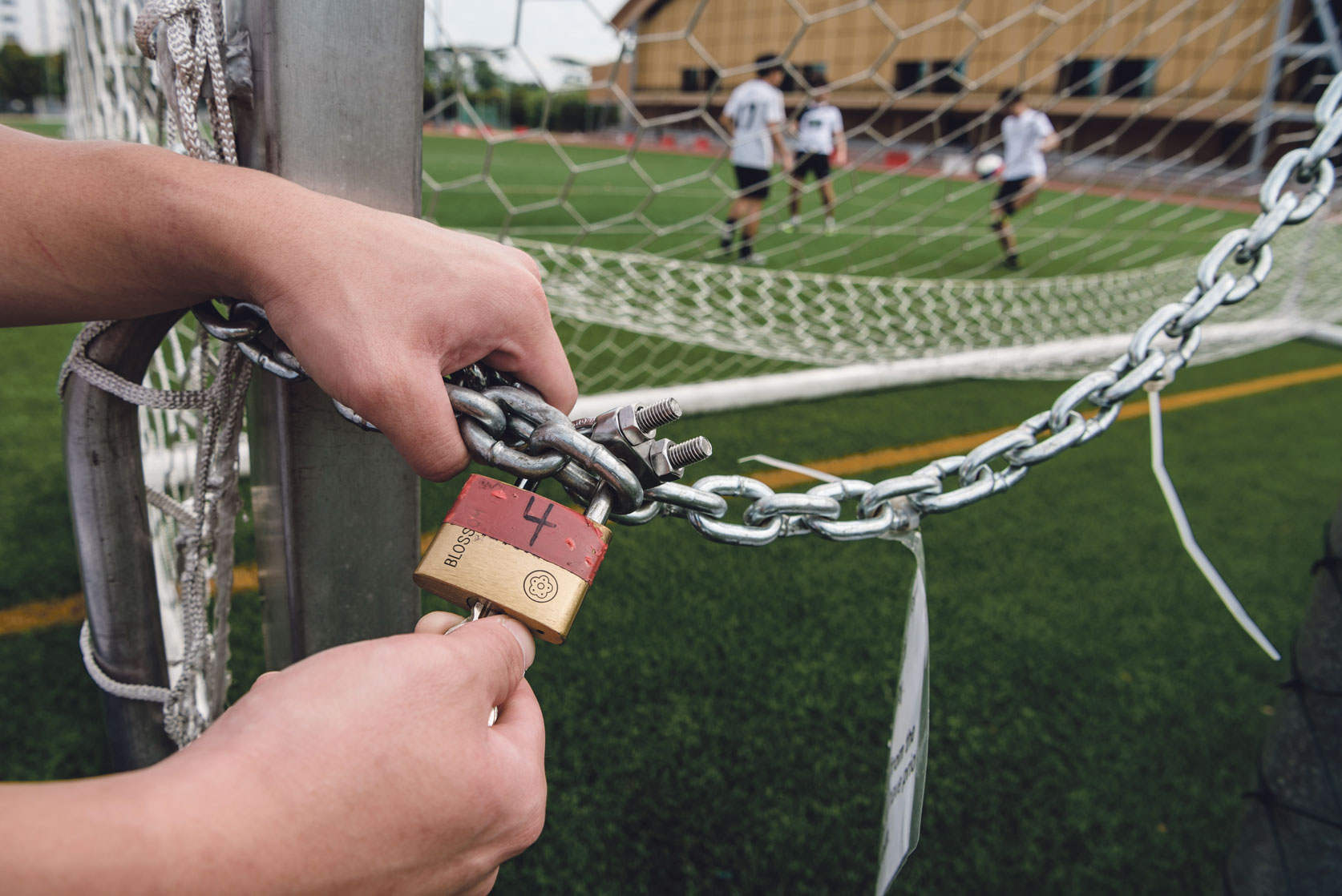
Those who want to use the full-sized goalposts at the SRC’s three fields now need to draw a key from the SRC. PHOTO: ZHENG JUNCEN
The Sports and Recreation Centre (SRC) recently implemented two new measures to make it easier for students to secure sports facilities for trainings.
A training schedule has been introduced for hall sports teams to book training time slots through their respective sports secretaries, while the SRC’s two lower fields have also been split up — one for softball, the other for football and touch rugby trainings.
Both measures seek to ensure NTU students and staff have adequate access to all of the SRC’s facilities, said Hall Olympiad Sports Chairperson Derrick Lim.
These come at a time when Inter-Hall Games (IHG) preparations are almost in full swing.
Lim, 22, said that the training schedule was introduced after this semester’s recess week to prevent clashes in training sessions among halls, as well as due to safety concerns about softball being played on the same pitch as the other two sports.
“As ironic as it may sound, the ball used by softball isn’t soft at all — other users of the pitch might get injured if they are unaware of the ball and (get) hit by it,” said Lim, a second-year student from the School of Civil and Environmental Engineering.
“The SRC and I thus came up with a plan to split the two lower fields up, one solely for IHG softball trainings, and the other for IHG football and touch rugby trainings.”
Lim added that the Hall of Residence 6 sports secretaries had consolidated team training schedules to ensure that all three sports have an equal amount of time to use and train on the field.
Hall 15 softball team captain Jason Aw said that softball trainings typically require at least three quarters of either one of the lower fields, and splitting the fields in such a manner reduces the likelihood of other users getting hit by the ball.
But Aw, a third-year student from the School of Computer Science and Engineering, added that there is still a chance that balls are overthrown, which might endanger those using the field next to that of the softball teams.
“When a ball hits any part of your body or your face, (it could) either (cause) a bruise or even bleeding.
It’s very dangerous,” said the 24-year-old.
To complement the two measures, the SRC has also turned away the goalposts from the main and two lower fields, and locked them to the nets at the end of the fields.
Students now need to exchange their matriculation cards for a key from the SRC General Office if they wish to use the full-sized posts.
The move, which was implemented in August, was done to make the field less conducive for outsiders’ use, according to Senior Assistant Director of the SRC Mr Yum Shoen Keng.
“While we do not mind having (members of the public) kicking around, the main priority still lies with our students and staff,” said Mr Yum in an email response to the Nanyang Chronicle.
He added that the move was also aimed at reducing the wear and tear of the penalty box, where the turf had to be replaced due to excessive use of the area by general users.
As an alternative to using the full-sized goalposts, students and staff can use the newly acquired smaller posts instead, which are unlocked and can be found on the fields.
Hall 16 football team captain Tan Zheng Yee, 22, said the new steps have made it easier for teams to organise trainings.
“Prior to this, it was always hard to find space and facilities on the field, as there were always secondary school students and other members of the public taking up the space on the field,” said Tan.
The second-year School of Humanities and Social Sciences student added: “It’s slightly troublesome to have to walk to the office to draw the keys (for the goalposts), but I guess that effort is justifiable because it ensures outsiders don’t hog them and we can have our trainings.”